
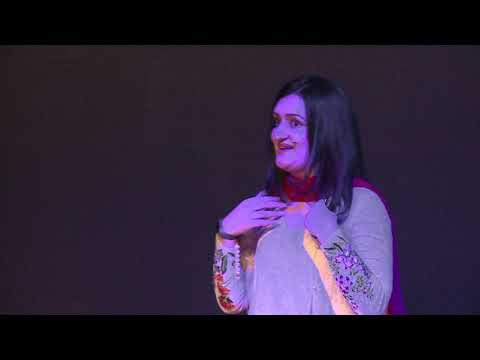
hello everyone today I’m here to share
with you incredible stories of young
women whose resilience passion and
intelligence have made a mark in
communities across Pakistan my story
starts from my mother my mother is a
housewife and by the age of eleven my
father passed away it was never easy for
my mother being a single mother to raise
four of my siblings and myself
she couldn’t complete her education but
with the passage of time and support of
my grandfather we all powered through
all of my sisters and I have been the
first ones to go to the University and
during my professional career I saw that
the during the conferences workshops I
was the only women among the sea of men
and I knew this had to change and I have
to do something about it
so I started working on programs that
focused on young people such as you
majority of you and as adolescence so we
started off by giving life skills based
education to young girls which focused
on communication leadership
self-awareness but we were not
progressing and we knew we had to do
something about it so we thought to
create an approach where we will turn
these potential victims into
changemakers and we call it Kiran
approach in this approach each girl had
to go into 20 households taking away a
message of right to an education and
girls right once getting those skills
these girls reached out to numerous
communities numerous households so let
me share a story of a young girl
let us call her Amon Amon was a student
of Class eight when she joined the
program and she was the only women to go
this far in education in her family and
she had secretly harbored a dream to
become a doctor in her family girls used
to be Wed when they hit puberty school
was very far and transportation was
expensive and these are all challenges
made Amon to think that this dream might
not come true so when she came into this
program
she learned negotiation skills and her
right to education so she spoke to her
teacher that she need a little help from
her and she want to convince her parents
to let her go and get her tree initially
it was not easy convincing parents in
that background in a conservative
setting and lack of resources but
eventually her parents agreed she is now
a student of medical college which is
far away from her village she lives by
her own self and her parents are
supporting us so this is this is the
power of a young girl so that program
eventually moved to other cities other
schools and almost thousand students
were trained on this program who
eventually helped three hundred other
girls to get the opportunity to grow get
education and get married at the legal
age we went off and took another ride
took another challenge
and that was to fight against you back
losses superclasses is an airborne
disease it’s highly stigmatized for
young girls parents in those communities
and where their girls are suffering from
tuberculosis
they hide it and the major fact is due
to their manageability and that is the
reason this disease is spread within the
family our TV program teams were having
a challenge a serious challenge to how
to get an access to test and treat young
women they were having a crisis of how
to mobilize young girls and reach to
those vulnerable communities in context
of Pakistan women are often dependent on
men to take them or to visit to the
hospital or clinics and the reason
primarily is that men don’t have time
and why is that so in those communities
most often families live one dollar a
day and if this skip that they’re for
work eventually they would not have food
at the end of the day so we thought why
not enable these vulnerable communities
and choose young women whose our
potential are going to be potentially
affected by tuberculosis to become
changemakers to become community leaders
so we started all of this approach and
where we worked with schools public
schools predominantly those in those
communities which we call hot spots a
hot spot is an area where TB is often ly
prevalent and where patients are often
Lee coming so we target those hot spa
and working with public schools requires
partnership and working relationship
with Department of Education so we
started off from sins and in those
schools chosen from TB hotspots we
started off a new strategy a cascade
model in a cascade model what we did
actually was we worked with your
education departments between the
teachers who are going to train students
of secondary school 8th 9th and 10th
class and these girls are going to take
message to their communities so this was
a cascade mod but what should be the
content so we prepared a content which
was called adolescent health and
leadership program it had leadership
women leadership it had communication
tools self-awareness health community
mobilization and plan an act so for the
first step is to train the teachers and
when we train teachers between them on
Adolescent Health and leadership course
initially facilitation skills and
primarily information on tuba classes
when I used to go into the training and
share information about TB symptoms
about infection control about treatment
testing etc I used to be called dr. Asha
I was really privileged to know that I
am a doctor but that was something
really interesting to listen to because
we listen to those people who have
information so once those teachers get
those skills they eventually teach to
their students now here I can show you
these are the secondary school students
who were taught at Oleson health and
so in a once they are taught each girl
has a responsibility to reach 20
households tend to her right side tend
to her right side and initially starting
for her by her home and the task was
very simple and very different
that was TB tuberculosis verbal
screening and how can TB be bubbly
screened well there’s three set of
questions that you can ask and
eventually you can ask you’re someone
sitting to next to you that do you have
two weeks
productive cough somebody in your family
or someone you know so in either case if
you say yes you might need to get tested
so in this way these girls ask these
questions to one household one house to
another to another and another short
listing those people with symptoms
sharing those information to her pair
teachers and also when they went into
the community they also faced challenges
and what sort of challenges they were
facing how would they go into the
community these were parents
these were community people who felt
that it’s difficult for them they will
roam around in the community what will
the community people say about them this
is not their job this is not the
responsibility is that age-appropriate
when these all questions were around us
we put them away and we said we are
going to move forward and let’s do this
we have done in the case of child
marriages let’s test it here so here
comes another story and let us call that
a dozen health leader
um now and she was named Kieren Satara
after going through her roles in health
and leadership program course
and what happened was that she went into
her community she was a very bright
vibrant student when she went into her
community she had mixed responses those
were very good families who welcomed her
and there were few other families who
just slammed the door we’re not going to
speak to you in the TVs we are not going
to speak about TV in our house TV no
there’s no TV so those were her
experiences of community mobilization
but in one of the households she found
that there were two women exhibiting the
symptoms of TV but she couldn’t speak to
them in detail so she went to that
household almost three times and finally
she spoke to those women and asked that
I’m here for this XYZ purpose and she
asked those three questions and spoke to
them that you need to get tested but
those women said that men in our family
don’t have time to take us to the center
it’s too far
we can’t go who’s going to pay me
another question
so I’m now went back to her school and
said to her teacher that there are a lot
of problems and these women can’t go to
the facility I have an idea we can call
the TV team to bring their services and
let’s have a community health camp
within our school it is nearby women can
come and it is a women space and due to
omnes leadership we got the idea of a
low cost effective female space
community camps and can you imagine can
you imagine the turnout at the camp
initial camp where Anna and her teachers
and her fellow students administered and
managed 75%
were women when other cases that was
totally opposite women don’t come they
were very interesting stories they were
women from the community we’re left food
on the stove half cooked but came to the
camp because they wanted to get tested
because they wanted to get access to
free of course services so that camp
went a very success we have reached out
to untrained firstly 1,500 teachers and
trained 32,000 Kirin stars across
Pakistan that includes Karachi that
includes Hyderabad that includes soccer
that includes Lahore and interestingly
that includes Peshawar
it and you cannot imagine what a
wonderful amazing work that those girls
have done in such a difficult having a
doubt on these girls and thinking that
these are liability not a resource they
have proven us really wrong especially
those who think that way they had done
wonders there were few girls who have
gone 200 households you just said them
please it’s just 20 households they were
know we want to do we want to go we want
to find people who are ill this is a
passion so in many cases people ask us
why girls why not boys our girls more
smarter than boys what do you guys think
yes
[Applause]
but I keep that keep that pole up as
open but why we focused on girls was
mainly because girls are uniquely placed
within the communities and societies
they can easily go into the household
speak to women and discuss however in
case of voice it can’t be possible in
the cultural context that we live but
also to tell you that when we build such
movements and we bring such vulnerable
groups together eventually state also
comes in and also become part of your
movement as in case of sins the Chief
Minister
he also appreciated and endorsed the
Kieren cetera program and the power of
these girls at a gathering of 10,000
girls in PF Museum and you cannot
imagine we were really worried that the
traffic is going to talk the whole
karachi is going to choke because of us
but it went amazing similarly in the
case of Khyber Pakhtunkhwa chief
minister also lauded the support and he
also admired the efforts of these girls
these young girls are powerhouses
they’re dreamers they want to do
something big in their life let’s give
them a chance let’s give them an
opportunity and together here we promise
to do whatever in our capacity we can so
that these girls can move forward they
are going to become mothers they are
going to run a family they are going to
be somewhere really big so we need to
give a boost to them and a belief in
them while working in different cities
across Pakistan we aim to make every
secondary school girl
and we also want to reach an aim and
plan hopefully in shala one-million
Kiran satara’s in the coming three years
[Applause]
we also felt that when we work with
girls there are many other challenging
needs there are many other aspects or
themes that are unaddressed such as
other health needs child protection
carrier counselling so these things are
well what they say it is true never
underestimate the power of a woman say taro says ah hog you are weak and
Please follow and like us: