
good evening and I hope like me you’re
enjoying these fantastic talks we’ve
been listening to the whole evening on
revolution revolution what a unique word
if you look at it from the viewpoint of
a wheel it means going around in circles
but revolution can also mean a powerful
dramatic change in a very short period
of time this change can be political
such as a french revolution or
technological such as Industrial
Revolution both of which have
contributed to the world as we see it
today my own field that of Audion
occations we’ve had such a dramatic
shift as well let me demonstrate
by a show of hands how many of you
recognize and have used any one of these
devices please raise your hands
excellent I’ll keep it a key back you
break it up if you recognize and have
used any one of these devices
excellent keep your hands up please what
about this oh this this
excellent this sir I would like to talk
to you because I would like to know the
secret of your long life I estimate the
age range in this room to be not more
than 50 years and in that short period
of time what a progress we have made we
have gone from being attached to a wall
whenever we needed to talk to someone to
being able to call people whenever we
want wherever we want and part of that
success is due to the relentless advance
in miniaturization and the consequent
decrease in computing power today we
have a computer the size of a credit
card that is thousands of times more
powerful than the Guidance computers the
astronauts use to go to the moon and
back but what does this advanced
actually have or mean for us in our
day-to-day communications when you use
your smartphone to make a call from
wherever you are a pub a cafe Metro on
the move did you ever wonder what the
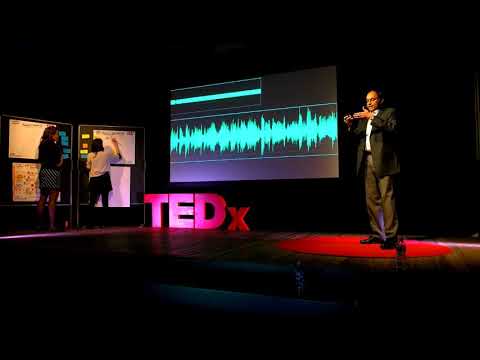
signal of the microphone sounds like
well it sounds like this in the course
of a December tour in yoga I wrote for a
long distance in one of the public
coaches on the day preceding Christmas
if you don’t recognize this I wouldn’t
be surprised because the algorithms that
are in your smartphones today are clever
enough to be able to separate speech
from the noise so what the person at the
other end of the line hears is something
like this in the course of a December
tour in Yorkshire I wrote for a long
distance in one of the public coaches on
the day preceding business have you ever
made a recording on a phone or any other
device and then realized later that your
volume settings are all wrong and you
obtained something like this
[Music]
what can we do today you feed it to the
right algorithm you can get this out of
it and how are we able to do this we
have trained our algorithms to find out
the salient features of the signals we
need and extract them from the
background now in the context of speech
enhancement extracting speech from noise
how do we do this we show the algorithm
several different kinds of speech
signals so that it learns the
characteristics of speech and it knows
what to focus on and how to extract that
from the background now in the past I’m
talking about before internet encroached
on every aspect of our life such data
was gathered by specialized companies
they would ask for volunteers from a
representative sampling of the
population gather their speech data and
then this was done in control conditions
curate the data and then offer them to
researchers for development and testing
but think about it this represents data
from a vast sampling of the population
but communications devices are extremely
personal
in fact the major or the only user of
your smartphone is you yourself how much
more powerful could these algorithms be
if they were trained on your voice and
your characteristics well in that case
even an extremely noisy situation like
we can reasonably hope to extract
something that sounds like this in the
course of a December tour in Yorkshire I
rode for a long distance in one of the
public coaches on the day preceding
Christmas and that’s the power of
personal data now we can obtain this
data in several ways we can do it the
direct way whenever you buy a smartphone
the shopkeeper will tell you here’s your
phone ghost on the corner talk to it for
10 minutes before you start using it so
it learns what you sound like and of
course if you did that you would feel
very silly doing it and I wouldn’t blame
you the other way is to ask you indirect
questions what do you think of the
weather today what do you think about
the performance of your favors favorite
favorite football team what do you think
of the political situation always a good
question and when you do that and when
you respond we can train the algorithm
on your voice characteristics and your
speech characteristics but be careful
such questions indirect questions reveal
much more information about you than you
think possible remember the small show
of hands question I asked at the
beginning that has given me enough
information to roughly guess your age
and this kind of indirect data is what
big internet giants are after whenever
you’re on the internet and you’re
offered a free service be it a social
media outlet a platform to share your
photos or to exchange email all that you
do is not you’re not getting it for free
you’re paying for it in terms of your
data and these companies will gather
your data and use this to build a
profile of you so that they can pitch
targeted offerings to you such as
certification you’ve been always
dreaming of or the designer goods you
saw your neighbor were wearing and you
wanted suddenly and at the core of all
these recommender systems are very
powerful very smart algorithms that
scan through the vast amounts of data
that you produce and extract only the
relevant information to make a profile
unique to you and this is a huge
technological leap forward although if
you think about it it’s mainly for
commercial purposes now being in the
university and as an academic I think it
is a responsibility of learning
institutions to harness such technology
for the benefit of society let me talk
about one specific problem depression
depression worldwide statistics indicate
one in four people will confront it in
their lifetime there are treatments
available for the clinical treatments
available for depression that are very
effective in the short term but the
depressing problem about depression is
that once you’ve had a depressive
episode
the chances are 60 to 80% that you will
fall back and the only way to prevent
this is to continuously monitor the
progress of the patient and that’s
practically impossible which doctor has
time to continuously follow up on his
patients what has this got to do with
audio or data that have been discussing
so far well depression changes the
behavior of the affected persons they
become less physically active they would
draw from society the way they
communicate changes the length of their
speech the utterance is the words they
choose all of it change and these are
data points that we can use to create a
patient profile to follow their progress
and that’s exactly what we want to do
with my colleagues Christine Lincoln
Mary Ann Thunder hustle we want to use
physiological and other data gathered
oops and I am sorry we want to use
physiological and other data that we can
gather from devices such as smart
watches to get an to gauge the activity
of the wearer we can analyze the speech
data from their audio Diaries that we
will
ask them to maintain and we can use this
information to create a profile unique
to the patient and follow up on them
continuously and the purpose of this is
not to present the patient with all the
scary data know this data is to be
shared with the trusted authority in
this case the attending physician that
person has much more information at his
or her hand to monitor the patient on a
more or less continuous level and then
decide to intervene where necessary
you know what the fun part about all of
this is the algorithms that we will use
to map the data on to the patient model
and attract them are the same algorithms
or very same algorithms that are being
used now to sell you your next pair of
shoes or your next vacation so let me go
back to where I started the wheel if you
look at a rotating wheel there are
points on the wheel that appear to be
moving backward change your perspective
slightly and you will see that this
backward motion is just a small part of
an overall forward trajectory in the
same way the powerful algorithms today
that are being used for such mundane
prosaic stuff can be harnessed to do
something truly beneficial to society
and I hope in a couple of years to be
able to stand here again and tell you
about the progress we’ve achieved with
respect to these objectives of making
your data work for you to take care of
you and in today’s world isn’t that a
revolutionary thought thank you
[Applause]
you [Applause]
Please follow and like us: