
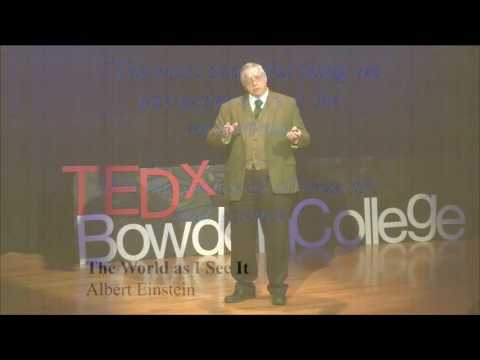
nature and training I’m a physicist I’m
going to be talking about an education
based on the liberal arts and sciences
but I’m actually going to try and answer
another question how do you prepare for
a future that is unknown and uncertain I
attended a Catholic High School which
stressed the breadth of education a love
of learning and a sense of community I
found two other things in high school
one I like science all the sciences but
especially physics and two I write a
book the book was by Gilbert Highet
in the book he stressed that there were
two ways to educate our minds one is to
be introduced to great ideas great
properties and the others to be
introduced to great thinkers perhaps
that’s why I felt drawn to physics
physics like our friends in philosophy
introduces our students to the great
problems for my college degree I
attended the state school where I took
more courses that I needed to in order
to explore other fields but I always
kept coming back to physics for me
physics was the most difficult most
challenging most fun set of courses that
I encountered after four years I
couldn’t stop it was just too
interesting I attended a large research
university for my PhD but there are two
elements that were in the best tradition
of the liberal arts one was the
expectation of excellence we’re expected
to be the best that we could be all the
time the second was at the University
had an honor code we do not lie cheat or
steal nor tolerate those who do though I
had intended Catholic schools there the
expectation of honesty and integrity was
a personal and private charge the
university’s honor code was embraced by
the entire
academic community intellectual growth
in expertise is only part of a liberal
education another vital element is the
examination and growth of values rooted
in ethics morality and for some
spirituality students in liberal
education are given the opportunity to
develop standards for intellectual
honesty and integrity for discipline and
self-sacrifice for responsibility to
others and for courage physics like our
friends in the other STEM disciplines
mirror these values in the science
community our students learn
intellectual honesty when they commit to
the work produce their best effort
acknowledge what is their work in the
work of others and it meant the limits
of their understanding they learn
courage has a tackle unknown problems
and accept failure as a cost of
advancing knowledge but as I was
completing my PhD I decided to look for
a professional home I like teaching
physics
I liked research in physics but I also
liked working with students helping them
learn physics and so I decided to look
into the liberal arts school you find
there is no single authoritative
statement for the liberal education
there are many and so I look for those
that I felt most strongly about this is
by Lori Lamar a writer who did not even
attend college his statement I would say
it should offer breadth of you ease of
understanding tolerance for others and a
background from which the mind can
explore in any direction is very nice
because it reminds us that a liberal
arts education is supposed to expand
your perspective another statement let
us dare to read think speak and write by
John Adams I like this because it
focuses on the basic tools of
intellectual growth
it also carries the sense that
subjecting things to a thoughtful
analysis is difficult challenging and
possibly dangerous from the book
teaching is a subversive activity once
you have learned how to ask questions
relevant and appropriate and substantial
questions then you have learned to learn
and no one can keep you from learning
whatever you want or need to know this
and so there are many other descriptions
of a liberal education Hana Holborn gray
former president of the University of
Chicago here at Bowdoin not too long ago
described a liberal education is one
that frees the mind of unexamined
assumptions and opinions promotes
independent thinking and critical
judgment develops a capacity for
complexity and ambiguity and opens the
mind to the pink mini opinions there are
many other descriptions of liberal
education including Boden’s own very
eloquent offer of the college i’ve
always maintained that the liberal in
the word in the phrase liberal arts and
sciences describes both arts and
sciences and certainly physics has
contributed many ideas have changed how
we view the universe of how we view
ourselves within the universe and when
you talk about the universe a very
common question is where is the center
of universe and by this people usually
mean are we the center of the universe
and in today’s world when we have
discovered the expansion of the universe
the Big Bang the mix a dark matter and
dark energy we’re still being asked this
same question there are many ways to
answer this question with reservations
and provisions with a cautious
interpretation of the of the question
and an admission to other limits of what
we know but the way I like to answer
this question is yes we are but so is
every other point in the universe and
this can certainly expand your
perspective and like our friends in the
humanities we have found it useful to
have our students learn in another
language
one that expands their vocabulary and
allows them to apply the precision of
but what about the content of the Arts
and Sciences are the content of the them
so separate I am reminded of a quote by
Albert Einstein but first I have to
admit that the Arts and Sciences do
offer different content different
perspectives different forms of analysis
and communication and different
standards of evidence but as Albert
Einstein once said the most beautiful
thing we can experience is the
mysterious it is the source of all true
and so uh the question then is how do we
build an education based on the liberal
arts and science I am reminded of a
story I heard at Colorado College this
concerns held general Palmer its founder
would go and solicit funds for the to
establish the college the way he would
ask for monies he would give a pitch
something like this if you give me ten
thousand dollars I will build the
dormitory where the students can live
and work together where they can argue
debate cooperate and compete if you give
me a second
ten thousand dollars then our builder
library where the students can learn and
study and if you give me a third ten
thousand dollars I will hire some
faculty I like this because it allows us
to see three facets of any education but
first there is peer learning this is the
learning you pursue in cooperation and
competition with your friends and peers
and here competition refers back to its
roots meaning to strive together the
peer education does not only occur in
the group work associated with courses
rather it occurs in the talks and
discussions you have with your friends
and peers about ideas and values about
courses programs and activities this is
where you learn to be part of a group
and to be a leader when to follow and
second there is individual study this is
where you learn to learn on your own
using books and notes the library and
the internet you do whatever is
necessary to learn hopefully you will
also learn to leave information into
knowledge and eventually knowledge into
wisdom this is where you test yourself
in order to find your potential and your
limits and the third facet is the
learning you take under the guidance of
faculty each faculty member has solved a
problem created an argument created an
expression that no one has ever done
before each faculty member is an expert
in the study of a discipline yes the
faculty here are here as your mentors
but they’re also here as your as models
of scholarly thinking expression and
the idea of the liberal arts is uh one
of the things that has puzzled me about
the labyrinth is that a lot of people
think that it is has no practical value
that it is for an elite that need not
work and yet and yet Lawrence has always
focused on the education the background
the knowledge that engage citizenship
requires the roots of liberal education
treasures back to classical Greece where
the primary goal of the education was to
promote engaged citizenship in a sense
the science mirrors this in the way
prepares students by the time students
finish their education they have breadth
and depth of Education they have an
aptitude for solving problems they can
express in mathematics
word and visual representations they can
work alone or in groups they have
learned the value of evidence-based
thinking they can deal with problems
that are complex and bu s is ambiguous
and tightly integrated and they feel a
[Music]
comfort with complexity and ambiguity
and so this is what makes the physics
student very able to work in diverse
fields and to be a citizen to our
democracy one of the things that we find
is that the visit of the faculty at
liberal arts colleges are
primarily designers we design learning
environments we bounce challenge and
support and balance time to reflect and
the need to be productive there is an
expectation that the end of college is
the end of your education that is not
true or accurate at best the end of
educate at the end of your college is
the end of the beginning of your
education you’re going to have to keep
learning new ideas new values new
techniques in order to answer the
question no perhaps not now well in
order to answer the question what kind
of world do we want to live in what kind
of world should we live in and what kind
of world will our children live in my
very best hope is for our physics
students is that when confronted with a
problem they have never seen they still
know what to do in a sense the liberal
arts education is our best effort to
produce an education that prepares you
for a future that is unknown and be
Lluis and complex ah is physics the most
fundamental of the liberal arts there
are many ways to answer this question
with Res
Relations provisions with a cautious
interpretation and a reminder of the
limits of our knowledge but the way I
like to answer it is yes yes it is but
so does every other discipline that we
teach thank [Applause]