
who doesn’t like sugar in the audience I
think if you if you don’t like sugar I
think you’re lying to yourself and why
do we like sugar because sugar gives us
energy and you know when you think about
where does sugar come from and what
sugar really is to me sugar is the
energy of the Sun captured there for us
to use and it comes from plants plants
are the only we can synthesize sugars
but we have to start from something that
comes from plants and how do plants get
it they get it through a process called
photosynthesis which i think is really
the first or maybe the second wonder of
the world that they can that they can
capture the energy of the Sun in a way
that they can store and use for other
things and it’s a complicated process
but basically to boil it down when it
comes down to is they’re taking water
from the ground and carbon dioxide from
the air and using the energy of sunlight
to mash those molecules together and
squeeze out a little oxygen and what
you’re left are these carbon hydrogen
oxygen chains which is basically sugar
and they use that for everything they
need to do when you look at plants
growing you know in a garden or in the
wild you’re not thinking about this
process of photosynthesis and what’s
happening but behind the scenes they’re
taking that sugar and they’re using it
for a whole array of all baby there we
go a whole array of different things
that they need to grow and to survive
and to bloom and to reproduce I think of
my job as a horticulturist is really a
manager in the photosynthesis Factory
right and you know what I’m out in the
garden what I’m doing is trying to get
plants to grow their best so that they
can bloom they can produce more flowers
more fruits etc this is a picture of a
wild iris in the woods on the left and
then when you bring it out into the
garden where you’re giving it more water
and fertilizer and it’s flowering more
so it makes sense that you’re how
helping that plant to photosynthesize
more to make more of that sugar that it
can use to produce more flowers and
that’s sort of the essence of gardening
in a way you can see that with trees if
you’ve ever looked at tree rings when
conditions are good during a year that
that tree produces more wood than it
does in a year when conditions aren’t so
good the red line not so good the green
line a better year so it grew more if
you’ve grown vegetables you know that
you do a good job growing your Tomatoes
you’re going to get a lot more fruit
it’s very tangible we don’t think
necessarily about what happens below
ground but that’s important too you know
really that half the plant is roots that
at our underground that we can’t see but
really in some ways probably the most
important part of that plan but through
photosynthesis that plant is growing
roots I like this graphic because it
sort of gives you the idea that here’s a
tree and we see the above-ground part of
the tree but underground is just as
complex a branching pattern a structure
pattern that that plant needs to grow in
those roots that you see there if there
were soil around them obviously they’d
be anchoring that tree to the ground
preventing from blowing over but roots
function in other important ways too
they’re really the the the connection to
a whole biological community underground
that the tree depends on to survive what
you see there are kind of the structural
roots but if you go and look in detail
at roots what you see are these little
furry structures on those root tips all
these tiny little roots that are growing
and dying on the ground are connecting
with the soil around them and those
little root hairs as they’re called are
absorbing nutrients water from the soil
that’s carried up into the plant into
the leaves and allows that plant to grow
and photosynthesize and then it flows
that energy flows back down into the
roots again so there’s a sort of upward
and downward flow that’s going on and so
the more connection that that root
system has with the soil the better it
can utilize those resources and
photosynthesis works better and
everything work
better so it’s really sort of a
neurological connection with the soil in
a metaphorical way but plants early on
when they made the leap from the water
onto land figured out that they could do
a much better job if they partnered with
organisms
underground to create a much more
intricate connection with that living
community and that’s really the essence
of symbiosis of you know mutualistic
relationship where both parties get
something out of the relationship and
what you notice when you study plants
that when they have this carbohydrate
budget the sugar budget which is
essentially what this is where are they
putting those resources they’re putting
a lot of resources to the symbiotic
relationships on the ground have you
heard of mycorrhizae before mycorrhizae
is it mycorrhizal roots are an
interesting fusion of a fungus and a
plant and so this is a picture of you
can see the kind of the yellow there
that’s the that’s the pine seedlings
roots and the all the white that you see
there are the the basically the fungal
roots of this mycorrhizal fungus that is
fused with the pine and created it’s
incredible surface area you can see why
I think of it as a neurological
connection with the soil create all that
surface area to absorb nutrients for the
plant I took this picture out in my
backyard and this is a white pine root
going down through the picture there and
branching off and you can see all the
white splotches there those are the
hyphae the the roots so to speak of the
fungus it’s partnered with now they’re
growing around the root of that pine and
as they digest that wood that you see
them growing on they’re absorbing
nutrients out of there and feeding it
into the tree and in return the tree is
taking some of that sugar that’s making
through photosynthesis and leeching it
out and feeding the fungus so the fungus
is doing things the tree can’t do and
the tree is doing things that the fungus
can’t do because when you think about it
you know that what that tree is doing is
I jet digesting it’s dead self things
that have Slough tauf and fell down to
the ground have gone to the soil and it
needs to recapture those nutrients too
to be able to grow again
plants don’t have internal stomachs
basically the soil is their stomach and
it’s something that I’ve kind of you
know thought about through the years
this concept of the soil has the stomach
for the plants and the soil is this
living community that we need to view
that way because the reality is in the
in the 20th century and now in the 21st
century we see soil as just you know you
track it across the carpet it gets under
your fingernails if you grow plants you
know it’s the stuff that you have to
plant the plants in but we don’t think
about it as an ecosystem and the Green
Revolution that triggered this you know
huge advances in agriculture in the 20th
century that allow us to feed this
growing population of the world was done
through the the how we figured out how
to take petroleum products and create
fertilizer that plants can use to grow
and so we put these chemical fertilizers
on the soil and the plants grow but
basically it kills off over time the
natural community in the soil the
natural ecosystem the soil because we’re
not really feeding the soil stomach it’s
basically like sticking an intravenous
needle in your arm and thinking I can
live this way for the rest of my life
with a drip bag of glucose syrup going
into your arm so one of the best things
that I can suggest you do if you’re
interested in in plants and especially
growing plants just think about the soil
think about feeding the soil we do it
through adding compost which is
partially digested food to feed the soil
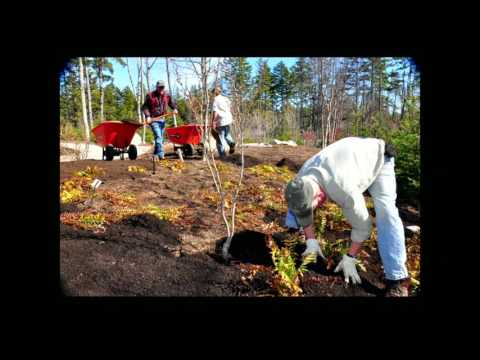
system we spread it on this time of year
we’re going out and you know spreading
the compost on the ground you can see
the effect that’s having if you if you
look at that that picture on the left
there that’s a sort of sterile dead soil
the kind of soil that you get if you
just add chemical fertilizers to it over
years it the roots can’t get through and
it’s very compacted there’s no life in
that soil and the middle picture is a
soil that I just put compost on the
surface of it and over a couple of years
as that breaks down the organisms in
that soil of create chemicals that break
that soil up so even the even without
mixing it in it’s become more friable
the roots can penetrate more deeply into
the soil
and the soil comes alive again so
fortunately it’s very easy to sort of
you know reinvigorate a dead soil
I said compost is you know what I’d like
to use but I prefer not to use bagged
compost because when you buy compost
you’re buying dead organic material and
you’re also buying this living community
that’s breaking down that organic
material so I like to get it
you know when it’s steaming hot and full
of life because when you think about it
you know heat means life and so if
you’re using this material that’s warm
like that that means it’s living and you
put it on the ground and the results are
really spectacular and we we spread this
around you can see this is a planting at
the Botanical Gardens this was put in
and then just two months later you can
see the way the plants have grown using
this system here’s another picture just
in planting in the middle of May and
here just a couple months later how
everything has really grown and filled
in people ask us you know how do you
grow all these plants you must use a lot
of pesticides and everything to do it we
don’t spray anything on these plants we
just mainly we feed the soil we pick the
right plants and we let nature do the
rest click one of the amazing things
that you learn when you study the the
soil is the amount of their carbohydrate
budget all that sugar that the plants
are making that they leach out into the
ground this is the area around a root
tip that you see and you can see that
kind of stippling look there that’s
basically the the the rhizosphere where
the plan is suiting sugars out to feed
these organisms in the ground and
they’re doing that
partly for their own defense the by
creating this beneficial community of
life around the roots they are actually
attacking problem things that are
killing off the roots so therefore
providing for their own defense because
that’s you know very important when your
plant you can’t run away when you’re a
plant you have to be thinking about you
know where am I going to survive how I’m
going to survive and so plants do that
through a number of means by utilizing
other organisms by creating poisons
poisons and defensive chemicals are very
important too
a large part of the sugar budget goes
into into this and if you look at this
electron microscope picture you see that
looks like a caterpillar down there
that’s a glandular hair that’s filled
with poisons there’s a really
interesting study that was done on this
is a wild tobacco while tobacco plants
are fed on by this tomato hornworm
caterpillar when that horn worm starts
to chew the leaves it breaks up in those
glandular hairs releases a chemical into
the air and that’s picked up by other
tobacco plants in the area that start to
build up their own defensive chemicals
to prepare for the attack of the
caterpillar so it also goes out into the
air and it’s picked up by tiny little
wasps that follow this chemical trail
and parasitize a caterpillar and kill it
so we we think plants can’t talk but
plants communicate through chemicals
through these pheromone chemicals that
they release to the air they also in a
respond in in a similar fashion that we
do to a you know an attack immune system
response that plants have two things
that happen to them when that horn worm
is feeding on that plant the hormone
that’s involved in that immune system
response is salicylic acid which is
basically the chemical and aspirin and
you can grind up aspirin and spray that
on a tobacco plant and cause that same
immune system response that you get
through feeding of the feeding of that
caterpillar without the Dilla Terius
effects of of the spray plant pigments
are defensive chemicals too we don’t
really think about them in that way
these are the colors of leaves the Reds
the orange and the yellows but they do
things like prevent fungal attacks they
prevent protect against cold the one of
the most interesting groups of chemical
plant pigments or anthocyanins and these
are what we know of as antioxidants when
we eat fruits rich in antioxidants it
helps prevent
supposedly you know helps us keep us
healthier again and what’s interesting
is that where you find the greatest
amount of antioxidants and most plants
is in the fruits that are available for
other things ease the idea with the
strawberries that something eats that
and then takes it walk somewhere else
and then poops it out and then the
strawberry plants grow there and so I
think it’s kind of interesting that the
plant is providing this in some ways to
keep its seed vector healthy so they can
do its job and spread those seeds
somewhere else so think about that the
next time you’re eating a strawberry
with that plant I want you to do they
also prevent you know cold damage
camouflage that sort of thing but it’s
what it is
we one of the most beautiful things
about plant pigments is what happens in
the fall
and this is also one of the greatest
enigmas too because when the when a leaf
is dying and all the sugar that it’s
making it can’t transfer that sugar down
to the roots it’s trapped in the leaf
and so that leaf just turns that sugar
into these beautiful pigments it’s
almost like it wants to go out and a
glaze a blaze of glory because it has
nothing else left to do entitle this
talk as sugar sex and poison so I had to
end with a little bit of a sex in the
end up fortunately sex in plants is very
g-rated flowers everything happens
behind the you know the veil of the
flower but basically the the colorful
flowers that you see are designed to
attract pollinators as we learned about
from Danielle’s talk that come and take
pollen the yellow substance in that
picture and move it to the next flower
and unite it with an unfertilized egg
and you get baby plants out of it but
the problem is pollen is very expensive
to produce takes a lot of sugar to make
pollen so what a lot of plants have
figured out how to do is to trick
insects with something a little less
expensive and that’s basically sugar
water or nectar so flowers are
structured in a way to fool the insects
so that they avoid the pollen for the
most part and go for this cheap sugar
reward I think if you ask flowers about
insects they’d probably say they’re so
you know that
stupid jokes because they they’re able
to get away with providing this little
reward do all that free service then
Danielle was talking about here you’ve
got that sort of a honey colored
background to that flower the bee sees
that goes in goes right past the pollen
and pollinates that flower hummingbirds
as they go in to feed on this Cardinal
flower are getting dabbed in the
forehead with palm where they can’t
reach it this flower the butterfly is
getting dusted on its belly with pollen
as it’s going for the nectar so they’re
the structure of these things that
designed very effectively to fool the
insect or you know or the bird to do the
plants bidding this is a Jack I mean
this is a skunk cabbage which grows in
the woods around here it produces a
rotting fetid insect smell and so flies
come into this and they lay their eggs
inside the flower and pollinate it but
of course the eggs don’t do anything the
Flies die there are other plants that
are even more insidious this one it
looks like the inside of a nice furry
dead mammal and smells that way too this
one looks like it already has fly eggs
all over it so the Flies think this must
be a good spot they lay their eggs on
there and so they’re pollinating the
plant but of course their own
reproduction has come to a halt another
one that I like is a this is a wild
flower that grows in the Midwestern
prairies a blazing star and this
releases the sex pheromone of monarch
butterflies and so if you grow this
plant every monarch in the neighborhood
will come and feed on this plant it is
drawn in by that sex pheromone and then
pollinate the plant in the meantime you
know sex is a very powerful motivator
even for insects and and some plants are
very effective at using it in that way
we learned about bumblebees a little bit
earlier in Europe there’s a species of
orchid called the bee orcas or oprah’s
and they’re designed to mimic both the
look and the smell of a female bee and
male bees see this flower and they mate
with the flower and all they get for
their effort is basically the
a little sack of pollen dabbed on the
back of their abdomen and so then you
know being stupid insects as a plant as
the flowers would say they would go and
they’ll mate with another one pollinate
that plant and then mate with another
one but they never actually get to mate
with a real be so powerful is that
pheromone that that work it produces own
baby
once that pollen is transferred to the
next flower to the you know and lands on
the right surface there we go
that pollen actually sprouts a long tube
which grows down down down deep into the
flower into the hidden recess of that
flower finds an unfertilized egg and
then squirts its DNA into that egg and
then a seed starts to grow it starts
this whole process over so you have the
next generation so I’m hope when you
when you go walking around in the woods
when you go walking around in a garden
and you’re looking at beautiful flowers
think a little bit about the magic of
photosynthesis and what what not only
this does for plants but that does for
everything else in the world we really
would not be here if it weren’t for
plants and if it wasn’t for
photosynthesis so I thank you very much
[Music] [Applause]