
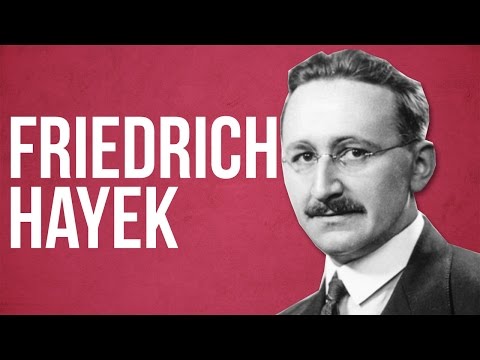
clearly August von Hayek was a political
economist who had a tremendous influence
upon how people in capitalist societies
understand the concept of Liberty
controversially for Hayek Liberty did
not mean democracy or a commitment to a
set of liberal ideals rather Hayek
believed Liberty was a policy which
deliberately adopts competition markets
and prices as its ordering principles to
Hayek’s way of thinking it was markets
that guaranteed individual liberty and
by contrast it was the interference of
the state in markets which disrupted the
operation of Liberty and started society
down as he famously put it the road to
serfdom Hayek was born into a minor part
of the austro-hungarian aristocracy his
father who came from a line of scholars
was a medical doctor and a part-time
lecturer in botany Hayek’s childhood was
filled with considerations of philosophy
and economics after a brief stint in the
austro-hungarian army during the first
world war
Hayek took up studies at the University
of Vienna obtaining doctorates in law
and political science and afterwards he
became an academic economist Hayek’s
career can be divided into two periods
the first which ended towards the end of
the 1940s was spent mainly at the London
School of Economics where Hayek
concerned himself with many of the
macroeconomic debates of the day the
second half of Hayek’s career was much
more varied from 1945 onwards in first
Chicago and later Freiburg Los Angeles
and Salzburg Hayek wrote and lectured on
a whole range of subjects economics yes
but also politics psychology philosophy
and the philosophy of science and while
he officially retired in 1968 it was
actually in the 1970s and 80s that Hayek
enjoyed his greatest moments of
influence being awarded the Nobel Prize
in Economic Sciences in 1974 and
subsequently being enormous ly
influential upon the governments of
Ronald Reagan and Margaret Thatcher
during Hayek stay at the London School
of Economics which he joined in 1931 he
wrestled with a number of the
contemporary debates with an economic
theory much of this revolved around the
business cycle which put simply is the
way in which economies grow and contract
traditional economic theory held that
over time economies find themselves in
equilibrium
in short glutes and shortages should
balance themselves out via market
mechanisms leading to the optimal
distribution of resources within an
economy the problem was that the
economic peaks and troughs seemed to
keep occurring and they also seemed to
be more dramatic than they should be
when the world economy stagnated and
then crashed in the late 1920s and the
1930s fierce debate began as to why this
had occurred coming in economics from a
fairly classical position Hayek focused
on issues of supply he noticed that when
economies were in a recession central
banks often artificially injected more
money into the economy by printing cash
or else or in addition by holding
interest rates low to encourage
investment rather than saving Hayek
argued that this was a mistake
when money was too readily available
entrepreneurs invested in products which
were not necessarily desired by
consumers when these products went
unsold companies would go bankrupt
leaving industrial capacity invested
where it need not be
in addition cheap credit incentivized
long-term capital investment and Hayek
argued that this too was a problem
because it limited the possibility of
entrepreneurs attempting to realize
short-term gains which would actually
kick-start the economy resisting the
temptation to meddle in the money supply
was for Hayek crucial to solving the
problems of the Great Depression
Hayek’s colleagues at the London School
of Economics were receptive to his more
classical approach but up the road in
Cambridge a very different set of ideas
was emerging centered on the thought of
John Maynard Keynes Keynes argued that
the problems of the 1930s economy were
located not so much in issues of supply
but rather of demand for Keynes the role
of government was to invest in Public
Works the buildings of roads for example
which would create employment and
therefore give people money to spend
stimulating economic growth for Keynes
full employment was therefore not only a
laudable social goal but vital for the
economy to Keynes’s demand led economics
was fundamentally at odds with
Hayek’s ideas Hayek felt that Keynes’s
focus on full employment would require
governments to keep increasing money
supply this in turn would create severe
inflation of the kind that had wiped out
his family savings when 1920s Austria
had suffered a bout of hyperinflation
throughout the 1930s Hayek and Keynes
corresponding with each other
argued bitterly and found very little
common ground during the Second World
War they even met under bizarre
circumstances because of the German
bombing campaign against London the LSE
had been evacuated to Cambridge one
night Keynes and Hayek were assigned to
fire watch duty together on the roof of
the chapel of King’s College sadly we
don’t know what it was they talked about
throughout that night the opening of the
second half of Hayek’s career is marked
by his first foray out from dry economic
arguments and the publication of what is
probably his most famous work the road
to serfdom Hayek saw the writing of this
book as a form of war work forced upon
him because as a former enemy competent
Hayek was refused official service in
the British war effort against the
backdrop of Keynes’s ideas on planning
which had become accepted within British
government circles the road to serfdom
was an attempt to save people from
themselves or more accurately from
central government Hayek put forward
several key arguments firstly that there
was nothing intrinsic to Germans as a
race of people that had caused them to
adopt authoritarian forms of government
Hayek rejected the idea somewhat popular
at the time that there was something
about German culture or indeed inherent
to Germans as a race which predispose
them to authoritarian and expansionist
forms of government secondly Hayek
argued where Germany and the Soviet
Union – for that matter had gone wrong
was in undertaking state planning that
interfered in the natural operation of
markets for Hayek the problem with state
planning was that it necessarily involve
offering up responsibility for deciding
upon a plan – a single individual in a
bureaucratic system such as the state
Hayek argued someone had to ultimately
decide on what course of action should
be taken and that person’s judgement
would necessarily have to be deferred to
and defer to repeatedly over a given
period of time
in this sense planning led societies a
sleepwalk in
dictatorship thirdly not only did Hayek
worry about the inherent need for
planners to defer to a single individual
but also he was concerned that
fundamentally no one individual could
actually make rational choices in
regards to economic problems due to them
not having enough information to base
their decisions upon to be clear it was
not that Hayek necessarily condemned
dictatorship after all his vision of
Liberty was a society in which markets
were the principal method of economic
organization not necessarily one where
society collectively decided upon
governments via the ballot box to this
end Hayek was comfortable with dictators
who adopted free-market economic
policies involving minimal state
intervention in a nation’s economy but
dictators who undertook economic
planning were for Hayek the really great
evil Hayek saw it like this markets are
extremely complicated networks with
millions if not billions of transactions
going on all the time even consideration
of some of the basics of market
transactions shows this items are bought
and sold commodities are invested in and
divested from and famines and bumper
crop yields affect how much there is to
eat and how much it will cost to acquire
it in keeping with the laws of supply
and demand when individuals make choices
as to whether or not to buy a commodity
they affect that commodities price if it
becomes scarce its price increases if it
becomes plentiful its price falls in
this sense the free market acts as a
kind of constant referendum on the value
of goods within an economy for Hayek the
market represented a form of collective
agreement made amongst all of the people
operating in that market as to the value
of particular goods and services and
against the collective wisdom of
hundreds of thousands or millions of
people what could one single planner
hope to offer that represented a
superior form of wisdom Liberty for
Hayek therefore was to be found in
letting the market do its work the road
to serfdom launched Hayek Slater career
instantly it became a best-seller during
the second world war it’s print run was
limited due to paper shortages and
obtaining a copy was nigh on impossible
due to sheer demand in the United States
of America a condensed Reader’s Digest
version of the book brought the message
to a very
large public so ii did a series of
lectures delivered by Hayek during 1945
at various venues in the United States
Hayek cold-shouldered by British
policymakers and economists was
delighted at the reception he received
in the US and in 1950 he moved to the
University of Chicago which became the
center of neoliberal economic thinking
with which Hayek was closely associated
much as Cambridge had been the locus for
Keynesian economics but despite the
popular acclaim of the Road to Serfdom
to negative reactions worked him first
of all some of his own colleagues
normally sympathetic to the ideas he put
forward saw the Road to Serfdom as a
kind of a lightweight form of journalism
rather than as a form of scholarship
Keynes who read the Road to Serfdom sent
Hayek what was for the most part a
complimentary message about its content
however towards the end and in quick
order Keynes challenged Hayek as to
where he would draw the line on
government planning some planning was
clearly needed Hayek was not an economic
anarchist after all but Keynes
challenged where would the line be drawn
it took Hayek many years to work out his
response to Keynes who died in 1946 with
a response eventually came in 1960 in hi
X book the constitution of Liberty the
book laid out high x practical vision
for where the line between the state and
the market should be drawn and it was
highly influential among the political
right in an anecdote a story is told
that at a meeting with a conservative
research department in 1975 Margaret
Thatcher responded to a policy paper on
political philosophy by reaching into a
handbag and withdrawing a copy of the
constitution of Liberty holding it aloft
Thatcher declared this is what we
believe as the 20th century unfolded
Hayek’s ideas gained more common
currency the notion that the state
should limit itself to providing a legal
framework within which entrepreneurs can
engage with free markets is now at the
heart of much of economic thinking many
politicians and large sections of the
public too are skeptical about the
ability of the state to plan and
undertake anything but the most simple
of economic tasks and this as much to
Hayek’s warnings about the anti
libertarian perils of planning and the
inability of planners to truly
understand the world around them even
when the financial
of 2008 hit the world economy leading to
a prolonged recession faith in
government planning was not restored in
the popular imagination this was best
testified to by the Road to Serfdom
hitting the number one spot on the
Amazon book bestseller list in early
2010 despite it having been written over 60 years ago
economist who had a tremendous influence
upon how people in capitalist societies
understand the concept of Liberty
controversially for Hayek Liberty did
not mean democracy or a commitment to a
set of liberal ideals rather Hayek
believed Liberty was a policy which
deliberately adopts competition markets
and prices as its ordering principles to
Hayek’s way of thinking it was markets
that guaranteed individual liberty and
by contrast it was the interference of
the state in markets which disrupted the
operation of Liberty and started society
down as he famously put it the road to
serfdom Hayek was born into a minor part
of the austro-hungarian aristocracy his
father who came from a line of scholars
was a medical doctor and a part-time
lecturer in botany Hayek’s childhood was
filled with considerations of philosophy
and economics after a brief stint in the
austro-hungarian army during the first
world war
Hayek took up studies at the University
of Vienna obtaining doctorates in law
and political science and afterwards he
became an academic economist Hayek’s
career can be divided into two periods
the first which ended towards the end of
the 1940s was spent mainly at the London
School of Economics where Hayek
concerned himself with many of the
macroeconomic debates of the day the
second half of Hayek’s career was much
more varied from 1945 onwards in first
Chicago and later Freiburg Los Angeles
and Salzburg Hayek wrote and lectured on
a whole range of subjects economics yes
but also politics psychology philosophy
and the philosophy of science and while
he officially retired in 1968 it was
actually in the 1970s and 80s that Hayek
enjoyed his greatest moments of
influence being awarded the Nobel Prize
in Economic Sciences in 1974 and
subsequently being enormous ly
influential upon the governments of
Ronald Reagan and Margaret Thatcher
during Hayek stay at the London School
of Economics which he joined in 1931 he
wrestled with a number of the
contemporary debates with an economic
theory much of this revolved around the
business cycle which put simply is the
way in which economies grow and contract
traditional economic theory held that
over time economies find themselves in
equilibrium
in short glutes and shortages should
balance themselves out via market
mechanisms leading to the optimal
distribution of resources within an
economy the problem was that the
economic peaks and troughs seemed to
keep occurring and they also seemed to
be more dramatic than they should be
when the world economy stagnated and
then crashed in the late 1920s and the
1930s fierce debate began as to why this
had occurred coming in economics from a
fairly classical position Hayek focused
on issues of supply he noticed that when
economies were in a recession central
banks often artificially injected more
money into the economy by printing cash
or else or in addition by holding
interest rates low to encourage
investment rather than saving Hayek
argued that this was a mistake
when money was too readily available
entrepreneurs invested in products which
were not necessarily desired by
consumers when these products went
unsold companies would go bankrupt
leaving industrial capacity invested
where it need not be
in addition cheap credit incentivized
long-term capital investment and Hayek
argued that this too was a problem
because it limited the possibility of
entrepreneurs attempting to realize
short-term gains which would actually
kick-start the economy resisting the
temptation to meddle in the money supply
was for Hayek crucial to solving the
problems of the Great Depression
Hayek’s colleagues at the London School
of Economics were receptive to his more
classical approach but up the road in
Cambridge a very different set of ideas
was emerging centered on the thought of
John Maynard Keynes Keynes argued that
the problems of the 1930s economy were
located not so much in issues of supply
but rather of demand for Keynes the role
of government was to invest in Public
Works the buildings of roads for example
which would create employment and
therefore give people money to spend
stimulating economic growth for Keynes
full employment was therefore not only a
laudable social goal but vital for the
economy to Keynes’s demand led economics
was fundamentally at odds with
Hayek’s ideas Hayek felt that Keynes’s
focus on full employment would require
governments to keep increasing money
supply this in turn would create severe
inflation of the kind that had wiped out
his family savings when 1920s Austria
had suffered a bout of hyperinflation
throughout the 1930s Hayek and Keynes
corresponding with each other
argued bitterly and found very little
common ground during the Second World
War they even met under bizarre
circumstances because of the German
bombing campaign against London the LSE
had been evacuated to Cambridge one
night Keynes and Hayek were assigned to
fire watch duty together on the roof of
the chapel of King’s College sadly we
don’t know what it was they talked about
throughout that night the opening of the
second half of Hayek’s career is marked
by his first foray out from dry economic
arguments and the publication of what is
probably his most famous work the road
to serfdom Hayek saw the writing of this
book as a form of war work forced upon
him because as a former enemy competent
Hayek was refused official service in
the British war effort against the
backdrop of Keynes’s ideas on planning
which had become accepted within British
government circles the road to serfdom
was an attempt to save people from
themselves or more accurately from
central government Hayek put forward
several key arguments firstly that there
was nothing intrinsic to Germans as a
race of people that had caused them to
adopt authoritarian forms of government
Hayek rejected the idea somewhat popular
at the time that there was something
about German culture or indeed inherent
to Germans as a race which predispose
them to authoritarian and expansionist
forms of government secondly Hayek
argued where Germany and the Soviet
Union – for that matter had gone wrong
was in undertaking state planning that
interfered in the natural operation of
markets for Hayek the problem with state
planning was that it necessarily involve
offering up responsibility for deciding
upon a plan – a single individual in a
bureaucratic system such as the state
Hayek argued someone had to ultimately
decide on what course of action should
be taken and that person’s judgement
would necessarily have to be deferred to
and defer to repeatedly over a given
period of time
in this sense planning led societies a
sleepwalk in
dictatorship thirdly not only did Hayek
worry about the inherent need for
planners to defer to a single individual
but also he was concerned that
fundamentally no one individual could
actually make rational choices in
regards to economic problems due to them
not having enough information to base
their decisions upon to be clear it was
not that Hayek necessarily condemned
dictatorship after all his vision of
Liberty was a society in which markets
were the principal method of economic
organization not necessarily one where
society collectively decided upon
governments via the ballot box to this
end Hayek was comfortable with dictators
who adopted free-market economic
policies involving minimal state
intervention in a nation’s economy but
dictators who undertook economic
planning were for Hayek the really great
evil Hayek saw it like this markets are
extremely complicated networks with
millions if not billions of transactions
going on all the time even consideration
of some of the basics of market
transactions shows this items are bought
and sold commodities are invested in and
divested from and famines and bumper
crop yields affect how much there is to
eat and how much it will cost to acquire
it in keeping with the laws of supply
and demand when individuals make choices
as to whether or not to buy a commodity
they affect that commodities price if it
becomes scarce its price increases if it
becomes plentiful its price falls in
this sense the free market acts as a
kind of constant referendum on the value
of goods within an economy for Hayek the
market represented a form of collective
agreement made amongst all of the people
operating in that market as to the value
of particular goods and services and
against the collective wisdom of
hundreds of thousands or millions of
people what could one single planner
hope to offer that represented a
superior form of wisdom Liberty for
Hayek therefore was to be found in
letting the market do its work the road
to serfdom launched Hayek Slater career
instantly it became a best-seller during
the second world war it’s print run was
limited due to paper shortages and
obtaining a copy was nigh on impossible
due to sheer demand in the United States
of America a condensed Reader’s Digest
version of the book brought the message
to a very
large public so ii did a series of
lectures delivered by Hayek during 1945
at various venues in the United States
Hayek cold-shouldered by British
policymakers and economists was
delighted at the reception he received
in the US and in 1950 he moved to the
University of Chicago which became the
center of neoliberal economic thinking
with which Hayek was closely associated
much as Cambridge had been the locus for
Keynesian economics but despite the
popular acclaim of the Road to Serfdom
to negative reactions worked him first
of all some of his own colleagues
normally sympathetic to the ideas he put
forward saw the Road to Serfdom as a
kind of a lightweight form of journalism
rather than as a form of scholarship
Keynes who read the Road to Serfdom sent
Hayek what was for the most part a
complimentary message about its content
however towards the end and in quick
order Keynes challenged Hayek as to
where he would draw the line on
government planning some planning was
clearly needed Hayek was not an economic
anarchist after all but Keynes
challenged where would the line be drawn
it took Hayek many years to work out his
response to Keynes who died in 1946 with
a response eventually came in 1960 in hi
X book the constitution of Liberty the
book laid out high x practical vision
for where the line between the state and
the market should be drawn and it was
highly influential among the political
right in an anecdote a story is told
that at a meeting with a conservative
research department in 1975 Margaret
Thatcher responded to a policy paper on
political philosophy by reaching into a
handbag and withdrawing a copy of the
constitution of Liberty holding it aloft
Thatcher declared this is what we
believe as the 20th century unfolded
Hayek’s ideas gained more common
currency the notion that the state
should limit itself to providing a legal
framework within which entrepreneurs can
engage with free markets is now at the
heart of much of economic thinking many
politicians and large sections of the
public too are skeptical about the
ability of the state to plan and
undertake anything but the most simple
of economic tasks and this as much to
Hayek’s warnings about the anti
libertarian perils of planning and the
inability of planners to truly
understand the world around them even
when the financial
of 2008 hit the world economy leading to
a prolonged recession faith in
government planning was not restored in
the popular imagination this was best
testified to by the Road to Serfdom
hitting the number one spot on the
Amazon book bestseller list in early
2010 despite it having been written over 60 years ago
Please follow and like us: