
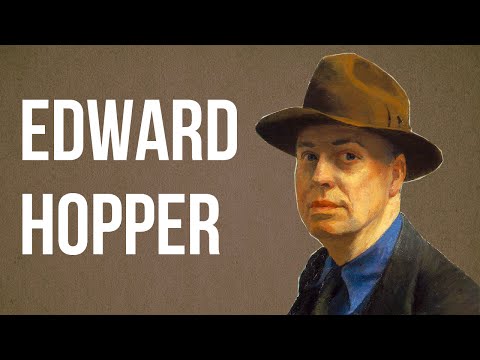
Edward Hopper is a painter of gloomy
paintings that don’t make us feel gloomy
instead they help us to recognize the
loneliness that so often lies at the
heart of sadness in his automatic woman
sits alone drinking a cup of coffee it’s
dark outside and judging by her hat and
coat it’s cold the room is large empty
and brightly lit the decor is functional
and she seems slightly self-conscious
and a little afraid perhaps she’s not
used to sitting alone in a public space
something seems to have gone wrong and
the viewer is invited to invent stories
for her of betrayal or loss she may be
trying not to let her hand shake she
takes the coffee cup to her lips it
might be 11:00 at night and of dark for
every night in the North America Automan
is a picture of sadness and yet it is
not a sad picture there can be something
enticing even charming about anonymous
diners the lack of domesticity offers a
relief from what can be the false
comforts of home it may be easier to
give way to sadness here than in a cozy
living room with wallpaper and framed
photos home often appears to have
betrayed hoppers characters something
has happened there that forces them out
into the night and onto the road the
24-hour diner the train station waiting
room and the motel are all sanctuaries
for those who the sound reasons have
failed to find their place in the normal
world of relationships community hoppers
ability to portray solitude came from
his own familiarity with it
he was born in 1882 in a shipbuilders
town upper Nyack New York he led a
comfortable middle-class childhood as
the son format and yet inside hopper
often felt awkward indeed a bit like an
outsider in one early portrait we see
him gazing almost distrustfully at the
viewer hopper longed to be an artist and
yet his parents insisted he trained in
commercial art to keep afloat
financially he hated it and to escape he
took several trips to Paris under the
pretense of studying French art but in
truth he didn’t feel a connection to the
sellers he absorbed some of the
Impressionists but forgot Picasso’s name
he preferred to be outdoors watching
children play in the Luxembourg Gardens
listening to concerts and dwellers or
traveling up and down the Sun by boat in
1913 when Hopper was 31 he settled in
Greenwich Village in New York where he
would stay for the rest of his life this
is where he discovered how crowded and
yet isolated life could be in the city
the population of American cities are
skyrocketing and yet they were inhabited
by passing strangers who were
increasingly alienated from one another
hopper would ride the El train and look
down at in his own words dark glimpses
of office interiors that was so fleeting
as to leave fresh and vivid impressions
on my mind in each room separate drama
was unfolding an unnoticed oblivious
Island in a sea of people
although Hopper painted in New York for
over a decade his paintings failed to
sell and he often struggled to find
inspiration then in his early 40s he met
a beautiful social painter named Joseph
E Edward and Josephine took excursions
to paint by the sea they went to the
movies they went to the theater and
actually they got married hopper was no
longer so alone but of course as most of
us discover in our relationships hoppers
marriage didn’t permanently end his
feelings of isolation and whoa he still
felt lonely at times he and his wife
couldn’t quite figure out their sex life
and she often seemed to prefer the
company of her cat hopper discovered
that even when someone loves us very
much there is always some essential part
of us that remains alone it is this
recognition that makes this painting so
compelling and indeed by addressing
loneliness the art can be at its most
therapeutic consoling us and reassuring
us that estrangement and sorrow are
normal and that we are neither strange
nor shameful for experiencing them sad
and lonely art allows us as viewers to
witness an echo of our own griefs
and disappointments and therefore to
feel less personally persecuted and
beset by them ha Bazaar helps us to
notice the landscapes of loneliness in
our own lives
a side effect of coming into contact
with any great artists is that we’ve
come more aware of the things that the
painter would have been receptive to
nowadays we become accustomed to what
one might call the hopper ask the
quality found not only in the North
American places that help have visited
but anywhere in the developed world
where there are motels and service
stations roadside diners and airports
bus stations and all-night supermarkets
for example service stations readily
available famous gas painted 13 years
after autumn in this painting we see a
petrol station on its own in the
impending darkness the isolation is made
poignant and enticing the darkness that
spreads like fog from the right of the
canvas contrasts with the security of
the station against the backdrop of
night and the wild woods in this last
outpost of humanity a sense of kinship
seems easier to develop than in daylight
in the city
hopper loved the introspective move that
travelling often puts us into he liked
painting the atmosphere inside
half-empty train carriages making their
way across a landscape when we can stand
outside our normal cells and look over
our lives in a way that we don’t in more
settled circumstances we have all known
the atmosphere inside hoppers car see
number 293 though perhaps we have not
recognized it as well as when hopper has
held the mirror up to it after hoppers
marriage his professional life suddenly
improved as well he felt more creative
it was the era of the Great Depression
and yet his paintings began to sell
critics raid museums bought his work and
he received awards yet despite his
success he remained deeply introverted
instead of escaping his solitude he
embraced it for decades he turned down
the awards rejected the speaking
opportunities and lived simply out of
the public eye he died in 1967 and yet
his art remains and retains the ability
to help us to see the loneliness in our
own lives from a wiser and more mature
perspective Oscar Wilde once remarked
that there had been no fog in London
until Whistler painted it there was of
course lots of fog
it was just that it was harder to notice
its qualities without the example of
Whistler to direct our gaze what was
said of Whistler we may well say father
that there were far fewer
strangely haunting and consolingly
beautiful service stations and train
Edge’s motels and diners before hopper began to paint
Please follow and like us: