
school I had a plan I wanted to get
great grades graduate early and go to my
dream school since elementary school
Harbor become an anthropologist and I
was on track I was doing well
academically I had a bunch of
extracurricular projects in the works
but that summer instead of getting my
driver’s license
testing out of algebra to going to swim
camp at Michigan State and getting my
lifeguard certificate
I slept you see the powers that be
decided that instead of all that I
should get mono and not in the fun way
that you can catch mono if you catch my
drift despite my best efforts I didn’t
recover my symptoms started growing
beyond the standard symptoms of mono I
had fevers headaches dizziness brain fog
a racing heart nausea and extreme
fatigue one of the fun things I did get
to do that summer was visit Georgia and
one day when I was on a day trip to
Senoia I had made it halfway down the
Main Street before collapsing my immune
system was so compromised that I’d
gotten pneumonia in the south during
summer has anyone here ever heard of
Senoia like raise of hands now yeah okay
it’s where they filmed the walking dead
so I was in the perfect place for a
walk-on role as a zombie and I had the
dead part down just not the walking by
November I’d stopped being able to go to
school on in fact on Black Friday in an
attempt to get me out of the house my
mom and I went to Joanne’s where I could
get from the car to the front to the
front door into a wheelchair
by the time that I got to the back of
the store I was so nauseous that I had
to go home again it was the most fun I’d
had all month and I have brain fog still
okay so ever since using a wheelchair
okay wait no no my brain often fails me
in the following months I continued
getting worse and despite a ton of tests
like EKGs halter monitors a tilt table
test and a ton of blood tests
we couldn’t figure out what was going on
by the time that I got to the Mayo
Clinic in January I was so ill that I
couldn’t get out of a wheelchair for
more than a minute
even then with my heart racing and
trying not to faint after four days
there I was diagnosed I had postural
orthostatic tachycardia syndrome or pots
not the fun way
that you can get pot pots is a form of
dissident Omiya it basically means that
when I stand my nervous system doesn’t
pump my blood up to my head and heart
correctly and so that’s what causes all
of my symptoms with a beta blocker my
heart can calm down but my autonomic
nervous system still doesn’t work
properly currently I’m in junior in high
school and I’m still working with my
doctors to improve to improve my
symptoms because the additional
treatments for pots just make me worse
25% of pots patients are disabled to the
point of not being able to attend work
or school and scientists have compared
the quality of life of someone with pots
to someone with congestive heart failure
or someone on dialysis for kidney
failure before I got sick I thought of
disability as something that I could
easily see I had no idea that someone
could be so ill that they became
disabled or that there were invisible
disabilities like pots if I’m not using
a chair and I’m wearing enough makeup I
look fine right right right okay but I
can’t want standing or walking long
enough so I after five minutes I look
like a ghost and I’ll need somewhere to
collapse the easiest way to explain my
energy levels is with the spoon theory
it was created in 2003 by Christine
misery and Ino and is now used by a lot
of chronically ill people we call
ourselves spoon ease it quits spoons two
units of energy for example it takes me
about two spoons to get out of to get
out of bed take a shower and get dressed
in the morning and it takes about three
to go to my 50-minute class here at LSU
and those are all the spoons that I have
in a day I never know if I’ll have that
many if I use more than my five spoons
of the day I’ll have less tomorrow so
doing this
going over my spoon limit ever since I
started using wheelchairs I’ve been
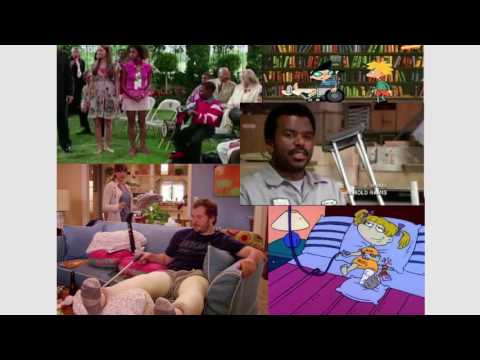
thinking about one extremely overused
trope the only examples of wheelchair
users standing up that I’ve seen in
media are used for an AHA they’ve been
thinking it moment the one I remembered
the most was in an episode of Cory in
the house where Stanley pretends and
sprained his ankle to get extra sympathy
and take attention away from Cory this
trope keeps me on edge whenever I’m out
in a wheelchair one time last year I was
hanging out with some friends and we
borrowed a wheelchair in a store to save
energy as we looked into the shops what
if I was kept pushing me in really fast
spurts even though I protested but
actually I was having the most fun that
I’ve had in months and I finally decided
to stop protesting and the wheels caught
on the sidewalk and I fell face forward
I really didn’t have a plan I just got
back up and back in the chair but I did
torment him a ton later and my other
friend said that she could see people in
the parking lot staring at us giving us
the eyes of you are disrespecting real
disabled people and playing with a
wheelchair if the only examples that we
see of peek of people in wheelchairs
standing up are when they’re faking an
injury all together for advantages how
can we be expected to know that there
are you wheelchair users that can stand
I’ve read countless stories of people
with invisible disabilities using
mobility aids and getting harassed for
it there have been people with notes
left on their windshields their mirrors
broken and their cars keyed we as humans
have this natural tendency to make
assumptions even if we don’t know what
we’re making assumptions about those
people were trying to make sure that no
one took advantage of disabled parking
but they were actually hurting real
disabled people in the process
so through my experience I’ve learned
that there’s no wrong way to be disabled
you can stand beneath a wheelchair you
can look happy despite being an extreme
pain my illness completely changed my
life
I learned that changing one detail can
change the entire experience as I was
going through all this I was meeting
more disabled people and learning more
about other marginalized groups a term
that I learned about was
intersectionality
intersectionality is defined as the
interconnected nature of social
categorization such as but not limited
to race class and gender as they apply
to a given individual or group regarded
as creating overlapping and
interdependent systems of discrimination
or disadvantage the term was coined in
1989 by kimberlé crenshaw when she
heard about a case involving a woman
named Emma Grafton Reid who was denied a
job at General Motors I believed it was
because she was a black woman because
the company had only ever hired women
that were white and black people that
were men but the court would only let
her have the case if she was suing for
either racial or gender discrimination
she was at the intersecting disadvantage
of being black and a woman but the court
couldn’t see that intersection an easily
visualized example of intersectionality
is the wage gap it’s often mentioned to
talk about gender inequality but the
wage gap is even larger for men and
women of color for example a Latina
woman holds both the identity of a woman
and a Latin ex person and is paid less
because she holds both of those
identities historically people felt that
they had to choose between black civil
rights or women’s rights for example
white women’s rights activists such as
susan b anthony decided to fight for
only white women’s rights to vote
concluding that women of color could
just get their rights later or simply
not caring whether they got them at all
there’s an example of this struggle
between choosing between civil rights or
women’s rights in the docu-series good
girls revolt where the actress that
portrays civil rights attorney and now
congresswoman representing the District
of Columbia Illinois owner Holmes Norton
says this these women have something
very important with us in common with us
they’re second-class citizens and you
and I know exactly how that feels don’t
we kept from your full potential paid
less than you’re worth talk down to told
to shut up stay in your place these
women live in a box just like you so
don’t be fooled because their box looks
a little more comfortable than yours
it’s still a box and the only way that
any of us are going to break out of this
box is if we stand together because when
the second-class citizens of the world
stand with each other not against each
other that’s how you change the world so
when you have these women that’s how you
for yourself
it’s not as simple as man or woman black
or white rich or poor gay or straight or
abled or disabled experiences can
overlap and not everyone falls on one
side or another for example this quote
really sums that up pretty well there’s
no such thing a single issue struggles
because we do not live single issues
issue lives rights for oppressed groups
are not mutually exclusive evidence
shows that adding one detail changes the
whole experience so we can’t be like
that Court was they understood the parts
but not the whole human experience is
not that simple we can’t just pick
either/or when I got sick we had to
figure out a way to handle my education
while trying to figure that out it was
implied to me
that I really stick the only thing that
had changed the only intersection that
was added was becoming chronically ill I
still have my goals I just have to reach
them a different way just because of
this advant disadvantage I was at this
disadvantage of being ill I was expected
to lower my goals and I don’t have only
one thing to say to that and it’s a line
I’ve got a lot of imperfections but I
don’t count my ambition in them the
worst thing that ever happened to me was
also the biggest learning experience of
my life but it doesn’t take a
life-changing experience to learn I
don’t know what it’s like to be a black
woman a trans Asian person a gay Latin
next person a blind person or an
immigrant I do not know what I do not
know what I kind of do is listen to and
learn their experiences learn their
stories and amplify their voices
accepting your privileges shouldn’t be a
daunting or guilt-ridden thing if we
acknowledge the privileges we have
that’s how we can start to tackle the
issues it’s kind of like saying
accepting you have a problem is the
first step to recovery after that we
have to be open to learn humanity will
benefit when more people listen to each
other
from Disney’s Pocahontas if you walk the
footsteps of a stranger you’ll learn
things you never knew you never knew thank you