
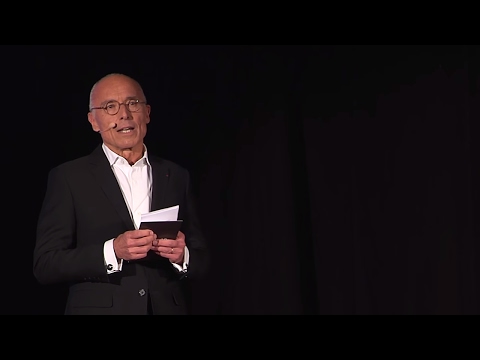
Translator: Lea Pedinotti Reviewer: eric vautier
I am a gastronome, and for many,
it is reduced to frequenting the great restaurants,
to taste foie gras and other stuffed pigeons.
In short, to be very far from ordinary mortals
and to limit oneself to an elite.
This is partly true.
I am lucky to frequent beautiful houses
and meet passionate people.
But not only.
My work leads me to be interested in the practices
in the matter of human nutrition.
I have a particular appetite for places where
eating is often a challenge.
High-dependence environments where the meal is crucial.
School canteens:
the meal must be a taste education marker,
and sociability.
Retirement homes:
the meal must be a marker of well-being,
and pleasure.
And the hospital:
the meal must be a marker of nutrition, and envy.
I will stop at the hospital.
Do you know that undernutrition is one of the leading causes of death?
When we no longer want to eat, we do not want to live anymore.
To eat is to worry about one’s well-being.
I am talking here about eating, not being fed.
You can be fed with pills or infusions.
Eating in the hospital is considered a care.
It’s a way to fight the disease.
In March 2006, I put on a white coat,
to respond to the request of Dr. Cécile Chambrier
who runs a service in a hospital in Lyon.
And in this service, the patients she welcomes
are so malnourished that she has trouble caring for them.
Of course, a lot has already been done but the results are not satisfactory
and 70% of the meal tray often goes to trash.
So she thought that Paul Bocuse Institute could help her.
I spend a morning observing the work of the caregivers.
I dissect their organization, I need to understand
how the meal is served.
What strikes me is the speed,
the discretion with which the meal is brought to the patient in the room.
The plateau: “I bring you the plateau. “
The tray is placed on the table called the adaptable,
very often, almost always cluttered with magazines, newspapers, computers
and regularly urinals.
So everything related to the environment of the meal is not implemented.
I have an intuition: I think this lack of acts
related to the meal environment
can be one of the causes of the difficulty of this food intake.
I convince the hospital to give me the caregivers
and I invite them to Paul Bocuse Institute.
They are impressed by the place and they are amazed by the fact that
I do not question their job –
they do it very effectively.
In fact, my goal is to make them understand that
the great humanity they deploy in cleaning the room,
in the cleanliness of the bed, in the toilet of the body,
this great humanity is absent or insufficient
when it comes to bringing the meal to the sick.
Among the exercises,
I have them set up the tray as they usually do
and with the same elements, I ask the experts
of the art of the table, of the Institute
to set the plateau.
They discover with astonishment that this plateau can be sublimated,
that he has another pace, that he is much more attractive.
They understand that eating is not a protocol like any other.
They become aware of the importance of symbolism.
That is to say, these little gestures, these words, this look,
which seem trivial but which have a great importance.
Back in their service, they implement an action plan.
The folding of the towel that will be in harmony with the Christmas period.
They draw, they make sets for meal trays.
In fact, their humanity is liberated when it comes to the meal.
This experience inspires Professor Pierre Singer
who runs a nutrition service in a hospital in Tel Aviv.
He is doing an experiment on 300 meals served over a period of 28 days.
Food intake increases by 30%.
The experiment is therefore conclusive.
So, what about you now? How did you eat lunch?
Have you sat down? Have you had lunch in front of your computer?
Did you put a set, a tablecloth for the shared meal with your children?
This morning, did you have breakfast?
When we get up, normally we have breakfast.
That is to say, we break the fast.
Personally, every evening, I set the table,
I take the bowl, the plate, the cutlery with which I am used
to take this meal.
I complete it in the morning, being attentive to the gestures that are mine.
And I take a few seconds to watch this staging.
Every familiar object has an impact.
And in fact, they become a presence that develops an energy
which I will use during the day.
I am in full agreement with the historian Pascal Ory
who says that gastronomy is neither haute cuisine nor good meat,
it is the rule – “nomos” – of eating and drinking
thus transformed into the art of the table.
To be a gastronome is to be able
to create, whatever the context, the place,
a moment when something amazing happens.
Being able to be absolutely present and not wanting to be anywhere else
than before his meal.
Whether in the office, under the coconut palms or in the hospital.
It is this ability to awaken all senses
to enjoy the moment.
In fact, it is the desire, the desire to have joy,
the desire for a moment that is felt like a gift,
a gift that I make myself, a gift that I give to the other.
In November 2010, the gastronomic meal of the French
is registered in the intangible cultural heritage of UNESCO.
But what do we do with it?
I am among those who think, that this heritage, this tradition,
is an answer to this search for happiness in the daily life of our lives.
We must not be afraid of tradition, tradition gives us weight,
she frees us.
Through the ritual, it forces us to be attentive
to the details, to the little things.
The ritual finally installs a rhythm, a feeling of slowness, of déjà vu,
but which gives thickness to time.
Put a tablecloth, a set, draw a table, a tray,
to choose a glass to drink a wine, these are details
but which sublimate the moment of the meal.
The act of eating does not have to be mechanical.
Even less a fashion.
It’s a way of life that becomes an art.
The art of life.
Dr. Jean Trémolières, who died 40 years ago,
is one of the founders of the French nutrition school.
He understood that food contributes to shaping man.
Not on a strictly physical, but global level.
So face the pressures that are ours
in the modern world where we speak constantly
efficiency, productivity, profitability
and therefore this interior bric-a-brac with which we must compose,
we still have the power to re-enchant the daily life of our lives,
re-enchant the daily life of our lives by re-enchanting the way we eat.
Thinking about the little details does not mean thinking small when you eat.
It helps to shine with each meal stars in our eyes.
So tonight I have a wish.
It is that TEDxLyon, as part of this meeting,
a spark, a spark that lights a bonfire.
The joy of gastronomy. Thank you.
(Applause)
Please follow and like us: