
why do we tell stories stories are how
humans deliver the most important
messages in life
ah and I’m here to make another such
delivery to you humans have created a
marvelous world of global connection a
great giant network that we think of as
the world system and often call
globalization the difficulty however is
that this world is perishable and when I
say perishable I’m not talking about
survival of the species but rather and
here is the moment 150,000 years ago
where humanity all almost went out
because of climate change
human beings were reduced
anthropologists have estimated – what
they call – about 600 of what they call
breeding individuals so all of us are
from those 600 people who gathered and
clung to existence at a place called
pinnacle point in South Africa right by
the shore and humanity apparently
adapted and survived the distress by
learning how to eat shellfish so I’m not
talking about this I’m talking and you
can see how they migrated
from be down there I’m talking about a
different kind of crisis the crisis that
we face with civilization itself and the
world network that we glory in the
Magnificent edifice of of a globalized
world and what I have noticed is that
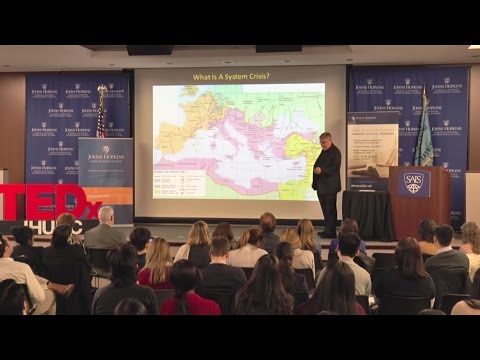
there were four times in history meaning
since people have learned how to write
stories
there have been four times where the
world system such as it was at the time
literally came apart and subsided and I
wanted to know why and how that happened
and the best way I could do that was to
gather group of students and create a
course which I did I’ve taught it three
times and the overriding a puzzle or
riddle is whether or not this could
happen again and how it would happen are
there elements that tie these global
crises that we’ve experienced since the
end of the Bronze Age other elements
that tie it together and this is the
world of of the Bronze Age are there
elements that we can look to that are
replicated in each of these crises and
uh there’s also the fact which we know
is a fact as we can look outside or look
at each other and that fact is that
these world systems eventually came back
together they survived and revived so
part of the issue is not simply how
could a crisis happen but how would we
how would we find resilience to put
things back together this instance took
a couple hundred years or more the
so-called Dark Ages at the end of the
Bronze Age and
writing was lost in the Aegean area the
migration of people’s was a big part of
it and the second of these giant crises
was the celebrated fall of the Roman
Empire as it’s known and this also had a
migratory element and perhaps the
strongest force was climate change
climate change bringing the great
Justinian ik plague that overthrew the
Mediterranean world the migrations of
Germanic people and then eventually the
surge of Islam then there was the great
calamity of the 14th century the Black
Death and in just a short few years 40
percent of humanity died and the great
globalized Eurasian network here
that was completely interlinked came
apart and it stayed apart for another
300 years but of course it eventually
came back together then we have the
crises of the 20th century the two world
wars and the depression and the system
came apart and it came back together but
if you were to look at the world say in
1940 after the Hitler Stalin pact you
could feel much like Orwell did in 1984
that the world could be permanently
divided into broken regions and that the
idea of a system at all would have
disappeared so the issue I thought was
an issue of massive external force and
the externality that that happened again
and again was climate change bringing
war pestilence and and famine and yet
with my students are teaching it three
times
they helped usher me through a passage
of transformative thinking which came as
a surprise to me I discovered that the
the climate change component was there
and and could act as a trigger just as a
war could unseat a system but the thing
that happened that stood out in all of
these historical cases was that the
system stopped working when people
stopped believing in the very idea of
civilization and its leadership
leadership and the elites lost Authority
and ultimately were overthrown
so this vision that I had gone into the
seminar expecting to pursue in in
tremendous detail became less important
it was a trigger for sure but it was
this underlying passage and this is what
I’ve come up with
thanks to my students as we looked at
these cases this is what happens with
elite based orders now when I say elite
the elite aren’t simply the 1% the
notorious 1% they are the intellectuals
the idea people they’re also the what I
call the courtier class which we see
everywhere in Washington the people who
run the institutions of governance now
what happens with elites every single
time the more successful the system the
stronger the elite order becomes elites
become stratified politics are frozen
see that in the Roman Empire you can see
it in the High Middle Ages with
feudalism and the way in which the
church had a lock on society as a whole
the elites take people and their
allegiance for granted they did this in
World War one sending a millions of
young men that their deaths and then
again in
world war two real social mobility
declines and it declines because elites
are working relentlessly working to
maximize their wealth and status but you
don’t simply get a growing inequality of
income and wealth you also get a a
decline in social mobility it’s a story
in each of these passages elites ignore
threats to the people’s way of life they
become insensitive they don’t listen
this of course um was something that
sneaked up in this recent election but
it’s happened in all of these cases
people abandoned Rome they went out in
the countryside to escape the the
dominance of slavery and the poverty
that they were burdened with elite
Authority becomes aggressively
militarized toward the end in Rome and
also the whole set up of feudal society
at the height of the Middle Ages was
tremendously militarized and the
militarization of course characterized
the 20th century and people in the
elites feel that this is civilization
and this is what needs to be protected
and this is what needs to be nurtured
and those that’s not a straight
ideological party distinction up people
on the right will talk about the free
market people on the Left will talk
about a government that is able to
regulate and so they’re both talking
about the focus on civilization and not
on people the one-tenth of the 1/10 of
the 1% also known as Homo Davos Davos
man and here’s the other side and
you have such a giant uh inequality of
wealth and income the world may be
getting richer but where is the wealth
going to whom is it going the
militarization a stands out in its
ability to resonate in our minds with
images of medieval Knights here so so do
Americans in their body armor in here so
you have a vision but a vision that is
yet unfulfilled I mean our system has
not yet come apart and I’m not sure that
we should think that it will come apart
anytime soon because the crisis comes
often very slowly the situation may
build for centuries violent popular
flare-ups rebellions insurgencies come
and go and are viciously put down it’s
only when that externality arrives that
outside force that it tips things over
so you see the climate change isn’t the
the thing that makes it happen
it is the spark plug the fuse the
trigger and what happens in these crises
is that elite legitimacy and for a while
authority is overthrown and it’s remade
and we can see this throughout the
periods of coming apart the elites are
overthrown
and the punchline not the final message
but the punchline in every single a
system collapse or coming apart or
subsidence there is space that’s opened
up there is more room for people to rise
there’s more freedom and in effect the
black death for example set up the the
the rise of Europe the new technologies
were were encouraged they needed them
that’s the innovation and new things the
physical destruction itself creates a
high demand for investment and growth so
if you look at writers like comes
Piketty you’ll see how the world war and
then the depression and finally World
War two could be interpreted as good
things because so much was destroyed
there was a pent-up demand for
rebuilding which was the economic dynamo
that fueled the rise of Western Europe
and Japan after World War two and in
addition there was more equality because
so much wealth was destroyed destroyed
in the Depression but also destroyed in
World War one and especially World War
two by the coming of parts in overthrow
of elites every nation in Europe with
the exception of Britain either suffered
a revolution or was torn apart for the
next 20 years like France what happens
and this is why the coming crisis is
potentially a good thing even if it
leads to our tearing the hair out of our
heads is that civilization is reimagined
what happens over time while the elites
are stratifying and corralling all this
wealth unto themselves they are also
stratifying and freezing the very
civilization itself and and this is
something that would lead to many other
stories but it is something you
see in late antiquity with Rome you see
it very powerfully in the crisis of the
high middle ages
you see it in the twentieth century and
then when is it when is it to come next
I put these things together as as
indicators up up from my students and
and our conversations and the the true
bottom line that I can give you and
deliver it now the bottom line message
is and and try to keep this in mind and
exploring if you’re able to face that
challenge you are the elites and the
revolution will come for you thank you [Applause]