
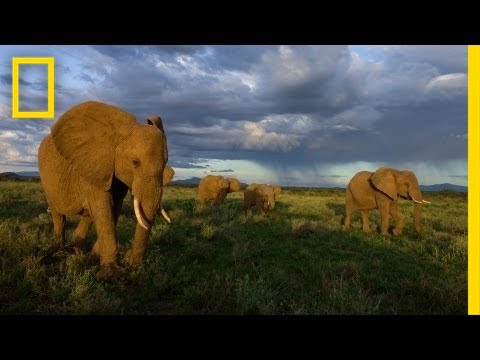
[Music]
today I’ve been asked to envision a
better tomorrow for elephants at a time
when their future prospects are well
really couldn’t could hardly be grimmer
the ivory trade is raging out of control
habitat loss is in freefall and human
human elephant conflict continues
unabated and with trade in wildlife
products valued at something between 10
and 20 billion dollars a year elephants
are just one of the better-known
casualties so are there any rays of hope
well I think so as examples in the
northern rangelands of Kenya in the
Masai Mara and in Amboseli just in the
last couple of months they’ve been signs
that poaching is abating and what each
of these positive stories has at their
core are people working together with a
heartfelt connection for the animals
that they’re protecting so only time
will tell whether this fragile trend is
going to hold and with Chinese demand
for ivory soaring we really are up
against formidable odds
I’ve studied elephants and worked for
their conservation and Welfare for close
to four decades and so much has changed
during that time in the early days in
the in the mid 1970s in Amboseli we
pioneered monitoring the life histories
of elephants in the old-fashioned way
using a few of us out following the
elephants with ID cards and Penan and
and paper and over the years through
films through books we popularized the
life stories of elephants the likes of
echo here became household names and
elephants were no longer merely objects
but they were character
with whom we could relate our research
assistants Nora soy la Couture were
women from the local community and today
they are internationally recognized
elephant champions and average Kenyans
now are actively engaged in elephant
conservation they’re protesting the
destruction of elephants writing
scientific papers working in the field
and voicing their concerns on Facebook
and people around the world seem to
yearn for a connection with these
incredible Giants asking to volunteer
naming elephants adopting orphans and as
the popular interest in elephants has
grown better my husband and elephant
voices colleague and I began to think
well what if we could involve people in
the kind of work that we do what if we
were able to share our observations with
the public what if tourists and local
people alike were able to contribute the
observations that they had made and what
if by doing so we were able to create a
community of people who cared as much
about the future of elephants as we do
what if elephants their families their
clans and their habitats could be
nurtured and protected by individual
people their families entire communities
what if we could build a global network
of people working together it would be
compassionate conservation at work
they’re so cute we sat here with these
elephants for about two hours and I
swear this this young female here was
just showing off for us I mean she she
came up and played with the car for a
while and then she just engaged with
these two little two little calves for
about two hours so our last year our
little organization elephant voices set
out to try and use citizen science and
web technology to forge those
connections starting elephant partners
in the Masai Mara our concept is to use
self phone-based upload of data and
online sharing of observations to
connect people to the lives of
individual elephants and our vision is
to inspire a global network of people
working together to ensure a future for
the Mara elephants and to inform
conservation management so working with
Kenyan programmers we designed and built
what we’ve called the Mara elephant
who’s who and whereabouts databases the
who’s who is a unique registry of
individual elephants that is searchable
by physiognomy characteristics and it’s
linked by individuals to what we call
the whereabouts database that houses all
of the sightings of elephant groups and
both of who’s who and the whereabouts
are connected to Google based mapping
function so to allow many different
people to contribute to the whereabouts
database we designed and built a cell
phone application which includes
sightings wounded elephants and
mortalities and permits direct upload to
the database and the Mara le app as it’s
called is freely downloadable from the
Android Market and we have built into it
an elephant program and of course the
Mara elephants are on Facebook so how
does it all work well let me give you an
illustration using Kirsten Buescher
she’s a nurse she lives in Germany and
she is one of our many participants
she’s a great photographer
she loves elephants and she saves up to
come to the Mara as often as she can and
she’s used the database to get to know
the individual elephants that she is
seen in the Mara and she and her
observations are helping us to build an
understanding of the Mara elephants so
how am i considering that there are
thousands of elephants in the Mara and
over 700 registered in the database so
far how might she be able to identify
this larger elephant well she might
notice that this elephant has a smooth
ear with tiny nicks she has an up curve
toss that’s higher on the right-hand
side
she’s a large adult female and if you
look here her ear bulges forward so then
she could go to the to the database
she’s selected female large adult on the
tusks higher right on the right ear
smooth with tiny nicks and the ear shape
lobes bulge and by pushing the search
button 700 elephants is reduced to two
individuals by hovering over the code
numbers they’re a little thumbnails
appear and she can see that F female
number one one five matches the elephant
she’s looking for so so then as a non
non-resident of the Mara Kirsten can
contribute $500 to name this elephant
and she’s done so she named her see on
you can see it says up there named by
Kirsten Buescher and her name then
appears on the ID card and on any
photographs that she’s contributed
toward the database so her her
observations and her
aiming of elephants and her financial
contributions allow Kirsten to feel that
she is integrated in the project and
that even though she lives in Germany
she can make a difference well each of
the observations that Kirsten has made
is then uploaded to the database so here
is an observation she’s made of seein’s
family and after having named Seon she
then decided she wanted to name the
whole family she’s named a second adult
female in the family
well her donations are going to go
toward an elephant scholarship the
tuition for putting a student through a
course at the kaki guiding School in the
Mara and Derrick nabela is one of the
hundreds of masai guides who has
graduated from the kaki guiding school
and Derrick is another partner of sorry
another participant of elephant partners
and we spend a day out watching
elephants together and after that
Derrick went back got on Facebook yes
you couldn’t get on Facebook in the Mara
and he wrote elephants are awesome when
identifying it gives more sense of care
and Derek just got it he had connected
with some elephants one of the elephants
that he connected with was F or female
number 96 and she has this beautiful up
curved right tusk and a hole in her left
ear and Derek then decided to name her
goodness because that’s what he thought
of her character well through citizen
science and the many photographs that we
that have been sent to us we’ve been
able to gather unusual pieces of
information for instance we know that
this apparently a peaceful female female
number three oh three oh three or Tillie
as she’s called covers quite a large
range and at least one of her family
members is a killer of cows if you go to
the mapping page and you put in her
number there and filter you can see
where she’s been seen and you can see
that she’s been seen six six times the
numbers in there show two two
observations in that particular area one
one of the observations was by a
researcher another by a Conservancy
manager two observations were by two
different tourists and two were made by
by me one of these was on ilaria Rock
Conservancy and where she was seen by
the manager Rob Amira leaving the scene
of a crime m73 male number 73 has also
been seen across the northern
conservancies and he’s been observed
seven times so far he’s a real ham he’s
been named stony by Pat Derby who runs
is the founder and director of the the
the performing animal welfare society in
California she runs an elephant
sanctuary there and she named him Stoney
in memory of an Asian elephant who was
injured while performing in Las Vegas
unable to walk Stoney was put into a
dumpster and wheeled out to the back of
the hotel and then put in a mechanical
cattle crush and left in a dark room and
it wasn’t until a year later that an
attempt was made to release Stoney from
the mechanical device whereupon he fell
injuring the other the other leg and he
had to be euthanized
later that day well Pat Derby was very
involved in this case and she wanted to
know that his namesake would live on
wild and free
well querying the database the mapping
function sorry reveals a basic trends in
in habitat use that can be useful for
elephant conservation for instance here
you can see that I have I have asked the
database to show me where family groups
have been seen or family groups with an
adult male and you can see that the
observations are across the Maasai Mara
National Reserve as well as outside to
the north in these northern
conservancies but if you if you search
then on male groups only you very
quickly see that male groups
preferentially use the bushland areas to
the north and east of the park and on
the eastern park
nineteen-year-old Jeanne Cowell lives
with her family and works with a team of
of Maasai scouts to protect elephants
and predators there and I’m in touch
with her via Facebook via Skype and on
email several times a week so the data
that she and the scouts have collected
show that that Siana is very important
they’re very large groups of elephants
and very large males but it’s also an
area that’s been neglected and as a
result it has suffered very high levels
of poaching so we already know in the
short time that elephant partners have
been working that this is a very
important area for us to focus on well
our databases have been online since
October last year we have over 700
elephants registered over 750 sightings
have been uploaded to the whereabouts
database and over 70 different people
have participated and we now have a
Kenyan master student working with us
elephant partners is an ambitious
project working in a cross-border
ecosystem on a population of several
thousand elephants and many challenges
lie ahead but the early results I think
are promising and in areas I think where
there’s good internet connectivity and
species for which recognizing
individuals
Jules is possible I think the method
we’ve pioneered provides a way to engage
people in the conservation of
biodiversity thank you
[Applause]
[Music]
you
Please follow and like us: