
Translator: Lana Gonoratsky Reviewer: Denise RQ
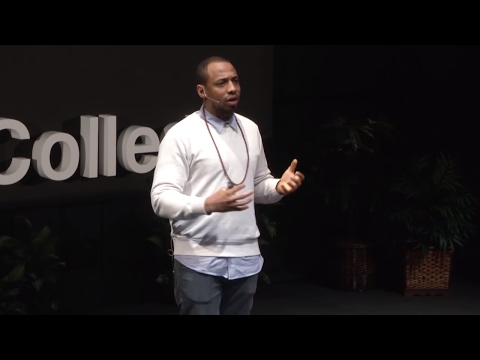
Hello everyone, my name is Old Man Saxon.
I’m a rapper, I’m also a professor of rap
at the Musicians Institute in Los Angeles California.
In July 2013,
I quit my job testing video games in order to pursue music full time;
because testing video games was so hard!
(Laughter)
Needless to say that by July 2014, I was completely broke.
I barely had enough money for gas, let alone rent.
I was officially a struggling artist.
I’m here today to talk about the year I spent living in my car
and the lessons I learned about creating and sharing during that time.
It’s important to know that I made a conscious decision to sleep in my car.
By no means did I have money.
I remember looking at my bank account having 23 cents in the checking account
and then looking at my savings account, and I have 15 cents. and I was like,
“Yeah, I’m glad I saved that 15 cents.”
But I did have a community that would have allowed me to stay
on their couches or in an extra bedroom as long as I need it,
and if I would’ve told my mom,
she would’ve done whatever she could to help me.
She always has.
But I kept it a secret from everyone.
I didn’t want to be a burden on anyone.
If anything, I wanted to be a burden on myself for a little bit.
And at the same time, my friends from college
were taking time off work to travel the world and find themselves.
I was doing the same thing, just on a slightly different route.
In a way, I was manufacturing my own Rite of Passage.
To give you an idea of a typical 24 hours during this time
I would usually wake up in my backseat, sweating.
Because LA is no joke; If I didn’t find a tree to park under,
that meant that the Sun was my alarm clock for the day.
I’d usually spend my days in two places:
one was this gym on Hollywood Blvd., the other was a park on Hollywood Blvd.
I didn’t go far.
The gym and the park felt like home
because I saw a lot of people there in the similar situation I was in.
At the gym, I saw people there for pretty much the entire day,
in the same clothes as the day before; not even gym clothes;
like jeans, and boots, and sweaters.
Not even working out; just sitting in front of their locker room
trying to get out of the sun for a bit and I can understand that.
At the park, where I wrote all my songs for my album,
I saw people sleeping, eating, and changing in their cluttered back seats
Just like I was.
It was weird because, we all knew that we had this thing in common,
but we never talked about it.
We were all kind of alone in our little community.
We were ashamed of our truth.
After the park, I’d go to work in this little restaurant.
I started out washing dishes;
it was great working at a restaurant
because that means I got to eat at least one free meal a day.
But washing dishes, I worked my way up to become a waiter.
And that was a weird dynamic
because I had to put on this smile and act like I cared about peoples’ carbonara,
even though I knew an hour later I’d be driving around looking for a parking spot;
hopefully, under a tree.
After I find it, I’d write some more music but I couldn’t get too tired
because I had to set up my sleeping arrangement, which meant
putting the seats down and hanging up my clothes on the windows
so people wouldn’t be able to see in.
But that didn’t stop the sun from coming in,
so I’d wake up again, sweating – another day.
The scariest part of that time had nothing to do
with sleeping in the back of my car,
It had to do with telling people about my situation.
I mean, there were some crazy times;
but I’ll tell you after the show; catch me outside; how about that?
But the scariest times were telling people.
I would always have to ask someone first, “Where do you live?”,
so that I could say that I lived on the other side of town;
hopefully, some place they weren’t familiar with.
I learned that early because I got caught once:
He was like, “Yo, where do you live?” I was like,”Silverlake.”
“Yeah, me too! Where do you stay?” “A in house… with doorknobs, I think.”
“A Bunch of doorknobs,”
(Laughter)
Whenever my mom would call, I’d have to lie to her, and be like,
“Yeah, I’m staying with a friend,” and that wasn’t true.
So when I started writing this album about living in the back of my car
while I was living in the back of my car,
I was confronted with sharing that
with an audience, a hip-hop audience that’s used to this:
the glamor and glitz of a rapper’s lifestyle;
In the capitalist society that we live in, where you are defined by what you have,
I was in a position where I was defined specifically by what I didn’t have;
I was homeless.
Which is why I don’t use the term, because I think it’s also crazy
to let someone else define what a home is to me.
I had a home, it was a mobile home. It moved, but I had a home.
I felt like I had to lie early in my rap career
to tell a meaningful story, to have fans.
I had lyrics like, “I got money in the bank, everything’s alright.
Let’s go big all night.”
So insecure because I didn’t have money in the bank and everything wasn’t alright.
I realized I wanted to be more truthful with myself.
But telling the truth can be really hard.
And maybe that’s not necessarily true
because the truth is the easiest thing to remember.
It’s actually pretty easy to tell the truth.
It’s sharing the truth that’s hard.
I thought people would perceive me as a failure,
because who wants to listen to a broke rapper?
I thought talking about the daily aspects of my life wouldn’t be good enough.
It wouldn’t be a viable form of entertainment.
But I’m here today to talk about how I was wrong.
I think it’s important to know a little bit about hip-hop history.
Hip-hop was born out of the magnificent ability
of young people to find their voices by using them.
Young people who believed to be human is to have a story to tell,
and to tell that story by any means necessary.
But if you’ve heard a hip-hop hit, you’ve realized
there’s been a huge shift in how rap is being shown these days.
In my opinion,
it’s defined by apathy, consumerism, and comparison,
“I don’t care about anything because I got money,”
“And ‘cuz I’ve got money, I get power,”
“‘Cuz I get power, I get all the women.”
The more extravagant you are, the more likely you are to be noticed.
Like peacocks.
We lost touch with the origins of the music.
We can all agree: money, power, women is something we hear in rap a lot, right?
That’s from the movie “Scarface.”
People don’t know this,
but Scarface is one of the most influential movies in hip-hop culture.
There’s been documentaries made about its impact on the culture.
Hundreds of rappers have referenced him in their songs,
and if you watch any early 2000’s MTV’s “Cribs” episode,
you will see a “Scarface” poster in a rapper’s home; I guarantee it.
One of the main themes of this movie is the connection between acquiring money,
achieving a status of power, and then getting women.
To paraphrase the quote, first you get the money,
then you get the power, then you get the women.
Two things are interesting about this:
one is the idea that first you get the money,
before anything else, you get that money;
second, is the direct and obvious correlation between money and power
as if power is something that happens outside of yourself.
Rappers definitely took notice
because the music became more about the success than the struggle.
In fact, whenever you do hear about poverty in hip-hop,
it’s usually spoken of retroactively; in past tense.
So some of my favorite songs: ScHoolboy Q has a song “Blessed” that starts out with,
“What’s life for a person like me? Livin’ out his backpack every night.
Needed a new place to sleep.” – Needed.
One of Drake’s most popular songs, “Started from the bottom, now we’re here.”
Even Biggie Smalls said,
“Birthdays was the worst days. Now we sip champagne when we thirst-ay.”
These are some of my favorite songs from some of my favorite artists,
I ‘m not going to lie.
I’m not here to say hip-hop’s dead, or there’s a problem with it,
but I think the disconnect for me is that now we’re in a time
where anyone with the ability to rhyme and an Internet connection
can share their music or their story to the public.
But the stories haven’t become more diverse.
More quantity didn’t result in more diversity.
I have two reasons why that is:
one is the idea that people want to speak their fantasies into fruition;
If they talk about the Lamborghini and the girls,
then eventually, they’ll get it.
Second is that people don’t want to seem sad and boring.
Sad, boring people don’t get invited to the party.
We don’t want them here.
I told you before: I teach, am a professor of rap at the Musicians Institute.
I don’t know what that means either, I just show up to work, and they pay me.
No but honestly, it’s a pretty hard job.
I’m trying to make students be themselves
in a genre where authenticity is a major rule that shouldn’t be broken.
So the students come to me with their own, original lyrics.
And I’ll read them and I’ll be like, “You’re like the richest person on Earth.”
“That’s crazy, how do you have all this money?”
But I know that they’re lying because they’re talking about their Bentley,
and their models, and the millions of dollars in their account.
But I know that they’re rushing out of my class to catch the bus home
to take care of their mom before their next shift at Burger King.
They don’t realize that’s their story.
They don’t want to seem boring. They want to get invited to the party.
But in order to get invited to the party, you need to bring something of value.
I feel like one of the reasons we lie – not only in hip-hop but in life –
is that we feel like we’re the only ones in pain.
But they don’t realize there’s a lot of people out there
that could benefit from knowing that they’re not alone.
And because of my students’ wild imagination,
we have this exercise we do in class where I have them write two verses:
one verse where everything is absolutely true;
the other verse where everything has to be a lie.
You can rap about a dragon on rims; I don’t care.
Every time, to this day, I have only loved the true verses.
There’s a unique personal point of view.
These lyrics are about where they went today, how they got there,
what time they woke up, their moms, their jobs, feelings, their broken hearts.
And these stories are way more relatable than the story about the Bentley
because we all have moms and feelings, but we don’t all have Bentleys.
And then I think about what Scarface says, “First you get the money.”
Before anything else, you get that money first.
Then I see the problem my students have with telling their story as is.
They’d rather wait until they achieve this status,
then walk around looking all cool, talking about what they have in present tense.
And I tell them this is not an option.
The big mantra in my class is, “Do not wait.”
Do not wait for your life to be perfect,
until you have arrived before you write and share your story.
My students have a problem with this
because the rags part of the rags-to-riches story
is really unattractive to tell.
Especially for them, in a Facebook generation,
where you only advertise the good parts of your life.
I’m sorry.
So you could imagine when I decided
to write about the year I spent living in my car
that I would be a little nervous
– actually, that was right, you know? –
because I wasn’t talking about how much I had.
I was using my lyrics to showcase the most mundane aspects of my life.
Lyrics like, “Six a.m.- wake up; all alone – like what can your boy say?
Shower; shave is taking the whole day.”
Saying in my song, asking, “Can I use your restroom?”
because that was a common phrase I was using during that time.
Admitting that I was “choked up while I was writing it,”
“Didn’t think my life would get so darn trifling,”
“living like ‘Mice and Men’,”
“Hoping it all gets right again,”
“Looking like I crawled out of a chimney,”
“But I was in my vicinity, hoping they remember me,
but stuck in anonymity.”
These were lyrics that were not about what I had.
I was admitting that I didn’t have money, or what my peers would classify as power.
But something really amazing happened when I released the video.
The video went viral, and I had people from all over the world contacting me,
saying that this too was their life.
That they were sleeping in the back of their car,
working and trying to make ends meet.
From the man who said
he was going to reconnect with his family after ten years of living on the streets
to the woman who said she was five months pregnant
sleeping in the back of her car with a full time job,
to the man who said he was contemplating suicide
until my music helped him through this dark time.
I told you the reason I think we lie
is because we feel like we’re the only ones in pain,
but these are real reactions from real people
that make me feel less alone
and more confident to speak my truth and be accepted when I do.
I can only imagine this increasing the quality of my music
and deepening the trust in my spirit and myself,
and proving that the risk was well worth it.
I use to think my story wasn’t valuable because it wasn’t like everyone else’s.
But that’s crazy, because now I realize my story is valuable because it’s unique.
Think about how we consider collector’s items valuable
because there’s not a lot of them made.
My story isn’t boring, it’s a collector’s item, that’s what it is.
I think that living in my car was probably
one of the most selfish things I’ve ever done,
but sharing this experience is probably the most selfless.
It’s a true mashup that explores my rite of passage from a boy to a man
and growing up from a fan to an artist in my own right.
By doing this,
I saw the beautiful alignment between what I do, say, think, and feel,
and that is an amazing feeling.
I know the TEDx audience doesn’t encompass everyone in the world,
but if I were to give a piece of advice
that wasn’t just for rappers and storytellers,
it would be that to understand there’s beauty in the mundane.
How you perceive a situation goes hand-in-hand
with how you experience that situation.
I spent a year sleeping in my car,
changing in the backseat, and using only public restrooms,
and I considered it one of the best times in my life.
I realized that the common denominator in all of my experiences is me.
I realized that the more personal the story, the more universal.
That the more terrifying something is to say, the more impact it will have.
And maybe, the more resistance you have to something,
the more you should pay attention to it.
This experience makes me
want to help my students who don’t want to tell their story
because they want to get invited to the party.
I say to them, and to you,
“Do not wait to get invited to the party.
You are the party.”
Thank you.
(Applause)
Please follow and like us: