
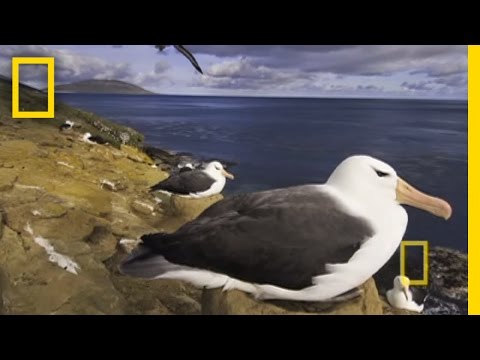
I’m privileged to be an observer to you
know spend time at these spectacular
Birds and I feel I have a responsibility
to share what I’ve come to understand
and appreciate about these birds and
take that knowledge back and use the
images as windows into a world that most
people will never see that means
spending time with animals up close the
more time I can spend or I understand
about these animals lives and the more
intimate that relationship becomes and
it’s really no different from the way
photographer who focuses his camera or
people operates it’s all about building
a relationship and having empathy for
your subject and understanding your
subject and ultimately you need to be
able to be like a fly on the wall you
need to be able to be transparent and I
like to slowly ease my way into
situations until the albatrosses don’t
pay the attention to anymore they’re too
busy with one another I try to put
myself in the position of the animals
that I’m working with and that means
that yeah I adopt another perspective
and then I’m an albatross sitting on a
nest and I’m approached by a large
mammal that stands 5 feet tall I would
be concerned so instead I try to make
myself small I crawl around him I move
very slowly
I don’t flail my arms and I give him
time to get used to my presence and
without speaking to that bird I can
indicate that that bird shouldn’t have
to worry about me because you know I’m
respectful
I’ve always been interested in
photographs I’ve looked at pictures in
the National Geographic since I was a
boy growing up in Holland but the idea
that I could become a photographer
myself didn’t occur to me until I was in
my 20s and at the time there were not so
many role models so I taught myself
photography I never went to school I
also trained myself to become a
naturalist I don’t have any background
in biology so I’m self-taught but even
today it is very hard to point to a to a
course at a university or in any other
school where you can go to study how to
become a natural history photographer it
is really all about doing it in the
field sometimes I work alone but more
often I do the fieldwork with my wife in
partner Christi next to him was a former
staff writer at National Geographic and
now she mixes up her fieldwork between
writing and capturing images with video
cameras so we are an unusual team in the
field but we also work with biologists
quite often we work with people involved
in conservation projects we work with
people who know situations very well on
the basis of living in a certain place
for very long so it can
be a very simple process of me sitting
in front of one albatross or it can
become a very complex situation you
don’t find albatrosses near 5-star
hotels and so the conditions in the
field can be pretty rough but you know
whatever it takes I do I spent a lot of
time camping out in tents on windswept
lonely islands and for this albatross
project I even ended up spending time in
a shipping container that this had the
only shelter that existed on that island
that enabled me to stay close to the
elders office when I was in my early
twenties I came to the United States and
I hiked around and I discovered the
phenomenal beauty and the wilderness of
the western United States and that was a
real eye-opener to me and I also
discovered photography as it had become
a tradition in the United States the
great wilderness photographers Ansel
Adams and Edward Weston and then Bullock
and Philip Hyde in quite a number of
others and in Europe we did not have
such a tradition and that is when I
realized that there was a artistic
tradition that I could perhaps become
part of
I’m inspired by how artists in the
deserts of Australia have come to
portray landscapes and I’ve also been
inspired over the years by how painters
and poets in China and Japan have
portrayed the world or now I look at the
way European wilderness and wildlife
painters deal with their subjects on
canvas all of those different points of
view have inspired me over the years and
sometimes they’re implicitly my images
and other times they are actually
resulting in images that have a very
clear affinity with a particular
artistic or cultural tradition I try to
tell stories about the natural world
using sequences of images and a National
Geographic we know how to do that you
know there’s a tradition that spans more
than a century and the editors at the
National Geographic have worked at it so
many photographers in so many subjects
over the years that a unique tradition
of working with photographs for the sake
of telling stories about the world has
been nurtured here and I’ve become part
of that tradition and you know after all
these assignments that I’ve done for the
magazine I’ve internalized that process
and now when I go out I don’t have to
think about it much anymore it’s just
becoming second nature to me what many
people don’t realize is how much work
and expertise goes into producing these
photo stories and covering a subject for
the National Geographic they think you
know I have the greatest job in the
world
which indeed I have but they think that
all you have to do is show up at a
camera of and the Sun is going down and
you make some pictures and that’s it
there’s a huge amount of work involved
in researching a subject and then
planning the expedition’s and then
developing relationships with people on
location and understanding that there’s
a whole socio economic and cultural
context that there are always
environmental issues which cry out to be
covered and made part of a coverage so
it’s very complex and at the end of an
assignment like this albatross project I
know as much as anybody about it and so
I’m not just a photographer I need to be
able to converse about the subject I
become the storyteller and I become an
ambassador for albatrosses
Please follow and like us: