
say that it is difficult to find a
needle in a haystack now would you agree
to that so I actually want to start with
using your brain I’m sorry for that so
let us imagine that all of us maybe some
of you are but let’s we are all
engineers now and we’re in an
engineering an engineering company and
the boss comes in i says i have this new
cos newer customer and he needs to he
needs to find needles in a haystack and
that’s his problem and you need to solve
it you need to solve it you need to come
up with a strategy of how to do that how
can you find a needle in a haystack can
I have any suggestions please magnet
magnet magnet all rights problem solved
in one second so was it that difficult
no so even seemingly very difficult
problems you can solve sometimes it very
easy solutions but problem we’re
tackling that is my team and the teams i
work with in belgium they are way way
more difficult than finding a needle in
a haystack diagnose influenza from human
we can expect that persons with
influenza in their normal breathing that
it will breathe out influenza particles
viral particles and we have reasons to
believe that a typical patient may
perhaps breathe out one viral particle
per breath of air so what we would like
to do is to find that particle in that
breath of air and identify it as being
influenza virus and as such diagnose the
patient there’s only a little problem
and that is the virus is very very small
actually it’s about 100 nanometer across
and that’s very little that is about
1,000 atoms and first I want to try to
explain to you how small that actually
is so let’s compare the problem of
finding a virus in a breath of air with
finding a needle in a haystack and yes I
am an engineer so I like to put numbers
on things and so I can try to do that
and I can see if I compare the volume of
this viral particle with the three
liters of air that you breathe out
compare it to the volume of a needle in
a haystack I see that our promise
roughly 30 billion times more difficult
so to give you an idea actually how
small such a particle is it’s hard to
say because hundred nanometer we have
few few people of us have actually an
idea of how small that is but what if we
would try to actually scale up things we
make everything a thousand times more
wide and a thousand times more high and
it tells times more deep so we’re 1
billion times up scaling in volume now
our three liters of breath that we have
become 3 billion liters of breath that’s
huge and we see actually three billions
of litres of breath that actually that
is the volume of the largest indoor
space ever built by humans this is a
picture of a Zeppelin hangar in Germany
been turned into a tropical holiday park
you can see it has an artificial sea and
the little black dots you’re actually
human swimming in it so it’s a huge
space or virus we have also also scale
it up 1 billion times and now actually
it becomes as big as the tip of a human
hair so we need to find the tip of a
human hair in this huge hole it’s
somewhere there this one
over here it can be in the water or in
the ceiling we don’t know but we try to
find it that’s the scale of the problem
we try to tackle but with a few clever
engineering solutions we think we can
actually do that this is the instrument
that we’re trying to tackle it with and
this is a picture also of Gaspar my
former PhD student that made that
prototype I have with me an actual
prototype a more recent one printed by
another PhD student of mine Lila and
this one is actually tried out in the
primary care unit in Belgium so the idea
is that you breathe in to this
instrument and that this instrument will
actually trap the viral particle and
detectors as such so how could we do
that well let’s take a step back and
look at what actually do we breathe out
as humans we breathe out three liters of
air and what is two liters of air that
we breathe out well the most of it is
just gas it is nitrogen its carbon
dioxide it is water vapors or their
glasses but also there are small tiny
aerosol droplets and every breath of air
typically have a few tens of thousand
one hundred thousands of very tiny
droplets of water that you breathe out
there are too small to see they’re only
a micrometer and size so they really
really small but the virus the one virus
in in one of these hundred thousand that
will be likely one virus and that virus
will probably be in the droplet and not
in the surrounding gas so if we can
start with collecting all these little
droplets together we have already a huge
huge of concentration I solve the big
part of our problem so that’s the first
thing we’re going to do try to collect
the iris or droplets and how does that
work let’s have a look inside the
instrument if you want that can in the
next breakout you can have a real look
at a real instrument out looks like you
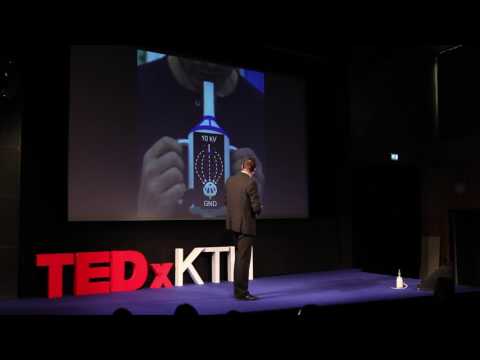
will see that in the top of the
instrument you’ll find one or number of
sharp needles and these needles we put
at very high voltage 10 kilo volt what
happens if you put a very sharp object
at 10 kilo volt is that electrons in the
tip really they’re all crammed together
and they don’t like that so they jump
out and they start ionizing the air
around them and the ions will bounce
into everything in the air and very soon
the three liters of air that you breathe
through this instrument gets ionized so
everything in the air gets charged so
the hundred thousand aerosol particles
or become
charge little water droplets they’re all
at a few thousand volts and then at the
bottom I have a little holder here I
have one of those in my hands here it’s
a few millimeters big it’s a little Kate
we call it the cage collector and in
that we put a little droplet of water
200 microliter of water and it’s
grounded electrically so all this
charged particles flowing down this
instrument they get attracted to this
ground and so they try to fly into the
into this collector and gets actually
absorbed in this little liquid volume so
now what we have done is we have reduced
our problem from finding a particle here
a virus particle in a hangar to finding
it in this little pile here sorry from
in front in the 3-liter into the little
collector here and so if i compare that
now i just need to find my human hair in
a volume as big as two standard shipping
containers which is where we easier than
trying to find it in a Zeppelin hangar
still very difficult so we have to do
some more steps next thing we do is well
let’s have a look at the viral particle
itself this 100 nanometer object so
beautiful artificially colored pictures
of such an object and you see the purple
thing in the middle here that’s a
nucleic acid that’s actually what
determines how the viral particle looks
and what grades of the particle but it
can also see this tiny little brown dots
here around this these are called
nuclear proteins so if I ask my patient
to breathe into this instrument for
about the minute i’ll likely capture
something between 10 and 100 particles
and what I do with this particle is that
I break them open we call that lysis the
virus break it open and release all the
little nuclear proteins that are in
there in the viral particle and now they
are swimming in this liquid volume so
we’ve gotta have 100 virus particle
wheel covers about 100,000 of these
nuclear proteins and so and these
nuclear proteins they swim around and
these are going to catch because what we
also put in this little vial up front is
little bullets little magnetic beads
these little magnetic beads are very
small they’re also only 23
micrometer-sized and they’re specially
treated so we have coated those with
something that we call an antibody that
protein that binds very specifically to
these nuclear proteins so what happens
we have a million of these little beats
swimming around here and I have a
hundred thousand of these nuclear
proteins and I mix it shortly and what
happens every time a nuclear protein and
a beat meet devil by to each other very
specifically and they get stuck and they
don’t let go from each other so very
soon oldest nuclear proteins that I had
this hundred thousand get bound unto one
of these 1,000,000 magnetic beats and
what do I do next is that I take these
magnetic beads and I flushed them over a
surface a specific specifically made
surfaces the surface made by another
student of mine whose name is razr and
razr has very tiny fingers no he doesn’t
but he makes very tiny wells he makes
tiny wells also of the size 2.83
micrometer-sized that is smaller than
your blood sauce these are very tiny
wells and so if we flush this liquid
over these wells and we put a magnet
under here all these little beads here
there will be sucked down in this well
so I populate every well with a beat and
I’ll some of course some of these well
have a beat that has a nuclear protein
and but most don’t actually have a beat
without a nuclear protein because
typically are only would have one beat
ten beats per nuclear protein so I trap
them in little else and then I can see
that this every little well I can
consider as being a bio chemical reactor
very tiny one but basically a chemical
floss I know I can do chemistry in every
of these wells oh by the way we call
this femme two liter wells FM two liter
well array or so femme two liter you
know you have a liter milliliter
microliter nano liter pickle eater fanta
liter yeah that is a millionth of a
billionth of a liter and every well
about but we use them as little chemical
reservoirs and we do chemistry on them
and the chemistry we do is that if there
is a beat with a nuclear protein there’s
a catalytic catalytic reaction going on
that turns this well fluorescent so I
let it react and after the reaction is
done I just put this well plate under a
microscope or on top of microscope and I
simply look which of the wells light up
and we do not
light up so every well that lights up
has captured the nucleoprotein and the
ones that did not light up don’t have a
nuclear protein and now I can just
simply count how many light light
applause do i see so and i can calculate
back how many viruses that i have and
this information you can give to a
doctor who hopefully can put the
diagnose so what we did is we captured
three liter or they’re in our machine
captured it the virus is down to a
little collector with lies the virus
release the nuclear proteins captured
them back on these magnetic beads see
the dome on the speaker at the Santa
liter well array and then looked at the
fluorescence and that gives us the
answer and now what can we do with this
technology what do we think we will use
it actually for well we think there’s
two main applications when it comes to
influenza that we can use this for the
first is companion diagnostics and
companion diagnostics are diagnostic
that are specifically for a specific
drug so there are a lot of drugs
developed nowadays antiviral drugs they
can be very expensive they can cost
thousands of dollars per dose and so
before you give such an expensive drug
to a patient it will be hopefully well
you would only give it to very severely
ill patients that has a risk of dying
and then you want to notice that patient
really have influence and then perhaps
our tests can find that out before you
give the drug another example where we
can use it and where the pharma
companies are very interested in is in
the triage of for clinical trials so
when you develop novel drugs first you
have your compounds that you sort out
first you’re going to test them on cell
cultures after that on mice maybe on
another animal on a few humans and if
everything goes fine in every step you
come to the step where you need to try
it out on a larger population in a
clinical trial and these clinical trials
they tend to be hugely expensive people
from the pharma industry tell me that
per patient they enroll in such a trial
it cost them 50,000 dollars now you need
to know that one trial can need thousand
two thousand three thousand persons so
what they would like to have is for
people with respiratory infections
before they enroll them in this trial if
they could have this quick test here and
actually determine does the patient
really have influenced a yes or no
before I enroll them and I have this
huge cost
good well i hope i have showed you that
with our micro and nanotechnology we’re
actually solving problems that seem
impossible but are not really impossible
to solve I hope I’d show you how that is
possible and I want to thank actually
all my collaborators Belgium and in here
in Sweden and I want to thank you the
audience for your patience [Applause]