
guys have to help me out a bit what are
the common or what is the common factor
in this image can anyone tell me I can’t
see anyone so shout it out humans people
true but the common factor in this image
is that they all share one thing more
prominently than anything else and that
is their passion for technology I wanted
to showcase the many faces that we have
around the globe some of these faces
have actually paved the way for
technology to blossom in their
communities others have actually
revolutionized it we usually have
prejudices and perceptions in which we
actually preference a certain gender or
race and this is what I would like to
talk about I’d like to talk about
first Who am I accept this beautiful
introduction that I won an award I
decided to create with some other of my
colleagues a foundation to help refugees
but I actually have a story that has
shaped my present and also shapes my
future and it has to do with the way I
was born I was born as a refugee as a
Kurdish refugee at 5 years of age I
finally landed in Sweden there’s a long
road when I came to Sweden a few years
later I reached my teenage years and my
passion for computer science woke up I
thought I’d conquer it and I started a
course I pretty much sucked at it
and then I decided that I don’t think
this is really my thing
so I moved on fast forward a few years
Tranmere of the matrix I don’t know if
you guys remember that movie that was
the best movie ever and I walked out of
there thinking I’m gonna do that that
special effect I’m gonna do that and I
started to studying graphic design and
special effects the whole purpose of
that course was to learn how to do a
laser sword online really didn’t go very
well there either so fast forward
graduated I left the country I ended up
in the MENA region Middle East
I spent approximately roughly around ten
years traveling around the world ending
up mostly in honeymoon destinations of
conflict zones and that was also to find
myself find my history and understand
what’s happening in that region why did
we leave it in the first place I found a
lot of things among them was to
understand inequality inequalities are
one of the driving forces in insecurity
around the globe it also shapes
prejudices and perceptions of other
countries outside our sphere so I’d like
to take up a few of these examples of
what countries that we perceive look
like and what realities they have to
start off with decided to land in Africa
and choose Kenya as much as the first
image shows a country that is tarnished
by poverty and under development it
actually also has a ravishing
development it is one of the fastest
growing economies in Africa and it’s
rapidly growing in terms of business and
tech another example of areas where we
know less about Fran’s dance Indonesia
history tells us it has been tarnished
by Civil War
ethnic cleansing and in Justices with an
agriculture
that is commonly known for
underdeveloped countries but there’s
also another reality to it
and that is the reality of being one of
the largest growing tech hubs in the
world for startups it has a stronger
economy than it had 20 years ago and it
keeps rising
the third example we move on to a Middle
East Iran one of the u.s. favorite
subjects and Israel’s as well we usually
see less and less about the countries
boom but we hear more and more about the
under development areas of it while it
has that reality it also has another
reality it is one of the most intense
research countries in the world with
science being one of the primary goals
in addition to that it has a growing and
a very strong export industry of
commodities so why am i bringing these
examples up of countries to address
perceptions we always believe that we
know that innovation technology
education grows the best in developed
areas but we underestimate the
developing country strengths and
experiences therefore I’d like to take
three examples of countries in those
regions in which local initiatives and
local needs and problems and challenges
have been addressed in a very
interesting way allow me to introduce to
you a project out of Ghana Ghana had a
challenge after the Ebola virus in which
lack of access to health care and
information to recognize symptoms caused
a lot of loss of lives this led to a
crew of people who decided to do
something about it find an alternative
way there is a challenge with
stigmatization of STDs in Africa
specifically in Ghana in which fear of
coming out and
asking for help makes a lot of people to
stay at home in addition to poverty
which makes them not being able to
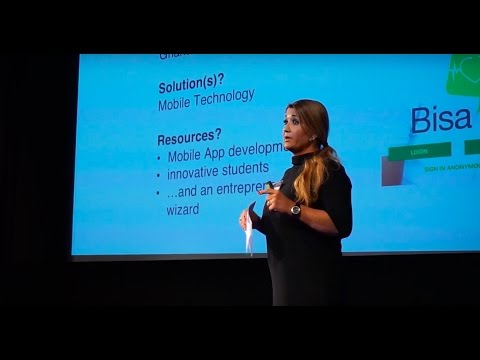
access health care the solution one of
them was to create an anonymous way of
avoiding also taking the step to a
doctor by using mobile technology a very
interesting guy by the name of Randolph
came up with an app called bisa it’s the
it’s the the name of basically
definition of it is called asked by
developing this app he also saw another
challenge he created a small team of
innovative students and used basically
an entrepreneurial step spirit in order
to create an app that is accessible to
everyone in Ghana and also neighboring
countries where they can actually have
direct contact with a medical
practitioner to address their symptoms
and diagnosis leaving Ghana and going
over to Bangladesh Bangladesh has a big
problem and a challenge of browning over
20,000 people every year drown due to
lack of swimming fifty children every
day drown because they cannot swim local
NGOs tried their best by teaching out
how to swim wasn’t enough so a team of
five innovative students came up with
another concept if we can’t teach them
to swim let us at least equip them and
they came up with a very very simple
innovative solution simple wristband a
balloon and a great thinking the third
project came out of Jordan the refugee
crisis of Syrian war a lot of victims
lost their limbs had limited or
basically zero access to health care and
prosthetic prosthetic limbs due to the
cost and the distance to healthcare
facilities
a guy called awesome husna was a former
paramedic volunteer they decided to help
his fellow citizens but lost his leg
along the way he ended up in Jordan met
a team of well one heck of a Kickstarter
project and collaborated with them on
how to solve this problem the cost of
one piece of the the prosthetics usually
lies around $35 they managed to reduce
it with a 3d technology for $1 so they
solved affordable solutions with very
fast learning curve
he actually programmed his own leg
within three days of ending up there and
started spreading the word spreading the
knowledge to others he’s in Berlin now
having a good life teaching out and
so why am I talking about these projects
and trying to highlight the need of
seeing the diversity out there
the innovative thinking it’s because in
some of these countries with all the
limitations and all the restrictions and
all the lack of resources there’s an
incredible willpower and there is an
incredible drive to create something to
solve local problems what I’m trying to
do is not only show the diversity but it
also brings us back to why I ended up
here today a year ago exactly I was part
of a large team that helped thousands of
thousands of thousands of refugees
within my own team the volunteer crew we
had diversity we used each and every
single person’s competence they were
refugees themselves there were Swedish
citizens and they came from all walks of
life but we also noticed one thing how
technology became a survival tool it
helped them to find their way to avoid
the gates to avoid the border controls
and to avoid danger and reach sanctuary
this goes back to
the next subject the world as we see it
is not fair and it’s not really just and
it’s definitely not equal we are bound
by geographical borders that are not
natural
we’re also seeing that some passports
are more valued than other passports
some races are more privileged than
others when you look at the internet you
don’t see any geographical borders you
see a lot of potential this is the
potential I would like to hire highlight
if you have all these opportunities and
technology is unlimited my interest in
seeing the technology being used to way
exchange of ideas exchange of
experiences and exchange of
collaboration it doesn’t take much to
take that one step forward and try to
explore the opportunities out there you
have no borders and you have no limits
so I’d like to leave you with a few
closing words from a favorite quote by
dr. Martin Luther King you all know this
one I have a dream I’d like to go take
it a bit further and say I might be able
to do it but together we can get one
step closer and making it thank you for me