
just like a diamond is valued by its
foresees pearls have their own valuation
system hi I’m Veronica the watchmojo.com
and Laura from Laura Allen is showing us
how pearls are graded and valued
how are pearls valued well generally
there’s five things to take into
consideration when buying pearls you
have to consider the shape you have to
consider their size their shine their
surface and their shape if we’re
shopping for pearls is there any way to
find out if they’re not genuine
definitely there’s a few a few methods
of knowing one’s pretty funny I mean
it’s you shouldn’t do this in front of
the the salesperson but one way is to
rub the Pearl against your tooth and you
if you feel this grindy kind of feeling
you know that it’s real but if it slips
then you know that it’s fake other than
that you can rub the pearls together and
if they slide you’ll know that it’s a
synthetic pearl and if you feel that
sandy kind of feeling you know that’s a
genuine pearl so right now do you think
you could take us for a closer look at
each of the esses yes absolutely we can
start with the shape of the pearl if you
like so we’ll begin with shape shape
plays a role in determining the price of
pearls usually the more perfectly round
the pearl the more expensive the Perot
throughout history pearls brown pearls
were generally considered the most
valuable and expensive because they were
a symbol of the moon but today pearls
perfectly round pearls are still
considered very valuable and expensive
but there are the not so perfectly round
pearls which are considered just as
valuable so this would be an example of
a round pearl this is as you can see so
symmetrical and it’s considered the most
valuable and the most expensive out of
all the pearls semi barak are considered
to be more irregular and more imperfect
examples of that would be egg shaped
pearls button shaped pearls pear-shaped
pearls and circular shaped pearls in
this store we often use the circular
shaped pearls I feel that they’re
beautiful and they add quite a pizzazz
as you can see here all the Tahitians
are circled there’s grooves going around
the pearl which also gives it an
exquisite beauty next we have the broad
pearl these are more distorted and again
very regular what I’m wearing here is
considered a freshwater baroque pearl
there’s beauty to be seen an
imperfection and this is one of my
favorite shapes to wear next we’ll talk
about size pearls can be as small as two
millimeter in size and can go up as high
as 20 to 25 millimeter in size but
that’s also very very rare over here we
have a pearl that’s 5 millimeter in size
and then this is as big as 15 to 17
millimeter in size when pearls reach the
eight to nine millimeter mark which is
this size pearls really jump high up in
price
second important factor is that when a
large amount of pearls of the same size
are harvested the cost will go down
third is supply and demand when there’s
a high demand for the same sized pearls
the cost will definitely go up and
fourthly another very important factor
is that saltwater pearls are created in
oyster and oysters only create one pearl
at a time and to be able to assemble
entire necklace of the same sized pearl
and shape is very very rare and could
take many many years hence the reason
why they’re very valuable and expensive
next is shine usually the deeper and the
more lustrous the pearl is the more
valuable it is when a pearl is created
what happens is that it becomes
threatened by a parasite or foreign
object that enters the shell and by
protecting itself it’s decreased what’s
called mother of pearl and it’ll just
keep layering itself and as it layers
itself it becomes more lustrous so
essentially the longer a pearl remains
in its shell the more lustrous it’ll be
for example here I have freshwater
pearls which don’t have such a high
luster I mean often these pearls are
examined under a specific light but to
the naked eye you can tell that these
don’t have the highest luster this is a
mix of South Sea pearls and Tahitian and
as you can tell it’s just very very
vibrant to be able to collect pearls of
this luster together it can take years
next we’ll talk about the surface of the
pearl the fewer the flaws and blemishes
on a pearl normally they are considered
more valuable but again there are pearls
with great imperfections that are just
as valuable and desirable in essence
there is no perfection in nature and
again these are created by a
and there is something to appreciate in
all in all the pearls whether they have
blemishes or no blemishes and here I can
show you an example of a strand of
pearls and these are considered to have
no blemishes at all and then here we
have a strand of Tahitian pearls which
do have blemishes and flaws but again
there is beauty and imperfection and I
think it gives it a very exotic and
natural feel lastly we’ll talk about the
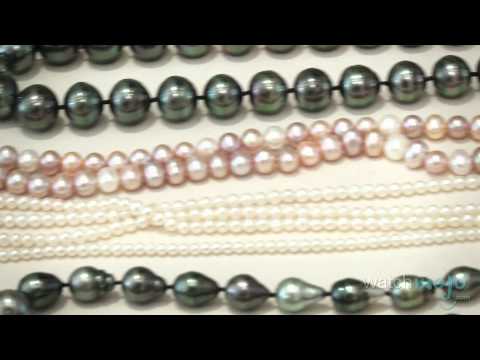
shade of the Pearl pearls come at an
array of all sorts of beautiful natural
colors to start off with Tahitians
they come in shades of blacks Browns
grays greens but the most desirable
color Tahitian is what’s known as the
peacock color and it possesses colors of
the peacock feather here we have a
Tahitian necklace with peacock colored
pearls and you can see there’s hues of
Pink’s greens purples which is really
exotic and different next we have South
Sea pearls they come in shades of creams
golden colors and grayish tones lastly
we have the freshwater pearls as what
I’m wearing here they come in white
creams pinks violets here we have a
strand of freshwater pearls and you can
see there’s different hues of pink
there’s orange II colors and ivory as
well and all these pearls are all
natural occurring colors anything other
than that would be considered guide so
these are the five s’s of pearls and
next time when you walk into a jewelry
store to buy pearls you know what five
important s is to take into
consideration
foresees pearls have their own valuation
system hi I’m Veronica the watchmojo.com
and Laura from Laura Allen is showing us
how pearls are graded and valued
how are pearls valued well generally
there’s five things to take into
consideration when buying pearls you
have to consider the shape you have to
consider their size their shine their
surface and their shape if we’re
shopping for pearls is there any way to
find out if they’re not genuine
definitely there’s a few a few methods
of knowing one’s pretty funny I mean
it’s you shouldn’t do this in front of
the the salesperson but one way is to
rub the Pearl against your tooth and you
if you feel this grindy kind of feeling
you know that it’s real but if it slips
then you know that it’s fake other than
that you can rub the pearls together and
if they slide you’ll know that it’s a
synthetic pearl and if you feel that
sandy kind of feeling you know that’s a
genuine pearl so right now do you think
you could take us for a closer look at
each of the esses yes absolutely we can
start with the shape of the pearl if you
like so we’ll begin with shape shape
plays a role in determining the price of
pearls usually the more perfectly round
the pearl the more expensive the Perot
throughout history pearls brown pearls
were generally considered the most
valuable and expensive because they were
a symbol of the moon but today pearls
perfectly round pearls are still
considered very valuable and expensive
but there are the not so perfectly round
pearls which are considered just as
valuable so this would be an example of
a round pearl this is as you can see so
symmetrical and it’s considered the most
valuable and the most expensive out of
all the pearls semi barak are considered
to be more irregular and more imperfect
examples of that would be egg shaped
pearls button shaped pearls pear-shaped
pearls and circular shaped pearls in
this store we often use the circular
shaped pearls I feel that they’re
beautiful and they add quite a pizzazz
as you can see here all the Tahitians
are circled there’s grooves going around
the pearl which also gives it an
exquisite beauty next we have the broad
pearl these are more distorted and again
very regular what I’m wearing here is
considered a freshwater baroque pearl
there’s beauty to be seen an
imperfection and this is one of my
favorite shapes to wear next we’ll talk
about size pearls can be as small as two
millimeter in size and can go up as high
as 20 to 25 millimeter in size but
that’s also very very rare over here we
have a pearl that’s 5 millimeter in size
and then this is as big as 15 to 17
millimeter in size when pearls reach the
eight to nine millimeter mark which is
this size pearls really jump high up in
price
second important factor is that when a
large amount of pearls of the same size
are harvested the cost will go down
third is supply and demand when there’s
a high demand for the same sized pearls
the cost will definitely go up and
fourthly another very important factor
is that saltwater pearls are created in
oyster and oysters only create one pearl
at a time and to be able to assemble
entire necklace of the same sized pearl
and shape is very very rare and could
take many many years hence the reason
why they’re very valuable and expensive
next is shine usually the deeper and the
more lustrous the pearl is the more
valuable it is when a pearl is created
what happens is that it becomes
threatened by a parasite or foreign
object that enters the shell and by
protecting itself it’s decreased what’s
called mother of pearl and it’ll just
keep layering itself and as it layers
itself it becomes more lustrous so
essentially the longer a pearl remains
in its shell the more lustrous it’ll be
for example here I have freshwater
pearls which don’t have such a high
luster I mean often these pearls are
examined under a specific light but to
the naked eye you can tell that these
don’t have the highest luster this is a
mix of South Sea pearls and Tahitian and
as you can tell it’s just very very
vibrant to be able to collect pearls of
this luster together it can take years
next we’ll talk about the surface of the
pearl the fewer the flaws and blemishes
on a pearl normally they are considered
more valuable but again there are pearls
with great imperfections that are just
as valuable and desirable in essence
there is no perfection in nature and
again these are created by a
and there is something to appreciate in
all in all the pearls whether they have
blemishes or no blemishes and here I can
show you an example of a strand of
pearls and these are considered to have
no blemishes at all and then here we
have a strand of Tahitian pearls which
do have blemishes and flaws but again
there is beauty and imperfection and I
think it gives it a very exotic and
natural feel lastly we’ll talk about the
shade of the Pearl pearls come at an
array of all sorts of beautiful natural
colors to start off with Tahitians
they come in shades of blacks Browns
grays greens but the most desirable
color Tahitian is what’s known as the
peacock color and it possesses colors of
the peacock feather here we have a
Tahitian necklace with peacock colored
pearls and you can see there’s hues of
Pink’s greens purples which is really
exotic and different next we have South
Sea pearls they come in shades of creams
golden colors and grayish tones lastly
we have the freshwater pearls as what
I’m wearing here they come in white
creams pinks violets here we have a
strand of freshwater pearls and you can
see there’s different hues of pink
there’s orange II colors and ivory as
well and all these pearls are all
natural occurring colors anything other
than that would be considered guide so
these are the five s’s of pearls and
next time when you walk into a jewelry
store to buy pearls you know what five
important s is to take into
consideration
Please follow and like us: