
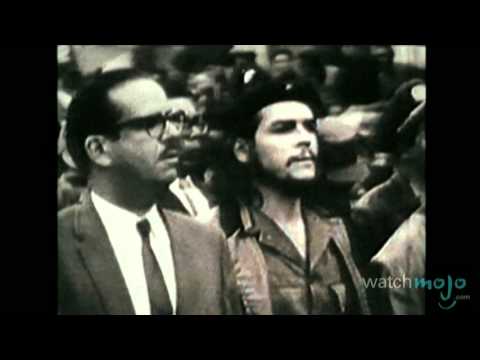
he was che total de los artifact tous
thermonuclear yeah poi amo la
celebración de una conferencia de todo
lo spices el mundo para llevar a Cabo
estas aqui ratio Nessarose well welcome
to watchmojo.com and today we’re
learning more about the life of che
guevara Ernesto Guevara was born June 14
1928 in Rosario Argentina as a child he
was exposed to politics by his leftist
parents and the diverse books in his
family library despite his athletic
abilities Guevara studied medicine at
University in the late 1940s as a
student he embarked on several trips and
had his eyes open to the
poverty-stricken conditions of his
fellow Latin Americans Guevara soon
decided that the key to a better future
for Latin America was a continent
without borders or boundaries and in his
eyes this could only be achieved through
armed revolution as a result after
getting his degree in the early 1950s
Guevara abandoned medicine and turned to
politics Guevara then took interest in
the efforts of Guatemalan president
cocklebur or Ben’s who was trying to
cause change by implementing new social
policies Guevara headed to Guatemala in
late 1953 to participate but ultimately
the United States helped the Guatemalan
military overthrow the arbenz government
in 1954 despite this loss the experience
reinforced Guevara leaf that only a
socialist revolution can end imperialism
during this time Guevara earned the
nickname shade due to his frequent use
of the sing which roughly translates to
bro che soon relocated to Mexico City
where he met future Cuban leader Fidel
Castro and his brother Raul who were
members of the 26th of July Movement
that revolutionary organization was
assembling a rebel army to bring down
Cuban President and dictator Fulgencio
Batista after joining their cause
Guevara became proficient in guerrilla
warfare and built a reputation for being
a merciless military advisor who never
thought twice about punishing traitors
following a botched attempt at
overtaking Cuba in 1956 the armed
radicals succeeded two years later
Guevara and his troop
ultimately won the battle of Santa Clara
and set the stage for Batista’s
resignation in 1959 Castro became Cuba’s
prime minister and put Guevara in charge
of the fate of the war criminals at La
Cabana fortress as commander Guevara
evaluated the appeals of traitors and
other prisoners and dispensed his
version of revolutionary justice by
sometimes having detainees executed by
firing squad once he became heavily
involved in the development of Cuba’s
agricultural reform policies Guevara was
appointed Minister of Industries of the
National Institute of agrarian reform
and presided over land redistribution
after also becoming finance minister and
president of the National Bank he
implemented various economic initiatives
that stressed moral rewards over
material ones but these proved
unsuccessful during this period Guevara
straining of the Cuban army helped block
the American attempt to overthrow Castro
in the Bay of Pigs invasion Guevara also
aided in the development of strong ties
between Cuba and the USSR and
contributed to the plans to place Soviet
nuclear missiles in Cuba ahead of 1962 s
Cuban Missile Crisis throughout the
1960’s Guevara shared his political
views by visiting several countries and
publishing two books one of which
discussed his Marxist leanings and the
Cuban Revolution while the other dealt
with guerrilla fighting but his growing
condemnation of the Soviet Union and his
subsequent alignment with communist
China put him at odds with Castro by
1965 Guevara decided other countries
could benefit from his vision he and
several Cuban guerrilla soldiers poured
their efforts into resolving the Congo
crisis the next year he went to Bolivia
to establish the foundations of a
revolution however both he and his
guerrilla army encountered numerous
obstacles including unaccommodating
local rebels the failure of Guevara
Liberation Army ultimately came at the
hands of a special team of Bolivian
combatants trained by CIA hired Cuban
officer Felix Rodriguez after attacking
his army the group captured Guevara and
gave him to the Bolivian military for
questioning on October 9th 1967 they
executed him
as remains were presumed lost for thirty
years until they were discovered in a
mass grave and buried with military
honors while some see Che Guevara as a
heroic guerrilla fighter others believed
he was a heartless man who never
hesitated to incite conflict either way
his likeness is an enduring pop-culture
image that solidifies his status as an
unrivaled figure of rebellion and
revolution
Please follow and like us: