
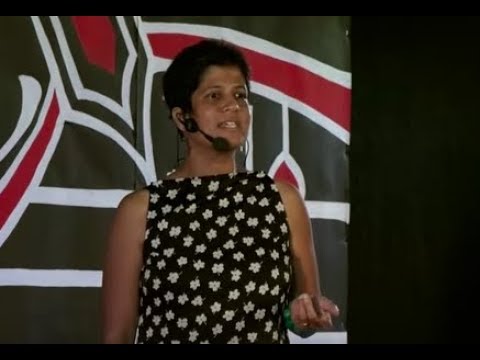
I’m not a teacher by profession nor do I
have the skills to teach and yet my
tryst with teaching began with my
neighborhood children I live in a modest
housing colony in pancham which has
about 70 families and I often play with
them in the evenings so one day I found
them very upset very dejected and very
angry and when I inquired what was the
problem
they mentioned to me that a few adults
were not letting them play and what were
the games football and cricket because
they were considered to be very
boisterous they were also not allowed to
make loud sounds because apparently that
disturbed the tranquility in the colony
so what did we do I asked them whether
they would like to come with me to
explore the outdoors at that point I was
also spending a lot of time with my
husband and children you know doing
bird-watching on nature trails or just
exploring various parts of Goa this is
my backyard this is my classroom I spent
a lot of time here and the children were
excited to come along with me so on the
first day we went to the nearby fields
and the wetlands and we just walked
along they were armed with their cameras
with little notebooks and as we walked
along I just pointed out to a few plants
that I was familiar with we all know
what is mimosa pudica is basically the
touch me not plant and the children were
engaged I started touching it looked at
the reaction and that was all that I had
to do after some time they noticed
little insects little wasps flitting
about from flower to flower after some
time they noticed but
lies sitting on different leaves when we
look closely with the magnifying glass
we notice that there were tiny specks of
gold which were actually eggs that it
had just laid you also heard a cacophony
of bird call there were parakeets
feeding on the rich and fresh rice that
was grown in the field there were also
these by aviva birds that were making
nests from the blades of grass from the
field they also noticed a garden lizard
that was waiting to pounce upon a
butterfly they also notice an
interesting bird with a curved beak
wading into the water trying to feed on
snails and as you all know snails are
considered pests by farmers the
experience was exhilarating and a memory
was made a lesson was learned that no
textbook could capture we went back home
and I just gave some assignments to the
kids the kids were also considered to be
completely failures you know back in
school because they were called
academically very weak I don’t know what
that term means but I found them to be
very very interested in learning so the
children who had a limitation of
language wrote a narrative in kokanee
marathi hindi and some of them have in
english about the experience that they
had just had some of them made a list of
what they had seen i’d rattle off some
names so they just got jotted that down
and some of them had made beautiful
illustrations now the purpose of this
was to document it on a blog I run a
number of blogs I’ve been using this to
share it with others and they were
excited to see you know their picture
their write-ups their images I also
write in the local newspaper so I send
these articles for publication they were
very excited on the next day to see
their names and their experience shared
with a wider audience some of the
organizations that I was associated with
use these pictures you know to develop
flashcards and the children eggs again
excited that their experiences were used
to develop educational tools a few
months down the line
explored so many places neighborhoods
are the villages and the hinterlands of
Goya that one fine day when a friend of
mine Pankaj lard who is excellent with
bird calls was conducting a talk for
school students I took this children
along and every bird that he showed
every bird call that was played were
identified by these children like little
and ornithologists my first contact with
schools began when a dear friend and
environmentalist Batu Sehgal asked me to
conduct the kids for Tiger program in
the schools in Goa I had no idea how to
present this you know project to schools
because I had no interaction at the
school level I didn’t know how to talk
to children about saving tigers and when
I approached a lot of principals they
asked me very difficult questions
some of them questioned me saying that
you haven’t seen a tiger so what I am
going to talk to children about however
to talk to or talk about conservation I
was intimidated but my passion for
children and sharing with them you know
what I had experience allowed me to take
the plunge when I went to the schools
when I interacted with them I was
shocked they had only book knowledge
when I asked him to identify a hornbill
that is so common in Goa they called it
the to converge is seen in South America
you know that very little knowledge
about Indian history in in geography
local language or local assets but you
everything what was taught in the
textbooks so I found that the children
were literally in prisons
you know forced to teach whatever was
there in the book and to churn it out by
rote there very little experience
outside they had no concept of a live
lab okay so I think that probably if you
dressed up parrots and send them to
school and school uniforms it would not
make any difference to them I also found
that outside exam students they really
didn’t have a life there was no camping
because parents were too sensitive to kg
to send them out
management’s also didn’t want to take a
risk
in this very complex situation what did
I do
I tried some of my outdoor learning
models I want to share with you about
four of them which are very exciting
this one is called trailing biodiversity
which I did with some of my friends who
were students then so basically it was
like a primer the children were taken
out into the immediate neighborhood of
campus the idea was to get them
acquainted to what was there in the
natural world outside so there was a lot
of noise they were very excited you know
some of my friends were so irritated
with the noise you know they said that
this is not going to work but you know
children need that initiation it is okay
if they make a noise and maybe that is
not allowed in classrooms but it’s
perfectly allowed in in a natural
environment so the purpose of doing this
project also was you know to collect
data for gwah as you all know NGO has
very little data in terms of its Natural
History in terms of its biodiversity
unlike the rest of India ok because the
British helped in documenting a lot of
it so what we did was took pictures of
whatever we saw in terms of flora and
fauna uploaded it on this website called
the India biodiversity portal and the
scientists and researchers they help you
to identify many at times you know
species which have been thought to be
extinct have been rediscovered so
basically the students were used to pull
into this missing data and it was a
great exercise of observation and seeing
and learning the second experiment I
want to share with you is called
metamorphosis and we started off this as
a project called metamorphosis with
Miren my remains at your French was a
student then and she was mad about
butterflies and she had taught me how to
nurture butterflies from a caterpillar
so I had done this over a couple of
years after learning from her one day my
I heard my mother you know scream out
saying that there are a lot of worms and
the curry leaf plant I rushed and saw
that it was a caterpillar of a common
Norman butterfly so I nurtured them I
took lots of them they were about 10 or
15 and I put them in these containers
and Mary had taught me okay and since
there were too many I offered to give
one of these live labs to the school
that I was associated with giving
instructions to the children to feed it
regularly and took
in the container the whole process takes
about 15 days and in about two weeks the
children reported back saying all the
caterpillars that were there were turned
into butterflies and they release them
and they said it was by far the most you
know memorable experience they’d ever
had and again something that textbooks
had never been able to capture the third
project that I want to share you share
with you is the process of learning
through making so there was this
principle from a school that contacted
me saying that there very little space
and the needed to sort of make a
temporary structure to host or hold
workshops so as an architect my my basic
initiative was to design and then to
make it and execute it but I thought why
not involve children in this whole
process so we asked the children to do a
little bit of research I was assisted by
this trainee called Aishwarya Reggie who
helped me with this the children found
out what are the best you know
temporary structures it’s a great
exercise for those who like maths and
even those who hate geometry you know
this is a very good primer so they found
out and we chose something called a
geodesic dome a geodesic dome is nothing
but something made of triangles and you
can make small structures like attend to
a large structure for exhibitions and
they use paper newspapers rolled it up
into pipes cut it into the desired sizes
and we used a dinner scaled down model
of the same it was a great exercise the
fourth model was to illustrate why
education needs to be inclusive and I
just wanted to try this whole model
whether teachers eliminated and children
learn through sharing sharing and
collaboration I work with a blind school
in Penn Jim and I work with an eco Club
of a school nearby from auxiliary did
was we asked some of the students from
us regular school to bring found
materials like shells you know anything
that was textual found in nature they
brought this to the visually impaired
children they shared with them they
allowed them to touch feel and help
identify and they sort of created a bond
they became friends forever
following this exercise we took the
visually impaired children out
and ask them to lead to identify cults
in nature and calls of everyday life it
was fantastic because they became
teachers in return sharing their
experience the turning point came when I
was invited to teach at the college
level I was selected as an adjunct
professor at the college of architecture
and also as visiting lecturer at the
denpa BBF it’s just a business school
I’ve been teaching there for five years
now and all my classes ninety percent of
my classes have been outdoors and the
challenge has been here to take these
models to a next level of community
participation in social entrepreneurship
I want to share this model with you
which is very close to my heart so the
idea was to talk about climate change
you know climate change is very real and
it connects not just to environmental
problems but it also connects to history
geography science and economics so we
took them to a water body in Goa we have
this shallow water bodies called cousins
they’re part of a unique man-made
history they’re 3,500 years old buried
my humans and they support many
traditional occupations so this salt
water salt harvesting there is fishing
there’s even agriculture and all the
water in these areas is very shallow it
was surprising to learn that 99% of the
children didn’t know swimming and they
had a fear of water and you know V it’s
ironic because we live in a coastal city
and all of us are supposed to know this
so we took them we asked them to found
bring along found material anything that
would float Salvage material waste
material and make an emergency pontoon
boat so the idea was also to teach them
a little bit about disaster emergency
and floods and how to save people and
also given insight into entrepreneurship
opportunities so there’s a lot of
product making here so they put it
together you know it was like a big
picnic at the end of it all of them were
on the boat rowing happily having lost
the fear of water I’ve been sharing all
these experiments on a blog I have a
number of blogs this is one of them
called mission green WA for anybody and
everybody to try out these exercises
because they’re so simple I was not a
teacher but I could teach in a different
way and so can you and this module
is thought to you this idea is not new
we have all heard of Shantiniketan which
originated in India where the teacher
sat with his students in the pleasant
shade of a banyan tree and nature took
over nature was the teacher I want to
influence a lot of people I want to
influence policy
I want to influence education in India
and outside and I’ve had a lot of people
encouraging me I met professor mark long
from the US who teaches literature with
a focus on environment I have met padma
shri b bd’o she in india and professor
lincolnshire who have encouraged me and
asked me to present this across india I
need your help here I want you to
influence your children I want you to
influence the management’s of schools
that you are associated with you know
because it is time that we free our
children from the confines of a
classroom and the limitations of a
textbook thank you
[Applause]
Please follow and like us: