
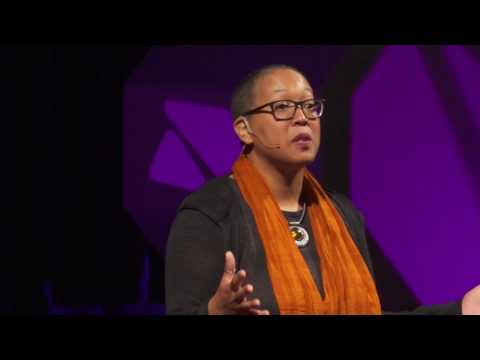
down with my surly eight-year-old ants
in a grass hut on our family farm on
Mount Kilimanjaro that our conversation
that day would forever change the course
of my life even though I grew up
spending my childhood summers on that
farm in Tanzania I was a kid more
preoccupied with playing or reading or
listening to Bowie on my Walkman I was
really into being American and less
invested in learning about my cultural
heritage but when I hit my 30s I started
thinking about having kids of my own and
I realized that there was a lot I needed
to learn about my Tanzanian family so
that I could have something tangible to
pass down and so I set out to make a
film about my family and culture but it
ended up being about the lens that we
bring to the stories of our lives the
stories that we inherit about who we are
and where we come from and how we filter
the stories that we passed down to the
next generation and you can really see
how speaking our truth has the power to
transform and heal not just the speaker
but the listener as well and that to me
is the beauty of stories and it’s why
our stories are so important but just to
be clear by stories I’m not talking
about our highly sanitized you know
curated Facebook feeds what I’m talking
about is the vulnerable deeply
considered truth seeking that explores
those deeper questions of Who am I why
am I here and where do I belong as a kid
I was obsessed with stories and in
particular my origin story because even
at five I knew how unlikely my my
existence was and how wildly the
universe had to conspire just so my
parents could meet and fulfill their
my father was born and raised on that
coffee farm on the slopes of Mount
Kilimanjaro he was the youngest of six
and a member of the chaga tribe and
growing up he would tell me stories
about walking for miles to fetch water
and sleeping in a grass thatched hut
with his family together with their cows
and goats he ended up doing so well on
his final exams that he got a
scholarship to study in the US and so at
the age of 18 he took off meanwhile
halfway around the world my mother was
also the youngest of six growing up in
Seoul South Korea which at the time was
actually even poorer than Tanzania she
also aced her exams and received a
Fulbright scholarship to study in the
States where she met my dad and they
fell in love and three months later they
were married so lying in bed I would
think about all the random life choices
that had to happen extended back
generations right that had to happen
just that my parents could meet and have
me and then as I got older I realized
that everyone has stories that are epic
in scope even if their families had
lived in the same town for generations
every one of us is the embodiment of the
life stories of our parents our
grandparents our ancestors we carry
these stories forward with us whether
we’re conscious of them or not but make
no mistake we are all here because of
our stories so as a kid I was raised in
the suburbs of DC and both my parents
worked for branches of the United
Nations so a lot of our family friends
were International couples with
mixed-race kids many of whom were
first-generation American like me
and so just about anyone who knew me
knew my parents so I didn’t have to
explain or justify who I was or how I
identified but that all changed when I
went to university and I remember one
night sitting in a introduced sociology
class and I was the only visible student
of color in a class of about 400 and my
professor he was white and
mail was expounding on the violent
mixing of blood between slave owners in
their slaves and the resulting politics
of skin color privilege that continues
to plague the african-american
communities to this day and the whole
time he’s talking he’s looking directly
at me I was like oh my god this guy he
thinks he’s telling my story and with
this crazy intense eye contact he’s
wanted to bolt out of that classroom so
bad but I stayed put and he continued to
glare right through me and I felt
completely exposed and completely unseen
and I felt the devastating power of
having someone just take one look at you
and construct their own narrative about
who you are and then feel completely
entitled to turn around and share that
narrative of the world I was livid but I
woke up that night I woke to the reality
of what it means to be a black woman
living in this country at this moment in
time and I realized that the history of
black people in the United States is
necessarily my history simply because
people will assume it to be my history
and so I went back in I’d go back in and
I reread the stories of the civil rights
movement queer liberation women’s lib
anti-violence movement and I saw how at
critical moments in our history like
this one we’re in right now our
collective stories can contribute to the
groundswell that leads to change okay so
now fast forward 12 years and my career
in crisis counseling is winding down and
one day I hear a song driving to work
that evokes memories of my summers in
Tanzania and in particular my favorite
drive from our farmhouse up in the
mountain down to the nearest town in the
plains
we’re on any given day I could look out
my car window and see elephants gazelle
zebra ostriches just grazing by the side
of the road this was at National Park
this was just our drive into town and
this vision is playing out so vividly in
my mind that it suddenly hits me their
video video would be the most effective
way for me to go back to Tanzania
collect my family stories so that I can
share them with my future kid
never mind that I had zero experience in
filmmaking or storytelling that night I
went home and I signed up for an intro
to filmmaking class and seven months
later My partner and I quit our jobs
bought our equipment on eBay and one-way
tickets to Tanzania now when we landed I
found that chaga culture if I thought of
it was on the verge of disappearing and
so I made it we made it our mission to
try to capture and preserve what we
could of this fading culture right but
it was frustrating because I didn’t feel
like we were filming anything that felt
authentic to me and then I realized why
now playing the role of that sociology
professor was me here I was I bought my
Western gaze to Tanzania I was pointing
my camera anything that even remotely
resembled capital see culture write to
me written songs dance folklore
spirituality healing practices all of
this completely bound up in my own
projections when I realized what I was
doing I was so disappointed because
soothly having been on the receiving end
of someone else’s imposed narrative how
could I turn right around and do the
same thing to someone else I should know
better
so I abandoned our culture search and
turn my focus back on my family and I
discovered that being a cultural
outsider actually worked to my advantage
when it came to interviewing my family I
mean I was inside her enough to have
access to dad and his siblings but I was
still an outsider coming from the States
plus I had my camera right which
actually I was grateful for because it
provided a comfortable
allowing me to be curious with my family
and ask them questions that frankly
anyone raised on Kilimanjaro would have
known were off-limits so I sat down with
everyone in my family and when we got
around to my aunts I won’t lie it was
tense sitting in that hut with them
because we were not close we do not have
a warm relationship my aunts had always
been cold and distant and angry and as a
kid I didn’t know what to do that anger
and so I just left them alone but on
this day I decided to be curious and so
I asked them about their childhood I
don’t know what I was expecting I mean I
thought I was asking them the questions
that any of us would ask our elder
relatives right if given the chance tell
me about your life what do you want me
to know about how you’ve lived or what
you’ve learned maybe I was also hoping
to plug into stories involving ceremony
and ritual you know something about what
that would feel uniquely indistinctly
chaga but instead I got the truth with
my camera rolling my aunt’s opened up
and shared stories with me about their
experiences with female genital
mutilation the practice that I was aware
of but I had no idea as part of my
family’s legacy and when I asked them
how they got married they told me about
how they were kidnapped and raped by
their future husbands and about the
ongoing abuse that they’d experienced in
their homes a lot of these stories
they’d never even shared with each other
I was totally caught off guard in’
despite spending the past 12 years in
the United States supporting survivors
of rape and domestic violence
I never heard stories quite like this
right Plus this was family it was
painful and it was raw and honestly my
Swahili wasn’t good enough to counsel
them so all I could do was bear silent
witness all I did was listen but here’s
what happened
my aunt’s changed
telling their stories to someone who
cared enough to ask them about their
life it changed them it changed the way
they looked it changed the way they held
themselves on screen you can see my
aunt’s transform as they release the
pain and shame they’ve been carrying
their entire lives their stories we’re
no longer their burden to bear they
could finally let those go knowing that
I would be the carrier of their stories
now so when I say your stories are
important this is why because having the
space to speak their truth mattered more
to my arms than being in my film right
speaking their truth telling their
stories it set them free and it set me
free too after our conversation in the
hut my aunt’s left me with a challenge
they said now that we’ve shared our
stories with you what are you going to
do about it for years I thought this
film was about my dad moving back to
Tanzania and struggling to fit back in
with a family and culture he left behind
but eight years into making this film I
finally realized if I was going to live
up to my aunt’s challenge I had to
follow their lead and I had to speak my
own truth I needed to share my story and
maybe make a film about my own journey
to discover the cultural roots of my
blackness plus my aunt’s had shown me
that when we open ourselves up to seeing
the world through someone else’s eyes
especially someone whose world is so
different from our own right then that
distance between us dissolves and we
experience their joys and their
suffering as our own and so by centering
myself in my own story I could tell a
story that allows for multiple
conflicting truths write a story about
the love and compassion that emerges
when we allow all of it the beauty and
the brutality the messiness the grease
to exist side by side but the toughest
part of this entire journey was
believing that I had the right to take
up space with my story
believing that what I thought as a queer
mixed-race first-generation American
daughter of immigrants and survivor of
rape and abuse that my story would
matter to anyone but me
and it’s precisely because I had never
seen a story that featured someone like
me or that was told by someone like me
or that was made by someone like me but
luckily none of that mattered because I
was going into hard labor with this film
this story was coming and there was
nothing I could do to stop it and we’re
living at a time when most of us have
access to the tools we need to tell and
share our own stories right so we don’t
need to wait for permission so just tell
your story for the past five years I’ve
been traveling around the world with
this film and after every screening
people from all walks of life come up
wanting to connect sometimes they’re in
tears as they try to tell me how
powerful it was to see their truth
reflected back at them from the screen
for the first time they tell me that
this is the first time they’d seen
themselves their families their lives
their secrets their struggles
represented so truthfully and as a
filmmaker I can’t think of a bigger
compliment but that is too many people
who are living their lives never seeing
themselves represented in the media and
this invisibility is taking a toll on us
all so tell your stories and share them
maybe you share your story at an open
mic and maybe you just reach one person
that’s one person who will stand taller
and breathe deeper after hearing your
story that’s one person who will leave
that night feeling validated and less
alone and maybe even inspired to find
their own creative way to contribute
their story because every time we share
our story we create a more expansive
inclusive portrait of humanity and so
this is what I wish
that we flood the world with enough of
our stories that they rise or fall based
on their own merits and while I love
being I love connecting with people who
are moved by my film I don’t want to be
anyone’s first anymore I want my story
to be one in a billion as it should be I
want the world to be flooded with our
stories thinking [Applause]