
you
why Reid we live in a digital world we
live in a world of screens of iPhones of
ephemera why sit there with the physical
book this famous picture of Rembrandt’s
mother shows us how the act of reading
in so many ways is an act of absorption
the notion of reading is not just the
absorption of information it is a
physical process what I would like to
share with you this afternoon are the
weight they told me there would be a
hundred and fifty people here where is
everybody that this notion of reading as
absorption is the magic of reading the
book is a physical object and learning
how to read as a child shapes the
physical visual and cognitive
imagination before this talk I prepared
by googling guy reading and this is what
I got I got a picture of a guy bending
over a book to bend over a book is to be
absorbed in the book you can see the
very physicality of the hand you can see
that road am like thinker esque move of
the hand on the chin you can see the
visor over the eyes shielding the Sun
reading a traditional book is an act of
absorption reading on a screen is an act
of spectatorship it is theatrical this
is a picture from the late 1980s and I
vividly remember when the screens first
arrived how we did not look down but we
looked out we did not put our hands on
our chins but we pointed our fingers at
the screens and you can see here as the
man leans over the woman pointing at the
screen you can see here how the very act
of reading changes your physical
relationship to the text from one of
privacy absorption and involvement to
one of spectatorship of theatricality of
publicness it’s very hard
to read privately with a screen
therefore in the early 21st century the
e-book emerged I believe as a way of
recovering digitally the experience of
reading privately the e-book is not a
real book the e-book is a simulacrum of
a book they replace paper with something
electronic ebooks are – real books as a
cigarette are – real cigarettes did you
like that one
you think that’s very fun next time I do
this I’m going to travel with you so you
can sit in the front and laugh loudly
with people how many of you are grownups
in this audience I spend all my life
talking about digital culture you know
at my age the only word that should
follow digital is examination that’s
what that’s a joke for the adults how
many of you smoke cigarettes how many of
you smoke real cigarettes how many of
you couldn’t give a about what I’m
talking about a cigarette they are like
ebooks they are the technological and
mechanical instruments for delivering
pleasure that used to be delivered
through paper they are a simulacrum of
the experience and I believe very
strongly whether you read on a pull on a
tablet or whether you read on a screen
you need to return to the physical book
and you need to recognize that for as
long as literacy has been around the
physical book the illustrated book has
been central to the formation of the
child the human being this is a papyrus
manuscript from the 3rd century it is
represents the labors of Hercules this
is the earliest Illustrated children’s
book that survives why were the labors
of Hercules children’s book reading
because in school every
mild felt Herculean how am I going to
pass that test
it’s like conquering the Nemean lion how
am i going to fulfill the assignment
it’s like sweeping out the audience
tables
how am I going to show up for a class at
9:30 in the morning
it’s like slicing off the heads of the
Hydra the image of Hercules fighting the
lion becomes the emblem of reading and
learning as an act of heroic labor it is
also an act of devotion this beautifully
illuminated manuscript from the
anglo-saxon period shows us how in the
study of the Psalms the study of the
Bible the purpose of the book was to
attract the child’s attention King
Alfred the Great who was king of the
anglo-saxons in the 8th 90s wrote about
how his own mother showed him a
beautifully illustrated book as a child
and the word he uses now remember this
is old stuff so he’s talking and writing
in Latin he says its pulchritude female
beauty he is electus he is seduced and
drawn in by the pulchritude by the
beauty of the book is reading a form of
seduction reading is certainly a form of
seduction here in this manuscript of
Terrence’s plays prepared for a
schoolroom in a monastery where the
children would see the representation of
the actors they would see the visual
ways in which the story that they were
reading is presented to their mind’s eye
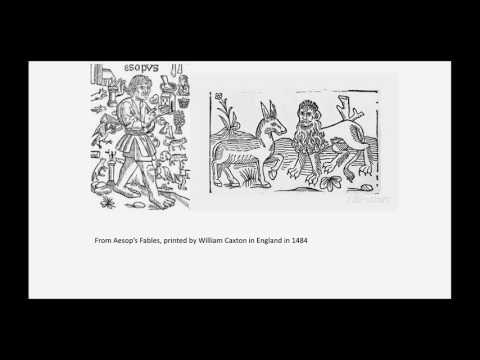
when print came into Europe one of the
first things that was printed was
Aesop’s fables those childish stories of
talking animals of rabbits and hares of
foxes and wolves and goats all of whom
took on a moral quality there you see
the figure of a Sophists
there you see the animals are you
seduced are you attracted are you
excited by the visual image of the book
when
I was a child the books that I fell in
love with were the Illustrated
children’s books by the writer and
painter Robert McCluskey one morning in
Maine blueberries for Sal make way for
ducklings and time of wonder these are
books that Illustrated to the child the
possibility not just of an imaginary but
of an aesthetic life life was beautiful
the job of reading was to experience the
beauty of the world as represented by
the artist and the illustrator time of
wonder is a story it’s a book that was
published in 1957 when I was 2 years old
and we began reading it in my family
throughout the 50s and the 60s we were
fascinated by the idea that he was a
family living on the coast of the state
of Maine I was a child in Brooklyn Maine
was another country for me it was exotic
the very idea that there was a coastline
the very idea that one could see poetry
and passion magic and miracle in a
coming storm over the see this beautiful
illustration and the poetic text that
accompanies it shows us how hoping for a
chance to drop out of the channel the
fishing boat wallows in the waves
seeking the shelter you can hear in the
alliteration you can hear in the rhythm
there the poetry of the water lapping on
the shore and in the course of this book
there is a storm that comes up the storm
comes through it blows through the
parlor it wrecks the living room the
Parcheesi game board Skittles across the
floor the books are gone the mother
reaches for the children the lamp has
disappeared it is as if a trauma has
come through the house and when the
storm is over
all is calm look at this picture now the
mother and the children sing their own
songs of joy the books once again placed
perfectly open and closed on the table
and dad remember this is the 1950s in
the 1950s dad can do anything I grew up
in the 50s when I became a dad in the
1990s I discovered that dads can do
nothing but in the 50s dads did
everything and you will see in this
picture how the dad takes a dishcloth
and covers over one of the last of the
broken panes of glass a window now
broken up in frames that looks all the
world like a set of splayed open books
each pane each window looking like the
side of a book and matching if you like
even rhyming visually with the open book
on the table when I was a child in the
1950s the world of the imagination was
the world of books but we did not have
the thunderstorms of Maine we did not
have the Salters of the imagination we
had the fears of nuclear attack look at
the difference between this picture of
the family and this picture of the
family this Chu from the 1950s the
fallout shelter the mother and the
father and the child sitting around a
text now not of the imagination but an
instructional manual and the only words
you see in this picture are the words
canned food as if in this apocalyptic
moment we would have no words left for
the imagination and so when I grew up
and when I became a parent I wanted to
give my own son this sense of magic that
I experienced the idea that a book could
take us to another world that reading
was a form
of magic and fortunately for me and
probably fortunately for many of you
Harry Potter came along many of you
think that Harry Potter is a set of
stories about magic and Wizardry and
sorcery and the imagination I want to
argue that Harry Potter is a book about
reading magic in Harry Potter is nothing
more than a heightened form of literacy
reading in Harry Potter is the true
magic the potions the spells the true
adventures in the world of harry potter
go on not on the Quidditch pitch not in
the forest but in the library and
Hermione and Ron and Harry as you can
see in one of these screenshots from one
of the films live out their lives in the
magic and mystery of the book and so in
Harry Potter and the half-blood Prince
Harry comes upon an old used a book of
potions and written in the margins are
corrections to the book it tells Harry
how to crush the supper forest beam with
the back of a knife
releasing the juice it tells Harry how
to complete his assignments effectively
in the marginalia to the book of potions
Harry finds the true magic of reading
what he does not yet know and what we
will soon find out is that the
half-blood Prince of course is Snape
himself
Harry brings the book into the library
and the librarian is terrified that
Harry has despoiled or desecrated the
book have any of you had an encounter
with a librarian librarians are all
about keeping things clean and keeping
things in order
libraries are sites of regulation not
imagination the job of the librarian is
to keep your hands clean to keep you
by it and to make sure that if you are
late returning a book you pay for it
these are the structures of society and
civilization for Harry Potter the
splayed margins the almost manic
marginalia here oh that’s a good one
the almost manic marginal are you taking
notes
the almost manic marginalia of the book
are you gonna write that one down too
good give us the sense that the true
imagination is not to be found in the
lines but all around the lines levy
corpus raise the body this is one of the
spells that Harry Potter learns written
in the margins by the half-blood Prince
he learns the spell and takes it back to
his room where he suspends his friend
Ron as if from an invisible cord from
the roof of the room levy corpus raise
the body if you grew up in a Western
Christian tradition you would know that
levy corpus raised the body is the idiom
of the very centerpiece of Christian
belief the resurrection raised the body
but also levy corpus raised the body
what I have tried to suggest to you
today at the end of a day full of
digital imagination full of virtual
realities full of professional expertise
and full of instruction and success and
getting ahead is that the real magic of
reading lies in levy corpus for what the
true book does is it raises our body it
suspends us in the fantasies of fiction
the magic of the book whether it is a
magic of digital
or traditional literacy is the magic of
the literate imagination and what I’ve
tried to suggest to you today is that by
thinking about the history of the book
by thinking about your own experiences
you may ask yourselves am i Ron am I
Hermione or am i Hercules think of
yourselves now in the school room of the
Herculean imagination and the next time
you enter a classroom or a TED talk
ask yourself levy corpus has the teacher
raised the body and in this book am i
suspended in by imagination thank you
very much
Please follow and like us: