
[Applause]
why does language and why do words
matter when we are dying a few years ago
many years ago Ashley I first set foot
in a hospice I was a junior doctor then
and I went there on a taster career day
to find out what palliative care was all
about I’d never experienced palliative
care but I’d heard many good things and
so I didn’t know what to expect when I
went into the hospice in fact I felt a
bit nervous of felt a sense of
trepidation when I stepped in there what
was this place going to be like was it
going to be very solemn was it going to
be very quiet respectful well nothing
could be further from the truth because
when I stepped through the doors and
went inside to the main downstairs ward
it was quite raucous laughter there were
patients standing around talking to the
nursing staff and the junior doctors and
in the center was was one clearly a
patient who was handing over bouquet of
flowers to one of the members of nursing
staff and he was sharing some
experiences from the last few weeks in
which he had been an inpatient here and
he was saying goodbye he was going back
home and everyone was very relaxed so
there they were drinking cups of coffee
and sharing biscuits and it crushed a
few of my cliches I thought well Hospice
is probably the place where people come
and they stay there
and they don’t really leave again but he
was going home after having had his
symptom controlled look to he’d gone
there with a lot of pain and now his
pain was much better and his symptoms
were better controlled and he’d clearly
built a really good rapport with the
nurses and the doctors there because he
gave one of the junior doctors a big hug
before he left so that day I spent time
with volunteers aroma therapists
hypnotherapists nurses junior doctors
all have idiosyncratic roles in the
management of people who were facing the
end of their life I hope this was
wonderful and then to top it all off at
about 4:30 that day one of the
healthcare assistants she she rolled out
a trolley laden with alcohol loads of
alcohol in it gin whiskey beer you name
it and I said all this looks good
what’s happening here and one of the
junior doctors explained well often in
cancer and in some terminal illnesses it
really Rob’s you of your appetite it’s
called anorexia and alcohol is a nice
little appetite increase uh it gives you
a bit more of an appetite so this is
essentially a pre-dinner drink so after
a Janette onic my own career choice was
made I was going to go into palliative
care and a few months later I went to
the same Hospice for a job interview as
a junior doctor and I got the job and
the rest is history
well this falls down so palliative care
the word palliative means to protect to
protect from ill to cloak from ill and I
wanted to talk to you really about some
of the lessons I’ve learned over the
years I’m now a consultant and
palliative care but the people who’ve
taught me the most powerful lessons
really have been patients over the years
and I really treasure this little diary
it’s something I usually keep fairly
private so this feels like a very open
space to share it with all over the
world but I’ve selected four quotes from
from patients which I found very
meaningful I want to talk through them
today and I think you will find them
them interesting so first quote less of
the militaristic battle language in
cancer please it came from a lady um she
was in the cancer center I was seeing
her with my registrar doctor and one of
the palliative care nurses she she felt
that down she’d used phraseology
throughout her illness like I will fight
this I will wage war on these cancer
cells
I will annihilate the cancer in my body
I will bravely go through chemotherapy
and radiotherapy I will I will
I will suffer there the hair loss and
the nausea and the vomiting but I will
fight my way through and she used this
terminology and doctors and nurses uses
terminology with her as well
and she used this with her family as
well on a family vice-versa were using
the same quite violent militaristic
terminology in trying to annihilate this
cancer trying to destroy it so what’s
wrong with that mine might be think I
think initially it was probably quite
enabling for her it was quite a good way
to approach this perhaps but now when
she had been told that her cancer had
spread throughout her body
she felt let down she felt like a loser
in this war and she she felt like she’d
let her family down
when this fighting toe carpet had
essentially been pulled underneath her
feet and so she she felt that had she
approached it differently from the start
had she used other language that perhaps
allowed for the worst moments or the
difficult moments she might have been
standing or feeling very different about
the news that she had just received a
famous doctor the doctor Kate Granger
died last year she was a big writer and
a big campaigner on end-of-life care
issues and she said if anyone if anyone
says about me after I’ve died but paté
lost her brave battle with cancer I will
come back and I will haunt them she
didn’t want to be remembered as a loser
she had contributed so much to
palliative and end-of-life care and to
medicine in general she didn’t want to
be remembered as a loser she wanted to
be remembered as a winner and that she
is so what language could we use well
I’ve thought of some sentences and I’ve
selected some of the patients again have
given me over the years and in fact they
use the language of peace and the
language of love
I hope I’m restful and calm when I get
more unwell I’d like to think about
chemo carefully consider the pros and
cons and come to terms with the future I
want to write lots of thank you letters
to the people I love as long as my
family and friends are around me perhaps
doting on me in making some ice cold
drinks then I will be happy
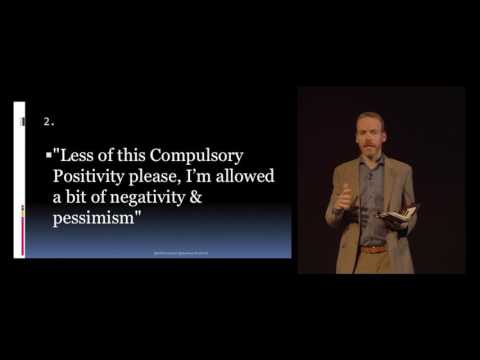
quote number two less of this compulsory
positivity please I’m allowed a bit of
negativity and pessimism now you might
find this one a bit strange because
surely positivity is a good thing in
cancer settings the positivity movement
is said to have started with a posture
called Norman Vincent Peale
in the 50s he wrote a book called the
power of positive thinking
he was Ashley Donald Trump’s mentor
whatever whatever you think about that
but it sold millions of copies and it
spurned this big positivity movement
with its its its books its DVDs its
self-help seminars and probably a fair
smattering of TED Talks as well but it
it has and so this lady felt as well
really come into the health care setting
as well and it came into the healthcare
setting what quite a vengeance when I
noticed that some of my patients had had
read a book called the secret the secret
talks about the power of positivity and
and the law of attraction so if you
remain positive at all times you will
invite positivity into your body if you
are negative if you’re a glass half
empty person you will invite negative in
energy into your body and create cancer
and other conditions in fact
if you have cancer and you are negative
it’ll make your cancer worse and many of
our patients believe this but then they
are terribly disappointed when despite
all their positivity and this mask as
they sometimes in retrospect have
described it has let them down and isn’t
natural is it if if something bad
happens it’s quite normal to feel
negative and to feel bad about it it’s
normal to be sad or fearful and in those
moments that is particularly important
that we share those fears were those who
are close to us
I’ve seen many families who’ve stifled
those conversations and said to a
patient no no please please don’t talk
about this this negative aspect let’s be
positive let’s just focus on the
positive well that isn’t always what
life is about and if you can talk about
your fears then you can express what
your darkest fears are and perhaps you
feel better afterwards because those
around you know what you don’t want
which leads us on to quote number three
when I expressed how I would like to
spend my last weeks and the treatments
I’d find acceptable and not acceptable I
actually felt a sense of relief now for
this one I would quite like you to
engage a little thought experiment could
you all close your eyes please now I can
only check on the front rows here
because the light is disrupting me a bit
so I won’t know if you’re not really
closing your eyes but close your eyes
please and I want you to imagine your
own dying moments where are you who’s
with you
what setting are you in what can you
hear
okay open your eyes again please hands
up those who were in a clinical setting
you know in a hospital setting yeah just
a few of you there and hands up those
who were perhaps at home yeah a few of
you there as well
hands up those who couldn’t quite
picture the scene yeah few of those as
well this is quite quite normal I used
this little thought experiment with the
students a lot at the time my favorite
one is when one student once said to me
he was on a beach with a pina colada
next to him has to be my all-time
favorite um but really now imagine
conducting this little thought
experiment which might have come easy to
you might have been difficult but now
imagine conducting a thought experiment
around Sunday lunch with your family it
would probably not go down very well
someone would say hang on a moment let’s
not talk about this this is a horrible
thing to talk about yet we feel it is a
very important thing to talk about
especially if you have a palliative
life-limiting illnesses
what are you wishes where would you want
to be how would you want it to look like
what is plan a and perhaps Plan B if
things don’t go so well
if those who love you don’t know then
they won’t know if you become less able
to communicate so expressing this
difficult topic and talking about it
with those where you are closest to it
becomes very important it’s strange
because I’m often a stranger in to a
person who has just met me but people
find it easy to talk to me about it
perhaps because I’m a stranger but they
found find it incredibly difficult to
talk to their own friends and family
about this very topic so this really is
just a plea to think about these areas
and I also work for a charity called
dying matters in Wales
it’s called beyou now which is Welsh for
live now I said that in a nice Welsh
German accent I hope you appreciated it
that’s my excuse anyway and we’ve
created some resource
to help people think about the
treatments that they would consider
perhaps but also the treatments that
they wouldn’t want when they become more
unwell and less able to communicate one
of those treatments or as many
treatments you might find it perfectly
acceptable to have an intravenous drip
or intravenous antibiotics or perhaps
even a blood transfusion and go to
hospital for that when you moron well
but when you hear about cardiopulmonary
resuscitation and what it can do to your
body and how unsuccessful it is in
palliative illness you might think twice
you might say well I’m happy for doctors
to consider it but or you might say well
actually no this is not something I
would particularly want now it’s a very
complex topic and we’ve tried to make
this a little bit easier so with the
charity we created some videos and with
patients and with volunteers and with
the NHS as well we’ve created these
videos and they’re on the talk CPR Tod
Wales website if you want to get there a
bit quicker by Twitter there’s a hashtag
called talk CPR and so this is just one
of many ways to open up difficult
conversations about a topic that is
often dismissed and brushed under the
carpet is too dreary to talk about quote
number four please doc tell my family to
lighten up a bit it’s not like I’m dying
today
this man was very very funny and the
nurses really liked him which is usually
a sign that he’s a big troublemaker
which he was he was a real Joker but he
also confessed to me that he felt quite
lonely and the reason for this
loneliness wasn’t because he didn’t have
friends and family he had many people
who were who surrounded him and but
their approach to him changed somehow
when they heard that he had a terminal
illness their language towards him
changed the language stopped they
stopped contacting him they felt awkward
they perhaps understandably didn’t have
the vocabulary to to express what they
felt and perhaps their own awkwardness
but what he really wished for was for
them to stay normal and just behave in
the same way that they always had
occasionally telling him to shut up as
well but he wanted them not to change he
wanted them to treat him in the same way
they always had I’ll never forget him
because one day on a ward round he was
always telling jokes but I won’t forget
this one he called me over and said Marc
Marc came over and said what’s going on
so I’ve got this joke for you probably
one laugh but I’m gonna tell you anyway
said doc I’ve been on a
once-in-a-lifetime holiday I tell you
what never again we looked at each other
for a moment and then we both started
laughing and I always remember that
moment because he died several weeks
later and I feel that the language he
used the humor that he used was so
fantastic and I have felt over the years
I’ve learned that in palliative care
humour death and dying often quite
closely intertwined and so I’m not going
to remember him for his death or his
dying I’m always going to remember him
for that joke in fact he would love it
that I’ve told so many of you this joke
it’s really great so I’m going to end on
someone who’s a greater language expert
than I will ever be and who died many
centuries ago
William Shakespeare this is from Romeo
and Juliet
act 4 scene 5 how oft when men are at
the point of death
have they been merry which their keepers
call a lightning before death thank you
you
[Applause]
Please follow and like us: