
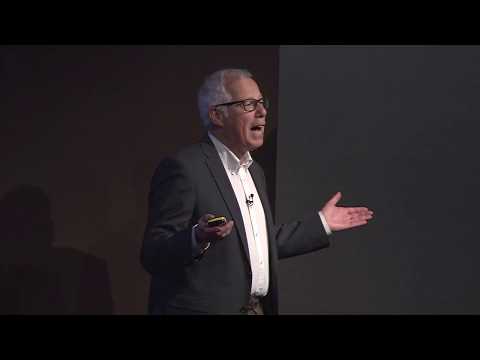
I have been thinking about design
talking about it and writing about
design for almost my entire career
that’s about 40 years even longer if you
consider my early childhood in a 1950s
Liverpool home where if you look
carefully you can see my parents thought
it was a great idea to balance a toaster
on top of a bakelite radio this was a
juxtaposition which clearly stimulated
my interest in innovation so here I am
aged 61 a silver fox a seasoned academic
a graybeard albeit a clean-shaven one
and I have officially joined the ranks
of older people in this country and what
I’ve been thinking about most recently
is designed for the age bracket which I
have joined and I have one overriding
thought why is it so bad why is it all
about medical looking aids and
appliances why is it sourced from
obscure catalogs rather than the Conrad
shop who thought that white plastic grab
rails in the kitchen was a good idea why
are expectations so low so beige so
bland now when we age things happen to
our bodies things go south it’s the most
natural and inevitable part of life’s
journey as Shakespeare said we start
with shining morning face and we end
sans teeth sans eyes sans taste sans
everything but why can’t we design for
these gradual changes in the same way
that great beautiful sexy design is
created for other age groups now I don’t
know about you but I’m not looking
forward to living in a design ghetto of
special needs gadgets
world where all our interest in
aesthetics and style and form is
abandoned just to survive in later life
we surely can do better than that
now let me share with you my three top
design fears for the future the three
things that I have told my grown-up sons
over my dead body
the mobility scooter it’s hardly an
object of desire is it it yes it does a
job it gets people out and about but you
are traveling alone frequently being
screamed at by white band man
you can’t take it into your own home or
through the front door or into a shop at
night it sits outside your residence
winking away advertising the fact that a
frail dependent person lives there it’s
a security risk
but inclusive design can improve things
I have been curating an exhibition at
the Design Museum just up the road in
Kensington called new world and we
invited several leading design teams to
reimagine aspects of later life for
older people one design team priest Minh
good who are better known for doing
Airbus interiors and Virgin Trains
they reimagined the mobility scooter and
what they came up with was they borrowed
the language of the push scooter that
children use and they created a stable
three-wheeled motorized version so that
grandmother’s can travel with their
grandchildren and share time with them
all it takes to rethink the object is a
little creative consideration design
fear number two
the stairlift isn’t it fantastic a heavy
invasive piece of engineering in your
home
guaranteed to wipe thousands off the
value of the property yes it does a job
lift you between floors
but shouldn’t design be intervening
before we get to this level of
dependency it really is the object of
last resort when all hope is gone design
should be helping people to stay fit and
healthy and the stair lift itself could
evolve through design I’ve been taking
part in a research project at the Royal
College of Art with Stan er a British
manufacturer in which we’ve put sensors
on the stair lift and it’s part of a
digital network of care so when the
stair lift goes up or when it goes down
a tweet is sent to the children and
grandchildren in that circle of care so
that they know that you are safe and
well and moving about the house and we
need more innovations of this kind
design fear number three the Zimmer
frame about the only thing good about it
is the name it gets you up and out of
the chair but surely we can do better
than that
and indeed we can another project
from the new old exhibition is by the
designer yves behar and this is a soft
suit it’s called the our power suit and
it was designed in conjunction with a
Silicon Valley startup called super flex
and this enables the natural muscle
movements of the body in the back the
neck and the legs to be enhanced by
those green hexagonal pads which are
full of artificial intelligence and
motors it’s a bit like an electric bike
you have to pedal at first but then the
machine takes over and we’re going to
need a lot more of
this type of innovation in the future
now it’s often said that the reason why
design for older people has such short
runs shoddy production values low
standards of design is because the
market isn’t big enough this is complete
nonsense according to the UN there are
going to be 1.4 billion people over 60
on the planet by 2030 that’s a 50%
increase from today we already have more
pensioners than we have seniors in this
country in Japan they have the simplest
way of all of describing the phenomenon
they say if you throw a stone in Tokyo
it will hit a senior so this idea of a
small market is utter garbage and we
really need to start thinking seriously
about how we’re going to raise
expectations and raise standards to do
this I believe that we’ve got to answer
three fundamental questions and the
first is about how we view the place of
older people in the world do we want
them safe and sound and out of sight in
a stress-free secure environment or do
we want them out and about in the world
still working still traveling still
contributing to their communities we’re
ambivalent about this in the UK and this
issue was crystallized for me in two
exhibits in the New World
on one hand we had an elder care
apartment designed by Sam Hecht and Kim
Colin in which everything is done for
the older person through a system of
modular walls in which appliances such
as dishwashers and
washing machines and fridges open two
ways they open into the apartment but
they also in open into a hidden network
of service corridors in which robots and
humans replenish the fridge or wash the
clothes and put them back so everything
is done for you
but is this a gilded cage could it lead
to more isolation if you don’t have to
pop down to the local shop for a pint of
milk when do you ever get to meet other
people in contrast we showed another
project by Hemingway design and this is
a housing estate in Gateshead in which
the car parking places have been removed
outside the homes and replaced by tennis
tables table tennis tables and barbecue
stations to encourage neighbors to
mingle across the generation so this is
design to keep people together rather
than push them apart and I think we need
more of it given the numbers the second
fundamental question is around
technology what do we want emerging
technologies to do for us this image
shows seniors in Japan interacting with
pero the robot seal and the Japanese are
brilliant in developing a home robot
industry because as a homogenous society
they do not want their elders to be
cared for by migrant labour but what’s
going on in this country what are our
preferences
well I took part in a niche sauce Mori
survey in which we asked people do you
want to be cared for by robots or do you
want to be cared for by humans to my
surprise 1/4 of the sample said they
wanted to be cared for by robots and
that rose to a third among young people
who obviously have a different
relationship with technology but we
should be careful what we wish for we
should be wary
a total total tech led approach in which
contact with other people is engineered
out of the equation we need a much more
balanced approach a humane approach to
technology and design can help us do
that
the final fundamental question we need
to address is something known as the
medical model of Aging
and the medical model sees aging as a
disease to be cured it’s all about
decrepitude and dependency and it paints
the older person as a passive indeed
hopeless recipient of care the elderly
person’s roadsign is ripe for redesign
and in fact a group of designers got
together to do precisely that what about
other models a social model of Aging in
which in the productive Third Age it’s
all about new connections and new
aspirations or a cultural model of Aging
in which designers are encouraged to
think about aging as an error there is
rich in possibility unprecedented and
unique and therefore deserving of
special design attention in the end it
all boils down to one thing do we want a
life full of years or do we want years
full of life and I know what I want if
we are to avoid clinging to the Zimmer
frame being marooned on the mobility
scooter or stuck on the stair lifts then
we need to make a change like a lot of
people I was delighted at the
government’s new industrial strategy
announcing a grand challenge for ageing
and I hope and believe that there’s
going to be a lot of breakthrough
innovation coming out of it but we also
need a sea change in attitude a big
shift that is conceptual and
philosophical as well as practical if we
can rethink our place in the world as we
age if we can use technologies in a more
humane and balanced way and if we can
replace the medical model of aging with
social and cultural templates that are
more useful for designers then I believe
that my worst fears about the future
will not be realized we have the tools
we have the technologies and above all
we have the talent we just need the will
thank you
[Applause]
you
Please follow and like us: