
[Music]
today I’m going to talk about life on
Mars I don’t mean icky little green man
I mean what will it takes for human
beings to live permanently on the red
planet and build houses there when we
talk to people about our Mars project
the first reaction is always a little
smile maybe they think there aren’t
really serious but we are serious we our
aim is to push the students beyond
thinking outside the box we want them to
sing off the planet by challenging them
with completely different conditions we
hope to give them tools to solve
building design problems we face here on
earth in very new and innovative ways
the course I’m talking is held at EPFL
School of Architecture civil and
environmental engineering and up in
groups the students must design a person
a permanent habitat that supports 100
colonists the next few minutes I’m going
to tell you a little bit how we do and
what challenges we have to face I will
share with you some of our findings and
at the end I want you to see how our
Mars project can lead to approaches that
could be applied even here on earth but
before talking about our work let’s have
a look what fate we have to face on Mars
what conditions first Mars is 50 percent
further away from the Sun than we are
this is why the temperature on the
surface are very low between minus 20
and minus 120 degrees
Mars has also an envelope an atmosphere
but this pressure is 100 times less than
we have on earth and it contains mainly
co2 so as you see the environment is on
Mars is cold and hostile but not
impossible to handle
the first issue have to solve is the
environment in which the colonists
really the question to answer is what
are the very basic needs for human
beings well they are air to breathe we
need to drink and then we need food but
we have also take into account that our
producer but he produces outputs but
every breath will release co2 and after
digesting food we eject urine and faeces
on earth we receive fresh air for free
by opening windows we get to drink at
the bar and food comes from the
supermarket while we were in a thesis
disappearing toilets but of course on
bars this wouldn’t work our colonists
are too far away from Earth to expect a
regular supply from a supermarket or a
bar we will have to use other strategies
than then than this to make an
independent ecosystem an ecosystem that
produces everything we need to support
life on site the key will be the use of
plants to grow plants need basically co2
nutrients water and light the first
three of this will be available from the
outputs of our colonists now the other
side
plants will be a source of food and
produce oxygen so if we are able to
create a balanced ecosystem where all
the flexes of air water the nutrients
are closed where everything is recycled
then we will have a stable and life
supporting environment all we have to do
is to supply it with energy in form of
light on earth we have light for free
and grows plants grow mostly outside on
Mars the colonists help to organize the
food production inside as it will be
difficult to have very transparent
lopes they will usually usually use
lamps to light the greenhouse plants
another challenge is the design of the
food production you have to install
greenhouses to produce vegetables
cereals potatoes fruit salads and so on
from our findings the greenhouses will
represent more or less 2/3 of the marsh
habitat volume but these large
greenhouses can also be an opportunity
to provide recreation spaces where the
colonists could spend free time what I
like about this artificial ecosystem is
that the humans the space habitat is not
a machine
service for humans the humans are part
of the system colonists could not
greater live without the plants but the
plants could not grow without the humans
both depend on each other another topic
we have to address is the question of
the building materials on Mars we must
find to produce building materials
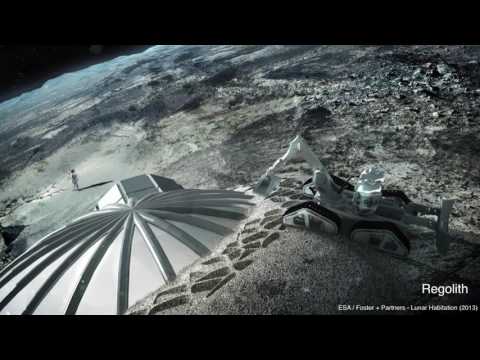
locally the first material the Martian
colonists will find is regulate it’s a
flower like stone powder that covers all
the surface of Mars regolith would be
the main resource for Mars concrete and
this would be very well adapted for
erecting structures with large-scale 3d
printers another obvious building
material is stone available everywhere
stone could be extracted for mass
quarries stone bricks assembled at MIT
with mason robots would lead to an
interval of walls columns orcs and walls
a third possible material is water as
the temperature outside are always below
the freezing point water in form of ice
could be used alone or as a glute for
Mars concrete and the last resource is
co2 from the atmosphere with the
photosynthesis nature officers aware a
way to harvest carbon out of co2
so colonists could grow building
materials in greenhouses for instance
bamboo it grows fast and offers various
applications so as you see the
architecture of the future not only on
Mars will certainly be a combination of
high-tech and low-tech Assemblies of 20
century first centuries and traditional
materials and finally we work also on
the case question of shape and space as
the atmospheric pressure outside is 100
time less than inside we have to deal
with the fact that Marsh habitat will be
inflated like balloons or tires pressure
forces are much more important than
gravity forces the consequence is that
the envelope must be curved in a certain
way and the resulting building shapes
are mainly spheres cylinders Tory or a
combination of these but small sphere
will produce weak forces within the
envelope and big spheres will produce
strong forces so the first thing we have
to do when starting a building design is
to find a way a good compromise between
form dimension and space the envelope
must be stay ensured the stability while
deform and this the size of the building
must create nice and adapted living
spaces sleeping working playing sport
and so on all this activity we do it on
earth at home or elsewhere must be happy
inside the marsh habitat so we have to
carefully reefing on the correct
questions like how would people live
within a small area what kind of space
do they need for all these activities
and how these spaces should be lighted
and at the end the Mars habitate will be
an optimized construction that contains
all the activity within one same
building a kind of a small city with
apartments meeting era’s workings places
and who knows perhaps even a bar or a
supermarket finally instead of waiting
for space engineers to bring us to Mars
within a few decades
we should start building Mars habitats
down here on earth it would help us to
brave challenges of our own world thank
you
[Applause]
Please follow and like us: