
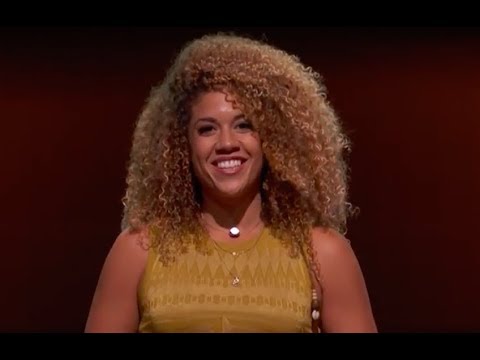
I started working in the White House in
2013 it was shortly after President
Barack Obama had won his second term in
office and I had a job that was called
an outreach director it was an advisor
to Vice President Biden and I spoke to
different groups on behalf of the White
House and one of the groups that I spoke
to was the labor union community not all
but a lot of the people that I worked
with we’re like stereotypical labor
dudes right they’re big and they’re
burly and a little bit gruff and
sometime early in my time at the White
House the vice president vice-president
Biden was on the phone as one of these
labor leaders and he checked in and
asked him how I was doing this labor
leader he says Oh Kerry she’s great
straight forward she knows her stuff I’m
still getting used to all that hair but
it’s good and I was good at that job and
I loved that job not just because I was
honest and hard-working because I
believed an American service which I do
but because of how I constructed my
identity and because I knew that you
could be a big gruff labor leader and we
would still have a lot in common and
that’s what I want to talk to you all
about today I want to talk about our
identities and how we shape them and I
want to talk about what that means for
the future of this country so I am the
daughter of two parents who have really
kind of typical American stories but in
different ways my mom is a daughter of
the American Revolution I am a
descendant of a signer of the
Declaration of Independence the town
that she grew up in a small rural Ohio
town was not only founded by but it was
named after her family my father is an
immigrant he grew up he was born and
raised in small islands in the Caribbean
and he was basically forced here in his
20s by his grandmother he was smart he
is smart hard-working earnest diligent
and she knew that he would thrive if he
were exposed to the kind of
opportunities that this country promised
so ten years later my parents meet there
in night class at a university in
Columbus
a civics lesson perhaps foreshadowing
the interest of one of their future
children and they get together we have a
happy little family mom dad my older
brother my older sister and I and I grew
up in a kind of classic suburb upper
middle-class well-to-do leave your bike
in the front yard front doors never
locked you have a community of energetic
citizens who have high expectations for
the young people who grew up there it’s
great
it’s an incredibly privileged type of
way in place to grow up and I loved it
with the exception of one very huge way
that it failed it was completely lacking
in diversity and in addition to making
me and our family kind of the odd family
out it also just wasn’t keeping pace
with where the country is headed in 2040
somewhere around there America is gonna
be a country that has that its citizens
are majority non-white in 2050 or
somewhere around there over a quarter of
the population of Americans will be
multiracial or biracial the youngest
generation of Americans currently is the
most diverse the most tolerant and the
largest generation of Americans ever and
this is a really radical social change
for our country to undertake and if
you’re student of history you know that
periods of rapid social change are often
periods of intense violence it’s really
tempting to think that old people with
old views are gonna die off and that the
young people will save us but I will
remind you that those were young men and
women in Charlottesville
and so if we want to have the type of
country that lives up to its ideals if
we want to be the type of Americans that
embody the Creed of this country and we
have a lot of work to do we have to do
it together
and there’s three things that we all can
do and I I’ve had to go through these
processes myself so I will assure you
that you is possible we can do it
so the first thing we have to do is we
have to identify our bias everyone has
bias I have built in diversity and I’ve
had to unlearn my bias like I should
have been you know way ahead of the
curve but I wasn’t so we have to
identify that we all have bias it’s a
legacy of the history of this country an
implicit bias just as a refresher
implicit bias is the set of values and
opinions and assumptions you have of
other people who are different than you
that you’ve absorbed passively that
you’ve learned from society that you’ve
picked up and then from the media or
from the coded language of politicians
it’s something you’re unconscious of but
I’ve we all have it it’s some
combination of isms and phobias that
help paint our view and our reactions to
other people and so the process of
undoing your bias it can be challenging
and hurtful I assure you it is also
embarrassing but we have to do it
there’s a thing called the Harvard
implicit bias test and when you take it
it’ll help you to understand what your
biases are and how they’re aligned I’ve
taken it I didn’t do so hot on my first
pass which is humiliating to admit but
it’s true I nailed it the second time
and it’ll help you to start unpacking
all the things that you have to unlearn
now I’ll tell a story to help illustrate
bias I’ve always been really sure and
quick to push back on stereotypes
I’ve always condemned any sort of
offensive language but it’s not the
overt stuff that really is so pernicious
a lot of times it’s the subtle stuff so
I was in college wasn’t my 20s when I
was at a dinner party and again I grew
up in an all-white not alway
predominantly white town and I’m at a
dinner party in college feeling very
sophisticated I’m sure and I was
chatting up as chatting up a handsome
Latino man and he told me that he was a
medical resident and I looked at him I
got a doctor good for you
amazing
and he looked at me with a combination
of fury and humiliation and also a
certain like a to brown girl like really
[Laughter]
and his reaction was spot-on I would
have reacted the same way and I often do
when people register surprise that I’ve
accomplished things so that I’ve
achieved but that was a function of my
bias I was in my 20s before I met a
Latino doctor I didn’t I knew they
existed but to me it was remarkable and
it’s not it wasn’t and I offended him
because I had not taken the time to
assess the bias and the assumptions that
I made about a different group of people
that I had not been very exposed to so
the first thing we’re gonna do is we’re
gonna recognize that we all have a
problem because we do and then the
second thing we’re gonna do is we’re
gonna try to fix it and that requires us
to change our habits it requires us to
go to different places talk to different
people visit a house of worship of a
different face than you sit and listen
and learn intentionally expose yourself
to different ideas and different people
with the express purpose of learning you
do not know what you think you do I
assure you you don’t and again I have a
little story so I was maybe one of two
or three black kids in my school of over
2000 because I like being good at things
by the time I was a teenager I was
convinced I was the blackest person in
America and because none of my friends
knew any better they were convinced to
write
got big hair I’m a great dancer I know
all the music I know the artist I knew
my history backwards and forwards and so
I go to college I was very excited I can
finally hang out with black kids in math
it was gonna be amazing and because I am
the blackest person in Ohio we were all
gonna get along great right it was gonna
be like straight out of a movie until I
actually get there and I bore the
unmistakable signs of someone who’s not
actually spent much time with black kids
I missed every social cue I couldn’t
understand cultural references I’m not
it turns out a very good dancer
which was a hard one that was tough to
give up and I probably said silly things
like no no no I’ve bunch of black
friends no no I’ve you know I probably
did all of those faux pas and so imagine
being that bewildered if I didn’t know
the things I thought I knew about the
group of people that I thought I
belonged to what could I possibly know
about anybody else
I assure you you do not know what you
think you do so one we’re gonna identify
that we’ve bias two we’re gonna start
fixing it and that requires humility and
the requires listening and that requires
us to stretch ourselves and to be
uncomfortable
the third thing we’re gonna do is we’re
gonna be really graceful and patient if
you go about the process of undoing your
bias and you do it earnestly and
honestly you are going to say the wrong
thing you are going to say something
that perhaps hurts someone that confuses
someone if you’re going to help someone
through this process they are going to
say something that hurts you that
confuses you we have to have space and
we have to have grace to have these
conversations
that doesn’t mean say whatever you want
doesn’t mean speak carelessly words are
powerful there are our most powerful
tool we have to use our language
compassionately but we have to be able
to try we have to be able to figure it
out
learning about other people as an
indelicate process
it is incredibly important that we
undertake these three steps if we are
going to be responsible inheritors of
this country’s future I have spent my
entire adult life in service of this
country and its ideals and its values I
believe that we can be a country that is
that is who we say we are we have a lot
of work to do and we have to do it
together
we will be better you will be better our
families our communities our country
will be better if we do this work thank
you
[Applause]
Please follow and like us: