
one of
the most critical challenge that we are
going to face in next decades is aging
aging of the population I think that
most of you have experienced that
elderly that aging can affect our
movement ability and capability to live
autonomously think about stroke patients
lower limb amputees or more simply the
physiological decline of your
biomechanics why aging is such a big
challenge I think there are mostly two
reasons one is in our personal domain I
think that it’s desirable that we can
live our life going around enjoying
until the last day of life without the
burden of our body becoming more and
more fragile the second reason is in our
society look at this number in about 40
years from now thirty five percent of
the population will be older than 65
this means that there will be an
increasing number of person requiring
assistance and that decreasing number of
person that can provide assistance guys
there is a strong need for mobility we
need machines that can help us to age
while remaining creative active and
happy my dream is to develop
exoskeletons robotic exoskeletons that
can promote the establishment of a
sustainable progress by means of what we
call human exoskeleton symbiosis
symbiosis between a machine and the
human is something that is not new about
50 years ago Joseph leek leader the
Fadden of Internet talked about the
symbiosis between human and computing
machines I think that nowadays this is a
reality you have your smartphone you
cannot live without it
unfortunately and a symbiosis between an
exoskeleton and the person is not that
much easy with your smartphone you just
exchange information with a robot like
the one I’m wearing you have to exchange
mechanical power
we humans are very good in being elastic
we are flexible
we are adaptive we are intelligent but
we are all of us different among us our
body sides our body shape our behavior
on the other side of the story
robots are very strong are very stiff
are easy to set up are fast but robots
are still incumbrance a bit bulky so
putting a human and the robot together
is not an easy task despite what you see
in the science fiction like no movies
like Elysium just to mention the last
one or Iron Man yes that science fiction
reality is a completely different story
at the PI robotics Institute of Scala
Santana where I have my lab we started
working on exoskeletons about 10 years
ago this is the first example I want to
show you this is an exoskeleton for the
elbow that was thought to be used in
clinics so to help physical therapists
to make rehabilitation after stroke
after stroke a person can have is the
ease or her elbow spastic so they need
mobilization this machine can help the
therapist to provide intensive treatment
and improve the mobility in 10 years 10
years we managed to make the device and
make early tests and still does a lot to
do of course you can continue your dream
and say okay this is the elbow but I
want to do also the shoulder the
shoulder joint inhuman the one that you
use every day is something extremely
complex I say to my students it’s a
piece of artwork or Blanchard you can
make rotations but yourself translations
so making a robot that couples perfect
with the show that is really demanding
we are still working on it of course I
told you that exoskeletons can be a
solution for mobility so you want
wearable robots coming outside the lab
outside the clinic and this is what we
tried with an L with the n hand
exoskeleton actually there are patients
like affected by spinal cord injury so
partially jiin these people sometimes
they stay on a wheelchair they can move
the arm but they cannot use the hand so
you move your heart but not grasping
ability you cannot drink alone you
cannot eat alone you cannot do anything
you need 100% of your time supports from
somebody else then we develop the robot
we try to connect it with the brain by
means what we call brain to machine
interface so by means of electrodes on
the scalp on the side of your face by
actually
detecting the eye movements we are able
to understand when you want to open and
want to close the hand people like the
one you see in this video can think
about to close the hand the exoskeleton
is able to do this and by this simple
parody these people were able to you
know eat again or to make a signature or
to use the credit card something that I
would say it’s very common and easy for
everybody let me come to the last
example which is about lower limb
amputation lower limb trans femoral
amputation so above knee prosthesis just
to be more pragmatic working with the
prosthesis is incredibly tiring think
about these people usually work at 40%
of the velocity that you walk and they
consume 2.5 times the same energy you
would never like a car that has this
kind of performance and these people
they don’t use the prosthesis indeed
they prefer the wheelchair and this is
the majority of lower limb amputees and
then we came with the idea with the
dream we want to help these people and
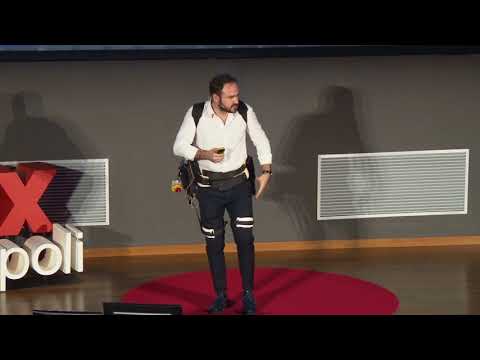
then you can develop devices like the
one I’m wearing that can actually inject
energy into the gate and making the gait
pattern more efficient if you are asking
how this machine works it’s extremely
simple in a sense there is an actuator
right here that has the same functional
I would say is inspired to our muscle so
there’s some elasticity there so you can
basically couple the human with an
elastic machine and then when you start
working the device actually gets
synchronized with your movement that’s a
kind of controller similar to the
pacemaker in our brain and then provide
assistance in a very gentle and
effective way let me conclude I think
that you are now aware more of the
potentialities of the wearable robotics
of the exoskeletons but I hope that you
are also aware that there is still a lot
of work to do and that’s the reason why
we as community needs to gain momentum
and keep the gradient of the challenge
thank you
[Applause]
the most critical challenge that we are
going to face in next decades is aging
aging of the population I think that
most of you have experienced that
elderly that aging can affect our
movement ability and capability to live
autonomously think about stroke patients
lower limb amputees or more simply the
physiological decline of your
biomechanics why aging is such a big
challenge I think there are mostly two
reasons one is in our personal domain I
think that it’s desirable that we can
live our life going around enjoying
until the last day of life without the
burden of our body becoming more and
more fragile the second reason is in our
society look at this number in about 40
years from now thirty five percent of
the population will be older than 65
this means that there will be an
increasing number of person requiring
assistance and that decreasing number of
person that can provide assistance guys
there is a strong need for mobility we
need machines that can help us to age
while remaining creative active and
happy my dream is to develop
exoskeletons robotic exoskeletons that
can promote the establishment of a
sustainable progress by means of what we
call human exoskeleton symbiosis
symbiosis between a machine and the
human is something that is not new about
50 years ago Joseph leek leader the
Fadden of Internet talked about the
symbiosis between human and computing
machines I think that nowadays this is a
reality you have your smartphone you
cannot live without it
unfortunately and a symbiosis between an
exoskeleton and the person is not that
much easy with your smartphone you just
exchange information with a robot like
the one I’m wearing you have to exchange
mechanical power
we humans are very good in being elastic
we are flexible
we are adaptive we are intelligent but
we are all of us different among us our
body sides our body shape our behavior
on the other side of the story
robots are very strong are very stiff
are easy to set up are fast but robots
are still incumbrance a bit bulky so
putting a human and the robot together
is not an easy task despite what you see
in the science fiction like no movies
like Elysium just to mention the last
one or Iron Man yes that science fiction
reality is a completely different story
at the PI robotics Institute of Scala
Santana where I have my lab we started
working on exoskeletons about 10 years
ago this is the first example I want to
show you this is an exoskeleton for the
elbow that was thought to be used in
clinics so to help physical therapists
to make rehabilitation after stroke
after stroke a person can have is the
ease or her elbow spastic so they need
mobilization this machine can help the
therapist to provide intensive treatment
and improve the mobility in 10 years 10
years we managed to make the device and
make early tests and still does a lot to
do of course you can continue your dream
and say okay this is the elbow but I
want to do also the shoulder the
shoulder joint inhuman the one that you
use every day is something extremely
complex I say to my students it’s a
piece of artwork or Blanchard you can
make rotations but yourself translations
so making a robot that couples perfect
with the show that is really demanding
we are still working on it of course I
told you that exoskeletons can be a
solution for mobility so you want
wearable robots coming outside the lab
outside the clinic and this is what we
tried with an L with the n hand
exoskeleton actually there are patients
like affected by spinal cord injury so
partially jiin these people sometimes
they stay on a wheelchair they can move
the arm but they cannot use the hand so
you move your heart but not grasping
ability you cannot drink alone you
cannot eat alone you cannot do anything
you need 100% of your time supports from
somebody else then we develop the robot
we try to connect it with the brain by
means what we call brain to machine
interface so by means of electrodes on
the scalp on the side of your face by
actually
detecting the eye movements we are able
to understand when you want to open and
want to close the hand people like the
one you see in this video can think
about to close the hand the exoskeleton
is able to do this and by this simple
parody these people were able to you
know eat again or to make a signature or
to use the credit card something that I
would say it’s very common and easy for
everybody let me come to the last
example which is about lower limb
amputation lower limb trans femoral
amputation so above knee prosthesis just
to be more pragmatic working with the
prosthesis is incredibly tiring think
about these people usually work at 40%
of the velocity that you walk and they
consume 2.5 times the same energy you
would never like a car that has this
kind of performance and these people
they don’t use the prosthesis indeed
they prefer the wheelchair and this is
the majority of lower limb amputees and
then we came with the idea with the
dream we want to help these people and
then you can develop devices like the
one I’m wearing that can actually inject
energy into the gate and making the gait
pattern more efficient if you are asking
how this machine works it’s extremely
simple in a sense there is an actuator
right here that has the same functional
I would say is inspired to our muscle so
there’s some elasticity there so you can
basically couple the human with an
elastic machine and then when you start
working the device actually gets
synchronized with your movement that’s a
kind of controller similar to the
pacemaker in our brain and then provide
assistance in a very gentle and
effective way let me conclude I think
that you are now aware more of the
potentialities of the wearable robotics
of the exoskeletons but I hope that you
are also aware that there is still a lot
of work to do and that’s the reason why
we as community needs to gain momentum
and keep the gradient of the challenge
thank you
[Applause]
Please follow and like us: