
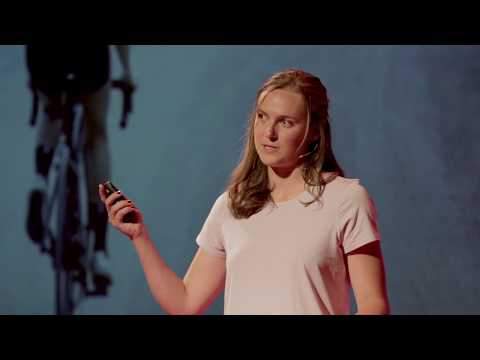
fall forward fall forward
fall forward these words were repeated
to me again and again
as I pursued my career in cross-country
skiing because cross-country skiing and
downhill skiing and mountain biking and
running for that matter in a lot of ways
are all just a controlled fall
it was the difficulty in actually making
my body do the falling that led me to
the thought experiment I’m sharing with
you today I like many here I’m an
athlete I’ve competed and played at
every level from recreational to
professional and in one way or another
have pretty much dedicated my life to
sport and that dedication has been
pretty good for me I like other athletes
have enjoyed the benefits of a healthy
body practice Drive practiced failure
and increased likelihood in a career in
leadership increased academic scores and
I am 20% less likely to get cancer than
my non-sporting companions I think
you’ll agree with me that’s all pretty
great and you’re a smart audience so you
might have noticed by this moment that I
am also a woman turns out being female
complicates the whole dedicating your
life to sport bang at every level at the
youth level girls drop out of sport at a
rate 50% higher than boys while at the
professional level female athletes are
paid on average about a 10th that of
male athletes and I rounded up meanwhile
at the cultural level female voices in
sports media and positions of leadership
range from about one third to one half
those of men so being an athlete an
advocate of woman sports and a really
really competitive person
and I wanted to know why there’s such a
dramatic difference between men and
women’s sports and it turns out there a
host of cultural societal socio-economic
scientific and physiological factors
that have structured women’s sports to
be unequal to men’s in over two years
I took in as much of that quantitative
data as I could
processed it agreed with most of it and
still felt that there was something
missing something more qualitative
because in my experience as an athlete
inequalities were less expressed through
the numbers and more through my direct
experience of not being able to perform
at the level of male athletes in my
sport when I looked at the things that I
struggled with technically to what my
male teammates succeeded at like
propelling oneself for oneself forward
over their skis in order to successfully
fall forward I wondered if the issue may
be just as much a perceptual one as it
was physiological that is I wondered if
maybe the culprit was not in how women
were using their bodies but how we were
experiencing them I wondered what might
happen if instead of using my body I
became my body I gave it a try and the
experience changed the way that I saw my
body perceived space and experienced the
world well beyond sport in her famous
article throwing like a girl
iris Marion young analyzes the way that
little girls and little boys throw balls
and considers how at a point in life
when male and female bodies are nearly
physiologically identical in fact little
girls are often times stronger than
little boys little boys could still
throw balls better than little girls and
their answer goes beyond our parents
teaching us how to throw – how culture
teaches us how to move from here on out
we are going to operate under the not
all that controversial assumption that
ours is a culture that objective
women when a girl grows up in a culture
that objectifies her that places the
majority of her value on the way that
she looks she in turn learns how to
objectify herself and that self
objectification can translate to a kind
of split in self perception where the
body becomes an object for use and the
self is located elsewhere doing the
using for example women will often say
that they imagine what they look like
even when they’re doing menial tasks
like working or walking or playing sport
as if they’re outside of their body
looking in disconnecting from our body
in this way is really getting in the way
of how we move and perform physical
tasks take for example the notoriously
humiliating task that is opening a
pickle jar when a woman considers
herself as merely an object her body
becomes more like a group of objects or
a series of interconnected tools rather
than one whole being and when she tries
and fails to open a pickle jar more
often than not she will hold it out
observe it use the tools closest to the
task at hand namely her knuckles and her
wrist and try to rent you open or not
and the failure of completing that task
translates into lower self-confidence
lower self-esteem and a lower chance
that she will open a jar in the future
and it certainly doesn’t help that we’ve
all been raised taught that women can’t
open jars so instead of inventing silly
expensive gadgets to help women open
jars maybe you need to teach them to use
their entire body their torso their
shoulders their court their entire self
to open a jar as a man might I
experience the pickle jar phenomenon
regularly on skis in order to help me
move my body up and forward over my skis
my coaches would give me physical cues
like
throw your arms up earlier or drive your
knees forward and I would focus so
intensely on those individual parts of
my body that I would look something like
yes and so those at home or those who
are not familiar with cross-country
skiing this is not an efficient way to
move your body because I’m leaving half
of my body behind and that
disconnectedness could be because I grew
up in America where we objectify women
identify myself and treat my body like a
series of objects rather than one single
being and our culture is affecting not
just the way that we move and perceive
our bodies but the way that we perceive
the space that surrounds them in her
same article young suggests that women
experience experience space on a
constrictive scale that is they
designate between the safe space
directly surrounding their bodies and
the unsafe space that is not theirs to
fill women’s movement is therefore
stumped did not only in its
disjointedness but in its ability to
reach stretch take up and move into
uncharted territory because it is
perceived as unsafe so perhaps I
struggled with the spatial and technical
parts of my sport not because I was
weaker or less coordinated or more
fragile than men but because I thought
myself so and that insecurity translated
to a desire for safety which kept me
closer to home so even when I tried to
ski aggressively change direction go to
the side my efficiency was blunted by my
fear of taking up space when I presented
these findings to a group of coaches and
athletes in Vermont a swim coach
approached me and talked about talked
about how upon entering high school his
female athletes chronically shortened
their stroke he was dumbfounded by the
fact that although their limbs were
getting both longer and stronger they
were taking up less space
shortening their strokes and swimming
less efficiently he asked me if I
thought it was because upon entering
high school these young girls were
beginning to identify and objectify as
women and considering the talk I’d just
given I thought that was a fine answer
he then asked me if that meant that as
long as we live in an objectifying
society women will never succeed at
sport at rates proportional to men woof
for someone who self describes as
dedicating her life to sport that would
be a bleak outlook however I have always
believed that my participation in sport
has actually increased my sense of
agency that although women do carry all
of these cultural burdens with them into
sport athletics themselves may be their
remedy and in the 37 years since young
wrote throwing like a girl women’s sport
has evolved to include several counter
examples that show just how empowering
learning to move your body can be there
are sports like rock climbing or
ultramarathon running where women do
achieve at rates equal to or higher than
men another fantastic female philosopher
Diane Chisholm wrote a counter article
to Young’s called climbing like a girl
where she uses the accomplishments of
Lynne hill the first climber to ever
free climb the nose about Capitan in
Yosemite
even though dozens of people had tried
it before her and no one male or female
was able to accomplish it for over a
decade afterwards
she used that accomplishment to show
that the whole inhibited movement
concept is a result of culture not a
sentence to failure so what’s the
difference
what male in Hill and athletes like her
transcend all of these physical cultural
barriers that hold so many women back I
argue it’s that they think a little
differently and you can too
it all has to do with how we think of
ourselves our bodies and our space if we
begin thinking of ourselves as extended
through our entire bodies we can move
more efficiently and effectively through
space if we begin thinking of our
fingers of our toes our knees our ankles
and lungs as more than just vessels or
tools but part of who we are we will
experience the world in a more connected
way if when you open that pickle jar you
use more than your knuckles and your
wrists but your torso your shoulders
your entire self and put yourself into
it it’s gonna open and when you ski if
you experience each movement as it
happens here and here and here and here
you will be able to move forward over
your skis but in order to really extend
you have to see that space in front of
you is yours to take one of the main
barriers to free movement for women is
failure or fear fear of failure fear of
an unknown experience or fear of injury
but once you’ve acknowledged that fear
you’ve recognized a barrier and what
good is a barrier if not to be overcome
move into the space in front of you
recognize it take it take up the space
before you beside you behind you move
into it and take it and recognize that
you have the power to move that there is
no difference between here and there
move like men hill did move the way that
your body was built to and you may just
fine
find that yours can do things that other
bodies can’t
and once you’ve extended your body and
taken up some space use your experiences
to inspire others one of the main
reasons that women have trouble owning
the space around them and their bodies
is because other women do as well but as
leadership and mentorship grows in
women’s sport so will access and so will
opportunity that’s why I’m here today I
am a product of title nine which 45
years ago began increasing women’s
access to sport I’m a product of the
women’s Sports Foundation and other
nonprofits whose sole goal it is to
educate and support female athletes I am
here because my parents believed that I
could accomplish just as much in sport
as my brothers thanks mom these are the
forces that change the way that we teach
our daughters treat our teammates and
encourage our competitors and I want to
be clear that what I’m speaking of today
can be experienced by any person at any
age in and out of sport whether you’re a
product or a writer of title 9 because
the more women who are willing to try to
reach to extend and to play the more we
will experience movement free of
cultural barriers and although sport can
be a microcosm of a host of constricting
societal factors it is ultimately a
freeing educational and empowering
activity it is for me because when you
really go for it really learn how to
fall the only direction you can go is
forward thank you
[Applause]
Please follow and like us: