
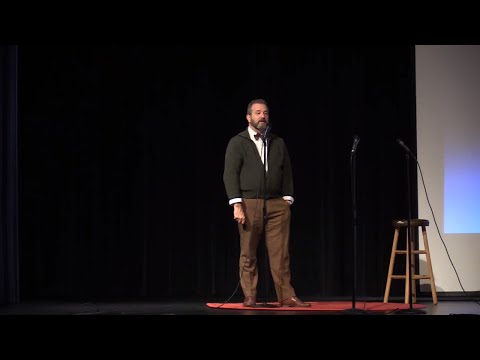
somebody named Joe hammock an art
therapist currently working a private
drug and alcohol facility here in
Pennsylvania and I’m going to tell you
the story of my journey from active
addiction and isolation to recovery and
connection I’ll say that when I was
growing up I was a little bit
mischievous I was a lover of all things
art and though I didn’t have a name for
it I was gay my dad was not he was
cerebral he was well-read and a lover of
baseball he later became a senator but
he worked as an attorney and he was kind
of eccentric and I loved it but later on
he became the judge and I realized that
he judged very well and when I was
growing up I was small I was made fun of
a lot I don’t think I hid the fact that
I was gay very well and I got made fun
of and so I started to using drugs and
alcohol at age 13 and for me when I
first started using it was that I could
escape from the pain that I felt
to change the way I thought other people
perceived me when I used I felt like I
was funny earlier I felt like I
connected with people in ways that I
couldn’t if I didn’t use and for a long
time it became a go-to it was a it was a
major coping skill eventually it left me
alone
that left me isolated and it left me in
a place that wouldn’t wish on anyone on
October the 24th 2004 my family
intervened on me and it was like an
explosion in the living room I was
nervous and I kept telling myself
they’re going to be fine they’re gonna
be fine I remember looking around and
thinking of all of the things that had
lost I lost I lost an eight-year
relationship I had lost a career in
architecture I’d lost myself used in
order to make myself feel normal
and really all I felt was not and I
remember in that intervention my dad
saying you’re gonna have to leave today
and it was really really scary
I kept thinking back though I could hear
his words and the words of the
intervention to something that my dad
set when I first came out at 17 he said
if you choose this lifestyle of being
gay you’re going to end up alone and
you’re going to be hanging out with
to addicts and alcoholics and I didn’t
want that to be true I had fought so
hard and most of my life to make that
not true
and there I was sitting in this
intervention with my three sisters
crying my moms crying those words
typical running around in my head and
the interventionist looked at me and she
says do you have any stuff to hear and
of course I said and then she said how
are you feeling
and I said I’m feeling fine feeling fine
and she said why don’t you go to the
bathroom and do what you do best and
that was the last time I got time I went
to rehab and was in rehab
I learned that addiction is a brain
disease and it alters the way we think
it alters the way we feel and alters the
way we behave it changes our perception
it’s not just while you’re doing the
drug but in between the times that
you’re doing that it’s very demanding
when I used twisty and I felt exactly
likely to find pictures that you see
almost like there was a mask over my
head it distorted the way I presented
myself and it distorted the way life
presented to me as a part of mine we
have experienced my parents joined me
and during that part there was something
that we were asked to do which is
creating a family an abstract portrait
this is the portrait that I created with
my mom and my dad in the center my three
sisters around the outside but there’s
and then this was me at the top and one
of the things that they asked us to do
with the image is include addiction and
so I included an addiction in my image
and that’s what it looked like for me in
that moment I realized that I could
connect with my thoughts and my feelings
better through the artwork than to
talking to somebody else about it and it
really really resonated for me I ended
up completing rehab and going into a
sober living facility in Washington DC
and while I was there I was really
excited I was thinking I’m gonna get
back into architecture
now therapists at the time however had
other ideas and they said why don’t you
get a recovery job because if you’ve
been in treatment for five months
inpatient because I was really sick I’m
just gonna come in and you’re not going
to know how to manage to your lives
especially something as demanding as
architecture unless you get a recovery
job I had friends in recovery and those
were really really important to me I had
started talking to my dad again and he
kept asking me questions
why doesn’t build our work are you sure
this is going to work all of these
questions kept coming and I knew that he
didn’t understand it I had started to
understand that
and was moving along in my recovery the
job that I got is my recovery job is
working at the front desk at our salon
it was a humbling experience it’s far
far cry from architecture on a
particularly difficult Saturday when
stylists weren’t showing up we were
overbooked I was losing my noodle and at
the end of the day I got a phone call on
ourselves from my dad and he called me
and he said hey I have a question for
you and I said sure dad what’s that he’s
like are you still using and I was like
no I’m not using he said that he’s still
too when the therapy as a yeah still
doing the therapy and then he said
something that really struck a chord
nerve booth he said when you never get a
real job and I had done enough therapy
and work through the anger with my dad
during the time that I was in rehab I
realized that you know our parents
aren’t given instruction manuals for us
when we’re born and we’re not given
instruction manual
an addiction certainly did to help any
of that but I said to him you know when
you say that sometimes it makes me feel
like I’m not doing enough of my recovery
and it makes me feel like maybe I’m not
going to make it but most of all it
makes me feel that I’m never going to be
worthy Hittner honest and there was a
long ear he paused and he said to me I
was just worried and concerned about you
and for the first time I could actually
hear it I could hear the emotion in his
voice
it wasn’t judgmental it wasn’t caustic
he was really concerned and I realized
that most of his life that was probably
true and he came out as judgment and it
was my misinterpretation and my use that
distorted that but he wasn’t very good
at emotions either and it was a powerful
moment for me a lot of my friends in
recovery could see that I was doing well
they could see it before I could see it
I eventually did get an architecture job
and I lost it in a month was the first
architectural job that I was ever fired
from pretty embarrassing to say but
that’s another story
and they said well since you’ve got so
much time on your hands why don’t you go
to this retreat
so I went to that retreat I was thinking
about the conversation that I had with
my dad and what all of that was like and
how I had told him so many times that I
was fine how many times that that word
really didn’t mean what it meant after I
lost a job my friend said you know how
are you feeling and when I was at the
retreat what I realized is that by means
effed-up insecure
nerado and emotional and it made a lot
of sense and all of us at that retreat I
met someone that was incredibly
instrumental in changing my life she was
an art terrorist and she told me a
little bit about it and she unknowingly
opened the door and I ran right into it
the next couple of months and years
looked a little bit like this I call the
juggling flaming chaos falls because I
was doing part-time work in the daytime
I was going to psychology courses
because I had a degree in architecture
not psychology so it’s taken
undergraduate coursework in psychology
and at nighttime I was taking studio art
career it was exhilarating that it was
also an interesting way to reinforce the
recovery and reinforce the connections
my family started trusting me a lot more
I was telling the truth I wasn’t hiding
parts of myself and most importantly I
wasn’t using I applied to graduate
school I got accepted and after two and
a half years I graduated and while I was
in graduate school I learned a lot about
how you can use art in therapy and I
want to talk a little bit about that
right now
just as I said addiction affects the
brain the way we think and feel and
behave art also functions as an
intermediary between your
and who you are as a person and it works
on the thought level the feeling level
and the behavioral level and it’s going
to show you some examples of that the
first one on the right hand side you see
Clark Kent and on the left hand side you
see Superman in active addiction I used
a lot I used manipulative manipulation
and they used a shroud of secrecy to
keep myself protected from other people
knowing that I was using and that’s kind
of like Clark Kent he had to keep those
secrets he had to lie about who he
really was in order to keep his
superhero Superman protected Superman I
used in this because of that cognitive
defense of perfection is also what I
used in architecture I learned if I do
things perfectly then no one questions
me and if I attempted to do things
perfectly in life no one questioned me
and it’s a great way to hide active
addiction that’s a cognitive kind of
approach it works both targeted lis and
symbolically it’s very much tracked and
it’s on the same level in terms of the
effect level or the emotional level
that’s kind of the mid region of the
brain and when you look at this image
what is your reaction
for me this is anger this is a shame
this is what it felt like to really look
at my past with image on this die and
for many people it’s scary this is
actually a mandala and Mangala means the
spiritual which you can kind of see the
circle here but there was a lot of paper
shredding and a lot of crayon
destruction when I created this the
other thing that I’ll say is that same
kind of thing on that effective
works as well and in recovery I felt
connected and this is a very different
image it’s still modeling it’s very
different this was about joy this is
about finding my self again this is
about connecting with people especially
like my dad both of those images depict
the way that mark can work on that
affective affective level through
perceptions the lowest is on the
physical and I can utilize
and pound out my aggression on this
Kenneth’s kinesthetic to Tharsis getting
it out just through using use of the
clay in a physical manner but I can also
use it to create essential lines of a
model space the curves of the djinn the
curves of the thing and it really did
connect you back to the physical because
you’re actually using your hands in
order to create that all three of these
levels that use as an art therapist and
they’re very effective
they actually casein the recovery
process for most people because they’re
not just sitting around there talking
they’re actually doing feeling thinking
and behaving differently it’s really
really important at the end of my
graduate school I had a party that was
there on campus and my family came to it
and this is probably some of the most
important part of my family that I
reconnected to an active addiction it’s
a main reason why I got sober and I
introduced my nieces and nephews that’s
who they are to one of my professors and
during that time the party about
and one of the professor’s came up to me
and she whispered in my ear and she said
there’s a really creepy man playing with
your nieces and nephews in the corner
and I looked over and I saw a pair of
black and orange tennis shoes
fuchsia running man’s socks that had
embroidered rabbits and carrots a green
windbreaker and a tweed hat and I said
yeah don’t worry about that that’s my
dad a left graduate school I worked at
mhm for a little while and then I got
the job but I currently have and it’s
been an incredible experience it’s very
different for me then where I thought I
was going when I started this journey
thirteen years ago all I wanted to do is
get my family out of that intervention
go do my 30 days and then move back
where I was from and that didn’t happen
at all I never thought that I would be
doing art therapy but that’s the way my
recovery unfolded there’s lots of lenses
that we look at life through for me
addiction only allow me to see through
one lens through the process of recovery
through the process of change through
the process of being able to pursue
things that I didn’t realize that I
could pursue different lenses can be
used at different times just like an art
therapy whether that’s on the thought
processes the feeling process
the behavioral processes it’s really
important and it’s a really important
way to kind of approach life now and I
loved the experience for it I was
exhilarated in college it was a new
chapter and it was one again that I
didn’t think was going to be possible
about three years ago my dad was
diagnosed with cancer and there was a
lot of things that I wanted to make sure
that I said and that I did with him to
make sure that there wasn’t anything
that was left out because my 26 years in
active addiction
my relationship with em was not that
great and so I went home when my parents
lived and my dad was in that he was
frail he was going blind and he’s like
hey Joe what’s going on and I said we
need to talk and he’s like we’re not
going to be doing any more of that
therapy stuff and I said well we kinda
are and he just stopped me with his one
good eye he’s like you just need to know
that we’re really really good and that
was so important to me because I
realized that I have made it through
something that a lot of my friends did
make it through a lot of my friends have
died from this addiction it’s not fair
but it’s true
my dad died three years ago and I spoke
at his funeral and after the funeral was
over a fellow judge that he worked with
came up to me and he said he didn’t know
my dad for about thirty years and he
said some amazing things to me he said
your dad and I talked a lot and he was
really really not fine during that
intervention because he thought he was
losing this farm and he said he was
really surprised when you called him
from that recovery job and told him what
you told him because he could see the
changes and that surprised and he was
never more proud than when you got your
graduate degree and he was able to play
with your nieces and nephews at the
party and I realized that my dad and I
had a lot more in common than I ever
realized we were both kind of emotional
cripples and my recovery process helped
me to reconnect with me with my emotions
but more importantly my family and
specifically my dad I was watching the
World Series this past month and my dad
loved baseball he loved watching the
World Series maybe not so much but I got
emotional and I started crying and I
realized that I miss my dad I miss him a
lot
I miss talking to him I miss the 10
years that we had after I got sober and
Owen traded through the world but I also
realized that it wasn’t fine but when
thinking about the relationship I had
with my dad
those words that I did have with them
and though we were not fine for most of
our lives in the end we were really
really
[Applause]
Please follow and like us: