
[Music]
[Music]
[Applause]
these beautiful children are the
children of my children they’re safe
they’re free they are spirited and
they’re happy they have one thing in
common with the rest of their generation
that in the year 2100 they will all be
in their 80s by that time all of you
will be well past that point but there’s
one thing or a couple of things that
scare me about that and that is what
kind of world are we leaving behind for
this generation my generation is what I
call the locust generation because we’ve
consumed almost everything in front of
us and what have we left behind for this
generation now let me share with you a
photograph that I took only a week ago
in a place that shall remain nameless
not that long ago probably 20 or 30
years ago that piece of land was
productive
it is now desertified with salt and in
Australia today there’s an area the size
of a football field disappears under
salt every hour and we’re degrading the
planet at that sort of rate and it’s not
just an Australian disease and so what
is it that might reverse that and what
is it that history might be able to
teach us now what I’ve done is I’ve
taken the the history of the world or
most of it 550 million years of it now I
don’t know how good your brain is but
mine can’t handle fire
hundred and fifty million years so I’ve
said well what happens if one year
equals one second and we condense world
history down on that basis and we end up
with the world history that is seventeen
and a half years old and back there five
and a half five hundred and fifty
million years ago the first thing that
started out was crustaceans shelled
animals at that point the atmospheric
co2 was seven thousand parts per million
but taking carbon out of the atmosphere
those organisms lowered over the next
hundred and seventy-five million years
load atmospheric co2 to about four
thousand parts per million ten times
greater than it is today then Along Came
rooted plants and plants with leaves and
mother nature invented 380 million years
ago photosynthesis and as photosynthesis
took off we lowered the co2 from four
thousand parts per million to five
hundred parts per million which back
then would have almost made the earth a
place we could live in during that phase
where we took all of that co2 out of the
atmosphere it had to go somewhere and it
went into vegetation that vegetation
eventually formed what we use today as
fossil fuel energy then about 30 40 50
million years after that
Along Came organisms that had the
ability to break down lignin now if
those organisms had arrived on earth
before coal seam and coal were actually
formed we would have no coal so then
what happened is that co2 went up again
because those organisms started
releasing carbon back into the
atmosphere and then five years ago on my
timeframe plants are flowering plants
arrived on earth
and then the rate of use of co2 from the
atmosphere started to accelerate again
and then we got some grazing animals and
man appeared and if we look at how long
man has actually been in the system it’s
one and a half days out of seventeen and
a half years where New Kids on the Block
Mother Nature and Earth has survived
quite well without us for a very very
long time
and she does not need us so how can this
375 million year old technology help us
with some of the issues we face on earth
today what Mother Nature created is a
thing called the carbon cycle or the
life cycle and that’s the process of
birth growth reproduction death and
decay every living thing is created from
that carbon cycle and during the process
of birth growth and reproduction
photosynthesis drives carbon out of the
atmosphere and into every living thing
but that has to be balanced and on the
other side of the equation we have
oxidation wherein Mother Nature also has
a lot of tools that release that carbon
back to the atmosphere again and so we
have carbon going around and around in a
circle sequesteration is leaving
something behind each time we go around
that particular cycle if we look at how
much carbon there is in that cycle on an
annual basis there’s a hundred and fifty
gigatonnes of carbon cycle through
nature’s natural systems on an annual
basis there’s about 800 Giga tons of
carbon in the atmosphere
there’s 610 Giga tons of carbon in all
of education on earth and there’s
fifteen hundred and eighty Giga tons of
carbon in the top meter of soil so if
you add up
the carbon in the atmosphere in the
carbon in all the vegetation on earth it
does not equal the amount of carbon in
the top meter of soils now it’s
estimated that as people we emit about
10 Giga tons of carbon a year from
burning basically fossil fuels and the
manufacture of cement so to me it’s a
fairly easy ask to take 10 Giga tons of
carbon and put it away in a fifteen
hundred and eighty Giga ton storage
every year and I remember as a kid there
was a right there was a radio program
called the goons and there was a
character in the goons who was an old
farmer from somewhere in the West
country in England and his answer to
every question was well I think the
answer lies in the soil and I think the
answer lies in the soil but how do we
get carbon into the soil and we’re all
well aware of a thing called
decomposition so as plants decompose
they come move from being organic matter
into organic carbon and it’s the biology
in the soil that actually does that but
that’s only part of the story the most
important part of the story driven by
photosynthesis is what’s called the
liquid carbon pathway and that is that
when a plant photosynthesizes it takes
carbon out of the atmosphere and creates
sugar and it takes about 40 to 50
percent of that sugar every day and puts
it down through the roots and out into
the soil and its purpose in doing that
is to feed the soil microorganisms and
if we were to take a teaspoon of healthy
soil we could find around about a
billion microorganisms in that soil but
we have agricultural systems around the
world where we’re basically forced to
overuse our environments and the reason
for that is that the true cost of
producing food is not paid for
Australia is a great example the
Australian population has never starved
and therefore we don’t value food for
its real cost somewhere on the line
farmers have to be compensated to stop
them having to mine these resources
which cannot be mined forever and so
what do we actually need what do my
grandchildren need to be healthy safe
and secure in the future they need
biodiversity in their ecosystems they
need healthy soils they need healthy
plants which will produce healthy
animals which will produce healthy food
which will produce healthy people every
one of us is linked right back to the
soil health that we all depend on I look
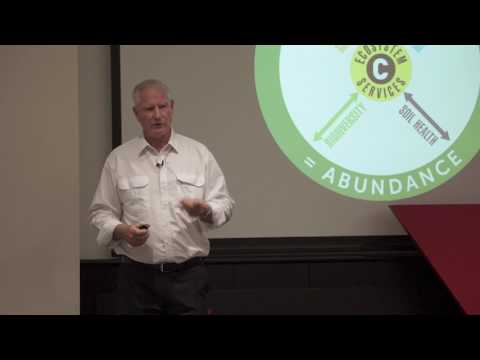
at an ecosystem is as a pie
the center of that pie is carbon and we
have ecosystem services and around the
edge of that pie we have another a
number of other elements and for the
last couple of hundred years at least
and and I would say for probably the
eight thousand years that Agriculture’s
been going we have been shrinking the
size about ecological pie every part of
that pie is interlinked but if we can
shrink it through mismanagement and lack
of knowledge it makes sense to me that
with knowledge and good management we
can actually expand that pie we can add
more carbon into our systems we can have
more ecosystem services better water
cycle better mineral cycle better soil
health biodiversity energy flow which is
how well we utilize sunlight energy we
can expand that entire system and in the
grazing industry you might look at that
fence there and say well one guy there
had a lot of rain and the other guy
didn’t get it no the difference is two
different guys one knows how to manage
land and the other one knows how to
abuse it and unfortunately it’s
basically the way the world operates but
when we know how to manage it
we actually start to spiral that
ecosystem up we build the size of that
pie because everything in that pie is
interrelated and when we change one we
change everything else and as it goes up
but the guy on the right his neighbor is
on a spiral dive down that ecosystem is
getting less and less productive every
year requires more and more inputs it’ll
make less and less money for that farmer
and yet you wonder he looks over the
fence and why doesn’t he develop an
ecosystem that can spiral up I wonder
that too and we could also do it in
farming systems and there’s new
approaches using biology that is that
are created through particular
composting techniques that we can add to
crops as they’re planted now the
outstanding thing about that there if
you don’t really know much about root
systems is that you can see a very small
plant there and a very large root system
that root system is being protected by
the biology that was put there with that
seed that plant was another photograph I
took about two weeks ago in drought that
particular crop had received 10 mils of
rain and nothing for five weeks and that
the little seedling there is not even
wilting and that’s because Mother Nature
and those organisms are actually
protecting it and looking after it and
getting it ready for when it does rain
and that’s the same property a previous
crop on that piece of land without
chemicals and fertilizers and the inputs
that we take for granted are needed in
cropping systems we can change what
we’re doing there are some outcomes that
I think we need and these are outcomes
that I would ask for firstly we need to
understand that farming practices
worldwide can take carbon out of the
atmosphere can improve soils in other
words we really just have to change the
which were doing it but the farmers who
are doing that are prepared to do that
need to be rewarded in farming there’s a
thing called the valley of death in that
we have a conventional farming system
here and we have a beautiful ecological
system over here but to get from a
system that I class is being run on
heroin to a system that’s run
biologically you often have to go
through the valley of death and that
valley of death is an economic one
farmers need help and encouragement to
take on that valley of death and
therefore we need to understand as
consumers that we need to be prepared
either to pay more for food or to
support eco credits or carbon credits
that go to farmers that do the right
thing by our national asset which is our
ecosystem and if we do that it’s a win
win win win in every direction it’s a
win for the terrestrial and ecosystem in
this country in any other country that
does it because we’re adding carbon to
the soil which increases the water
holding capacity there’s a win for you
as consumers because that gives you food
security which is currently under threat
it gives you water security which is
currently under threat and those are two
of the biggest things that give me fear
about the future for my grandchildren
it’s a win for the atmosphere because
we’re taking co2 out of the atmosphere
and we’re able to influence that change
that’s already happening in our climate
and it’s a win for consumers because
you’ll end up getting better quality
food there is absolutely nothing about
this that doesn’t work for every person
in society and all I ask is that for
this generation of these beautiful
little people that every one of us take
responsibility and do something to help
change the environment and the attitudes
in which we live if we can just change
some policy if we can change the way in
which we’re prepared to spend our dollar
then we can help secure the future for
this generation
[Applause]
[Music]
you
[Music]
[Music]
[Applause]
these beautiful children are the
children of my children they’re safe
they’re free they are spirited and
they’re happy they have one thing in
common with the rest of their generation
that in the year 2100 they will all be
in their 80s by that time all of you
will be well past that point but there’s
one thing or a couple of things that
scare me about that and that is what
kind of world are we leaving behind for
this generation my generation is what I
call the locust generation because we’ve
consumed almost everything in front of
us and what have we left behind for this
generation now let me share with you a
photograph that I took only a week ago
in a place that shall remain nameless
not that long ago probably 20 or 30
years ago that piece of land was
productive
it is now desertified with salt and in
Australia today there’s an area the size
of a football field disappears under
salt every hour and we’re degrading the
planet at that sort of rate and it’s not
just an Australian disease and so what
is it that might reverse that and what
is it that history might be able to
teach us now what I’ve done is I’ve
taken the the history of the world or
most of it 550 million years of it now I
don’t know how good your brain is but
mine can’t handle fire
hundred and fifty million years so I’ve
said well what happens if one year
equals one second and we condense world
history down on that basis and we end up
with the world history that is seventeen
and a half years old and back there five
and a half five hundred and fifty
million years ago the first thing that
started out was crustaceans shelled
animals at that point the atmospheric
co2 was seven thousand parts per million
but taking carbon out of the atmosphere
those organisms lowered over the next
hundred and seventy-five million years
load atmospheric co2 to about four
thousand parts per million ten times
greater than it is today then Along Came
rooted plants and plants with leaves and
mother nature invented 380 million years
ago photosynthesis and as photosynthesis
took off we lowered the co2 from four
thousand parts per million to five
hundred parts per million which back
then would have almost made the earth a
place we could live in during that phase
where we took all of that co2 out of the
atmosphere it had to go somewhere and it
went into vegetation that vegetation
eventually formed what we use today as
fossil fuel energy then about 30 40 50
million years after that
Along Came organisms that had the
ability to break down lignin now if
those organisms had arrived on earth
before coal seam and coal were actually
formed we would have no coal so then
what happened is that co2 went up again
because those organisms started
releasing carbon back into the
atmosphere and then five years ago on my
timeframe plants are flowering plants
arrived on earth
and then the rate of use of co2 from the
atmosphere started to accelerate again
and then we got some grazing animals and
man appeared and if we look at how long
man has actually been in the system it’s
one and a half days out of seventeen and
a half years where New Kids on the Block
Mother Nature and Earth has survived
quite well without us for a very very
long time
and she does not need us so how can this
375 million year old technology help us
with some of the issues we face on earth
today what Mother Nature created is a
thing called the carbon cycle or the
life cycle and that’s the process of
birth growth reproduction death and
decay every living thing is created from
that carbon cycle and during the process
of birth growth and reproduction
photosynthesis drives carbon out of the
atmosphere and into every living thing
but that has to be balanced and on the
other side of the equation we have
oxidation wherein Mother Nature also has
a lot of tools that release that carbon
back to the atmosphere again and so we
have carbon going around and around in a
circle sequesteration is leaving
something behind each time we go around
that particular cycle if we look at how
much carbon there is in that cycle on an
annual basis there’s a hundred and fifty
gigatonnes of carbon cycle through
nature’s natural systems on an annual
basis there’s about 800 Giga tons of
carbon in the atmosphere
there’s 610 Giga tons of carbon in all
of education on earth and there’s
fifteen hundred and eighty Giga tons of
carbon in the top meter of soil so if
you add up
the carbon in the atmosphere in the
carbon in all the vegetation on earth it
does not equal the amount of carbon in
the top meter of soils now it’s
estimated that as people we emit about
10 Giga tons of carbon a year from
burning basically fossil fuels and the
manufacture of cement so to me it’s a
fairly easy ask to take 10 Giga tons of
carbon and put it away in a fifteen
hundred and eighty Giga ton storage
every year and I remember as a kid there
was a right there was a radio program
called the goons and there was a
character in the goons who was an old
farmer from somewhere in the West
country in England and his answer to
every question was well I think the
answer lies in the soil and I think the
answer lies in the soil but how do we
get carbon into the soil and we’re all
well aware of a thing called
decomposition so as plants decompose
they come move from being organic matter
into organic carbon and it’s the biology
in the soil that actually does that but
that’s only part of the story the most
important part of the story driven by
photosynthesis is what’s called the
liquid carbon pathway and that is that
when a plant photosynthesizes it takes
carbon out of the atmosphere and creates
sugar and it takes about 40 to 50
percent of that sugar every day and puts
it down through the roots and out into
the soil and its purpose in doing that
is to feed the soil microorganisms and
if we were to take a teaspoon of healthy
soil we could find around about a
billion microorganisms in that soil but
we have agricultural systems around the
world where we’re basically forced to
overuse our environments and the reason
for that is that the true cost of
producing food is not paid for
Australia is a great example the
Australian population has never starved
and therefore we don’t value food for
its real cost somewhere on the line
farmers have to be compensated to stop
them having to mine these resources
which cannot be mined forever and so
what do we actually need what do my
grandchildren need to be healthy safe
and secure in the future they need
biodiversity in their ecosystems they
need healthy soils they need healthy
plants which will produce healthy
animals which will produce healthy food
which will produce healthy people every
one of us is linked right back to the
soil health that we all depend on I look
at an ecosystem is as a pie
the center of that pie is carbon and we
have ecosystem services and around the
edge of that pie we have another a
number of other elements and for the
last couple of hundred years at least
and and I would say for probably the
eight thousand years that Agriculture’s
been going we have been shrinking the
size about ecological pie every part of
that pie is interlinked but if we can
shrink it through mismanagement and lack
of knowledge it makes sense to me that
with knowledge and good management we
can actually expand that pie we can add
more carbon into our systems we can have
more ecosystem services better water
cycle better mineral cycle better soil
health biodiversity energy flow which is
how well we utilize sunlight energy we
can expand that entire system and in the
grazing industry you might look at that
fence there and say well one guy there
had a lot of rain and the other guy
didn’t get it no the difference is two
different guys one knows how to manage
land and the other one knows how to
abuse it and unfortunately it’s
basically the way the world operates but
when we know how to manage it
we actually start to spiral that
ecosystem up we build the size of that
pie because everything in that pie is
interrelated and when we change one we
change everything else and as it goes up
but the guy on the right his neighbor is
on a spiral dive down that ecosystem is
getting less and less productive every
year requires more and more inputs it’ll
make less and less money for that farmer
and yet you wonder he looks over the
fence and why doesn’t he develop an
ecosystem that can spiral up I wonder
that too and we could also do it in
farming systems and there’s new
approaches using biology that is that
are created through particular
composting techniques that we can add to
crops as they’re planted now the
outstanding thing about that there if
you don’t really know much about root
systems is that you can see a very small
plant there and a very large root system
that root system is being protected by
the biology that was put there with that
seed that plant was another photograph I
took about two weeks ago in drought that
particular crop had received 10 mils of
rain and nothing for five weeks and that
the little seedling there is not even
wilting and that’s because Mother Nature
and those organisms are actually
protecting it and looking after it and
getting it ready for when it does rain
and that’s the same property a previous
crop on that piece of land without
chemicals and fertilizers and the inputs
that we take for granted are needed in
cropping systems we can change what
we’re doing there are some outcomes that
I think we need and these are outcomes
that I would ask for firstly we need to
understand that farming practices
worldwide can take carbon out of the
atmosphere can improve soils in other
words we really just have to change the
which were doing it but the farmers who
are doing that are prepared to do that
need to be rewarded in farming there’s a
thing called the valley of death in that
we have a conventional farming system
here and we have a beautiful ecological
system over here but to get from a
system that I class is being run on
heroin to a system that’s run
biologically you often have to go
through the valley of death and that
valley of death is an economic one
farmers need help and encouragement to
take on that valley of death and
therefore we need to understand as
consumers that we need to be prepared
either to pay more for food or to
support eco credits or carbon credits
that go to farmers that do the right
thing by our national asset which is our
ecosystem and if we do that it’s a win
win win win in every direction it’s a
win for the terrestrial and ecosystem in
this country in any other country that
does it because we’re adding carbon to
the soil which increases the water
holding capacity there’s a win for you
as consumers because that gives you food
security which is currently under threat
it gives you water security which is
currently under threat and those are two
of the biggest things that give me fear
about the future for my grandchildren
it’s a win for the atmosphere because
we’re taking co2 out of the atmosphere
and we’re able to influence that change
that’s already happening in our climate
and it’s a win for consumers because
you’ll end up getting better quality
food there is absolutely nothing about
this that doesn’t work for every person
in society and all I ask is that for
this generation of these beautiful
little people that every one of us take
responsibility and do something to help
change the environment and the attitudes
in which we live if we can just change
some policy if we can change the way in
which we’re prepared to spend our dollar
then we can help secure the future for
this generation
[Applause]
[Music]
you
[Music]
Please follow and like us: