
and as a biologist I’m particularly
fascinated with how Darwinian evolution
has played a role in shaping our minds
and motivations today I’d like to talk
work hard play hard what does it mean it
implies an expected relationship between
working hard and playing hard but why
might we expect this perhaps we might
expect it if playing hard represents a
recovery from having to work hard or
maybe playing hard is a goal that
requires working hard in order to
achieve or to earn in other words maybe
some people many people work to live and
live to play but we might also
reasonably expect a negative trade-off
relationship in other words more work
might leave less time for play with
workaholics at one end and hedonists at
the other or perhaps their relationship
is largely mythical is there even any
evidence that people who tend to work
hard also tend to play hard I searched
everywhere I could think of but I could
find no published data and so I recently
was involved in a survey study together
with a student Laura Cryme involving a
large sample population of Queens
University undergraduate students our
goal was to test the work hard play hard
hypothesis in other words we asked do
indicators of attraction to work
correlate with indicators of attraction
to play
we measured attraction to work in terms
of potential indicators of attraction to
accomplishment or fame we assumed
therefore that recognition or fame is
the principal goal and that striving for
these
commonly involves striving for
accomplishment of some sort we asked
students on a scale of one to seven how
important is each of several possible
pursuits as a potential life goal for
example involving success in a reputable
career of some sort we also asked how
many friends do you regularly associate
with and how many Facebook friends do
you have
we measured attraction to play in terms
of activities that one might pursue for
pleasurable free time indulgence for
this we asked students on a scale of one
to seven how important is each of many
pleasurable activities as a source of
leisure in your life for both of these
we collapse the responses into a single
index ranging from zero to one with all
questions weighted equally and here are
the results showing a very strong and
significant positive correlation
individuals who have high attraction to
work also tend to have a relatively high
attraction to play or leisure and so the
work hard play hard phrase is not just
mythical or an ideological cliche it
actually exists as a particular pattern
of Ko variation in motivations at least
for our sample of university students
but the critical question is why why
would we expect work hard play hard to
be associated with each other as a
biologist I’m particularly interested in
on whether we can understand this work
hard play hard relationship in terms of
the evolutionary roots of human
motivation and so what are the main
categories of human motivation these
animals are creatures who spend their
whole lives just trying to get fed stay
alive and get laid that’s about it
but that’s all they need in order to
leave descendants in other words for
gene transmission success which is what
biologists call evolutionary fitness and
these extinct species of early humans
were also probably creatures who spent
their whole lives just trying to get fed
stay alive and mate with each other and
this is certainly true of chimpanzees
our closest living genetic relative in
the family of great apes survival
insects done well is pretty much all
that these animals require in order to
transmit successfully gene copies into
future generations and of course our
species must also accomplish these in
order to leave descendants but the
motivations of modern humans include so
much more as a claim philosopher Albert
Camus said we humans are creatures who
spend our whole lives trying to convince
ourselves that our existence is not
absurd our species inherited genes from
ancestors that gave us an awareness of
time an awareness of self and an
awareness that others also have
self-awareness this gave us a whole new
advanced toolkit for social intelligence
on a scale unavailable to other animals
but this self-consciousness also gave us
a capacity to foresee our own mortality
a being who knows that he will die arose
from ancestors who did not know now this
might have been all well and fine but
natural selection was not finished it
also gave us an anxiety about this but
not so much about the eventual
experience of literal death but rather
it gave us an anxiety about what
eventual death imposes impermanence of
the self self impermanence anxiety is
about worrying that one’s life is absurd
meaningless pointless without purpose it
is a fear of not being able to leave
something of oneself for the future
not just because time brings eventual
death but more importantly because in
bringing eventual death time inevitably
annihilates all that we do in all that
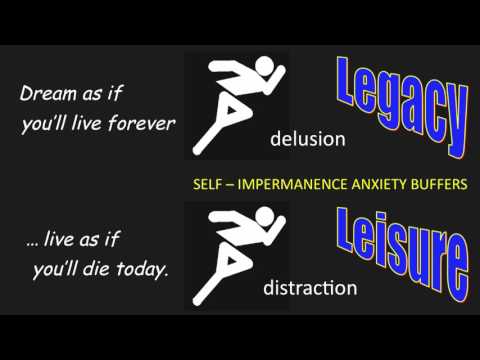
we are and so evolution has given us
some self impermanence anxiety buffers
involving two main types and they are
represented particularly well in this
well-known manifesto for life dream as
if you’ll live forever live as if you’ll
die today the first of these is just a
delusion above being able to leave a
legacy something of oneself that will
transcend death and the second is a
distraction provided by leisure free
time indulgence in opportunities for
pleasure and so we humans have more than
just a survival Drive in a sex drive we
are also motivated by what I call a
Darwinian evolution then I suggest has
shaped our minds with motivations that
convinced us that our lives have meaning
in terms of being able to achieve a
sense of self impermanence but it has
also given us an ability to distract
ourselves from the nagging worry that it
probably doesn’t have self impermanence
legacy and leisure drives then I
suggests our components of our evolved
psychology because our predecessors who
lacked them generally did not become our
ancestors because they were unprotected
from the curse of consciousness or self
impermanence anxiety and so they were
less likely to reproduce and so play
hard I suggest is rooted in our deeply
ingrained disposition to be easily
distracted by leisure
work hard is rooted in our deeply
ingrained susceptibility to delusions of
legacy and in particularly a particular
interestingly this interpretation of the
human condition
driven by intrinsic needs for both
delusions and distractions is echoed in
what appears to be the earliest
published reference to the work hard
play hard phrase in this book from
almost 200 years ago on page 602 we have
whatever is done should be habitually
done with earnestness in every pursuit
exertion should be employed work hard
and play hard always recollecting that
Klassen’s the stillness inactivity is
destructive to the mental welfare the
work hard play hard phrase also appears
in this 1885 book as part of an
advertisement for a religious college in
the United States there it appears as
part of a motto involving not just work
hard and play hard but also pray hard
and so cultural domains for legacy
delusion involve more than just
accomplishment it commonly also involved
religion as philosopher James feeble man
wrote the human individual knows that he
must die but has thoughts larger than
his fate religion is an effort to be
included in some domain larger and more
permanent than mere existence but the
most rudimentary delusion for legacy in
terms of evolutionary roots is obviously
Parenthood as evolutionist theodosius
dobzhansky wrote man has a hope perhaps
an illusory one that he somehow survives
in his descendants a life devoted to
one’s family into one’s progeny seems to
acquire a meaning it may be experienced
as capturing a particle of an
immortality which is beyond the reach of
an in
other animals have offspring only as an
incidental consequence of sex drive but
only humans hope and plan for offspring
and then spend much of their lives
seeking pride in them and so in our
survey of University students we also
asked several questions to measure their
level of attraction to religion and also
several questions to measure their level
of attraction to Parenthood and the
result for the relationship between
attraction to religion and Parenthood
also show a strong and significant
positive correlation high attraction to
religion was found only when there was
also high attraction to Parenthood and
low attraction to Parenthood was found
only when there was also low attraction
to religion and so we have two very
strong relationships in our data
religion with Parenthood and
accomplishment with leisure but next we
wanted to see if we could detect
distinct types of individuals based on
levels of attraction to all four
motivations for this we use the
clustering analysis which shows us the
relative similarity of individuals in
terms of all four motivations at the
same time and this revealed three
general groups or types of individuals
and they are particularly conspicuous on
our scatterplot for attraction to
religion versus Parenthood shown here
with data points plotted using
transparency so that data overlap is
more evident so the three groups are low
religion combined with low Parenthood
scores shown in red high religion
combined with high Parenthood scores
shown in green and low religion combined
with high Parenthood scores shown in
blue now here we distinguish these three
groups separately to show where they
also fall on the work hard play hard
scale
so the low religion low Parenthood group
in red tend to align themselves also
with low attraction to both
accomplishment and leisure essentially
an apathetic type and the high religion
high Parenthood group in green or the
religious family oriented type
distribute themselves nearly evenly in
terms of moderate attraction to both
accomplishment and leisure and finally
the low religion high Parenthood group
tend to align themselves with high
attraction to both accomplishment and
leisure essentially a secular go-getter
or the work hard play hard type and so
our analysis suggests that there are two
distinct strategies for buffering self
and permanence anxiety the religious
family oriented type combines two
delusions of legacy religion and
Parenthood and the work hard play hard
type involves distraction through
leisure essentially in place of legacy
delusion through religion but is
combined more conspicuously with legacy
delusion through accomplishment but note
that both types also have a generally
high attraction to Parenthood and I
suggest that this indicates that
delusion through Parenthood is probably
the ancestral domain for legacy drive
and the delusion through religion and
accomplishment may have evolved later
but how do we interpret the apathetic
type with low attraction to everything
perhaps this might be better described
instead as the keep calm and carry on
type this might involve for example
mindfulness meditation although this
might also be considered as a
distraction through pleasure or leisure
of of a certain kind and so what type
are you
the work hard are the care to keep calm
carry on type looks pretty attractive
actually but it doesn’t describe me I
kind of wish it did or perhaps you are
the prey hard and breed hard type or
perhaps you are the work hard play hard
type now both of these types in my view
need will need especially to be managed
more carefully now that our species has
become too successful there are too many
our lives resemble the lives of chimps
more than any other animal they have a
rudimental theory of mind and a capacity
for culture through social learning
across generations but chimps live in a
world as they find it humans however
live in a world as they make it and we
have made it mostly a world of delusions
for chasing legacy commonly through
working hard and a world of distractions
for chasing leisure commonly through
playing hard and this has made a world
that is annihilating other species at a
rate never seen before in the history of
life and a civilization that is
unsustainable for our species and so
this is the central problem of what we
are most of us are attracted
instinctively to delusions and
distractions of one kind or another as
poet TS Eliot mused humankind cannot
bear very much reality this does not
bode well in terms of our being equipped
to respond effectively to a collapsing
civilization the good news is that
cultural evolution could come to our
rescue but I think it will need to be
better informed with what it needs in
order to promote the positive
consequences and to manage the neg
consequences of our biological evolution
and this will require having a much
deeper and more broadly public
understanding of what we are and how we
got that way thank you [Applause]