
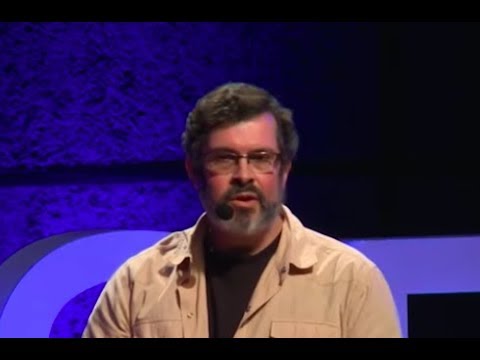
Translator: Rebeca Camarotto Reviewer: Claudia Sander
Good evening.
I wanted to start taking you on a trip to prehistory,
per year 1 aG, before Google,
which is 1997.
It was the year when, as the presentation said,
I joined one of the first essays in Brazil to produce
exclusive content for the Internet within the great Brazilian press.
Until then, normal practice was what we called “shovelware.”
“Shovel” is shovel.
It was to take with a shovel the content produced for the printed vehicle
and play on the internet.
There came a time when it was concluded that this was not a good idea,
it was cool to start producing things that really went for the internet,
with internet face.
We came to this conclusion and my boss told the team:
“Our research shows that there are three things
that really attract people on the internet:
pornography, sport and science. “
With pornography we do not work,
sport I did not like, so I went to science.
The internet at that time, 1997,
the way we know it today, was still starting.
The internet as an open network,
to the general public,
open to commercial interests was a recent phenomenon.
It was still the era of dial-up access.
The big media companies still did not know exactly what to do with it.
There was a lot of discussion about whether it was worth it
maintain a presence on the internet, can be fire of straw,
soon nobody else will want to use, etc.
Because of this, doing internet journalism at this time,
was to do journalism on the internet.
Explain to people what the network was, what they were going to find there,
what was that space for, and so on.
And I would have to do internet journalism
and science on the internet.
What were the main guidelines
science and science dissemination in 1997?
There were several, of course, but I’ll concentrate on two here,
that explain more or less the somewhat bizarre course
that my career ended up taking.
One was the launch of the Cassini spacecraft.
I do not know if you remember, the mission is now over in September.
She spent years on the Saturn system
and made many beautiful pictures,
several important discoveries, etc.
In 1997 the probe was going to be launched, everyone read about it in the newspapers.
On the internet, one thing people could find about Cassini
was something called “Stop Cassini”.
“Stop” in the sense of stop, stop, stop.
It was an organized movement,
social movement, organized online,
perhaps one of the first great movements organized by the internet,
whose aim was to prevent the probe from being launched.
Because?
They thought that if there was an accident during the launch,
the probe would spread plutonium through Earth’s atmosphere
and this would be an environmental disaster.
This is bullshit, NASA had to spend time, effort and money
producing content to explain that this was silly,
the thing arrived at the judiciary in the United States.
Some journalists in Brazil have embarked on this story
that the Cassini launch was a threat.
And I was forced to write explaining
that this was not so.
Second major major science agenda in 1997:
the arrival of the Mars Pathfinder mission to Mars.
It was the first robozinho on wheels to descend on Mars.
It was the first space mission to generate images directly for the internet.
Lots of cool stuff.
Print media coverage also emphasized these aspects.
But on the internet what people found about it?
A lot of people looking at the photos that NASA sent online
in the smallest details and speaking: “This is a pyramid!”,
“This is an alien structure.”
There were people who went into Photoshop and built a cylinder
which looked like those science fiction things from the 1950s,
right in front of the little robot.
And, again, how I had to write about science
for the internet and the internet,
I went there to explain that things were not quite like that.
After a few years begins to circulate through Brazilian e-mails
a complaint that there was a textbook in the United States
which showed that the Amazon was an area under international intervention;
and came to have a very sophisticated version of it
which was a page of the book written in macaronic English, very funny,
saying that the UN has taken possession of the Amazon because Brazilians are irresponsible,
incompetent and can not handle it.
Maybe that was the only true thing about the hoax, but anyway.
And I had to write explaining that it was not quite like that.
To explain in explaining that this is not so,
I suddenly found myself in a career.
in which my daily life was to write about:
Atlantis, astronaut gods, Bigfoot sighted on Mars …
Mars is great, when NASA started sending pictures,
the staff found everything on Mars.
Anyway, a lot of these things.
Monsters of various kinds, conspiracy theories,
the internet has always been a barn of conspiracy theories.
Another thing that also gave me some work:
Majestic 12, I do not know if any of you
accompanied some old TV series
who dealt with it.
Even well-made papers, a well-known fraud,
typewritten, scanned, stamped “Top Secret”, “Confidential”,
saying that the United States government had an agreement with gray aliens
so they could kidnap people with impunity.
That was online, there were people who took it seriously, I had to write explaining
which was not quite so.
Anyway, I ended up building a career.
of two decades, basically,
dealing with the incredible, the extraordinary, the fantastic and the idiot …
and it’s fun, yes.
Write explaining that the pyramids of Egypt
were built by the Egyptians, not by the Venusians
It’s interesting, you learn things.
But you start to notice other things that are not quite like this and are not so cool
as people saying that vaccines cause autism,
or that can cure cancer with diets,
this world of things that are not quite like this
has a sinister and very dangerous side.
Last year, when ….
when the concern with false news,
post-truth, alternative facts, etc.
came to global consciousness, everyone woke up to it,
the first thing I thought was, “Welcome to my world!
Now you know how I feel. “
I was talking to people who work with politics and economics:
“You thought science was easy, right? Look, that’s cool.”
The second thing I thought was, “This my accumulated experience,
of 20 years in this trench,
with the false, the almost false, the badly explained,
the pseudo-scientific, pseudo-factual,
what I learned, what tools I developed
in the meantime they can help
the people who are in my world
to sail in this world?
Can I be a kind of safari guide? “
And after reflecting I arrived
to a toolbox that is basically composed of three questions.
These are three questions I want to leave to you here today,
that I strongly suggest that you, if you do not do it explicitly,
at least always keep in mind,
have them bothering in the back of the head
whenever someone tries to convince you of something.
The questions are: what are you talking about?
What exactly do you mean?
And how do you know this is true?
I’ll try to expand a bit.
“What are you talking about?” is the basic philosophical question of the definition of terms.
Not only are there terms of emotional appeal, democracy, freedom and such,
who mean different things to different people,
but there are also some more concrete contexts
in which this doubt may arise.
Returning to the area of science: life outside the Earth.
If someone says, “Do you believe in life outside the Earth?”
What does the guy mean?
Are you asking if you believe in little green men,
if you believe in Mars pyramids,
or are you asking if you believe
that there may be microorganisms in the Martian subsoil?
Life outside the Earth can be any of these things.
Now, what exactly are you saying?
The guy says he’s talking about Martian microorganisms. OK.
What are you talking about these microorganisms?
He may be saying that perhaps they exist,
that it would be legal for NASA to send more probes to try to determine this,
that this is an interesting question.
Or you may be trying to say that these micro-organisms arrived here on Earth
and are causing global warming, for example.
The specificity of the claim is very important.
And the third question: “How do you know that this is true?”,
is the famous search for evidence.
To cite a cliché that Carl Sagan made famous:
“Extraordinary allegations require extraordinary evidence.”
If a person tells you that there is a clown throwing candy around the corner,
You record it and you’re done.
If the person tells you
who has an alien dissecting little kids on the corner,
you may need a little more information
before accepting this as truth.
These questions are important to do and to keep in mind.
when someone tries to convince people of something.
And this “someone trying to convince people of something”,
I’m not just referring to TV commercials
or appeals that come through social networks,
but I am also referring, mainly,
and this is an important thing in this world of social networks,
where the sources that we have today,
because of Facebook and Twitter,
are very much our friends and our relatives.
They are people we love.
The person you love may be
sharing something from another source,
of a content, of a newspaper or of a website,
but when it comes to you,
comes as something that the person you trust has shared.
But the fact that someone you love
was deceived, or was deceived, or was naive,
do not force yourself to be deceived in solidarity.
It is important to keep these questions in mind even when people
with people who are important to us,
when things come from what appears to be a close and reliable source.
Who convinces us, who controls
what we believe,
it also controls, after all, how we feel and what we do.
Remember the “Stop Cassini” people.
They organized a movement because they were convinced of one thing,
that the launching of the probe was a danger
environment on a planetary scale.
It’s really,
if you believe that the X phenomenon is a danger to the environment,
you have a moral obligation to combat this phenomenon.
Then the control of belief,
this concierge service of conscience,
is a very important thing.
And my suggestion is that these three questions:
“What are you talking about?”,
“What exactly do you mean?”
and “How do you know?” are a good way to control this.
Having these questions in mind when we talk to other people,
when we receive things even from whom we love,
and also keep these issues in mind
for ourselves.
For self-examination.
Because the human being is a stubborn animal.
When one assimilates an idea as true,
it is very difficult to get rid of it.
Even her being fake.
People sometimes think intelligence is a vaccine against it.
I’m very smart, my IQ is high,
study in a university of first line,
if I was convinced of anything,
if I believe too much in one thing, it must be true.
Maybe not.
Very smart people are very good
in creating defenses for indefensible beliefs.
So that was basically what I wanted to leave it to you.
Suggest that you have this tool, these three questions
always in mind, before letting something pass
the barrier of critical sense.
What are you talking about?
What exactly do you mean?
How do you know?
And now to close, I wanted to suggest an exercise.
I’ve been talking to you for over 15 minutes.
As I make my way back,
I would like you to ask yourself …
What was this guy talking about?
What did he say?
And how does he know?
Thank you!
(Applause)
Please follow and like us: