
[Music]
why is it that this silhouette of a
storm-battered leafless tree at sunset
is considered beautiful when this
corresponding silhouette over
multipurpose university facility is not
the mathematician Binet Mandelbrot in
the mid 80s said simple shapes fail to
resonate with the way that nature
organizes itself and as a consequence
fails to resonate with the way that we
as nature’s product are organized so in
his mind nature is the benchmark for our
understanding and if things are not
consistent or coherent with nature then
they don’t mean a great deal to us now
this is Euclidian geometry and it is a
very powerful tool that has been one of
the fundamental principles of our
civilization it’s the mathematics that
we learn in high school it’s the
relationships between points in space
it’s the relationships within physical
constructs and we also learn platonic
solids cubes spheres dodecahedron these
are a particular kind of object a
particular kind of intellectual
construct that is based on observable
phenomena however when do you really see
a pyramid unless it’s made by man when
do you really see a pure sphere these
are abstract ideas that don’t represent
the nature of the nature that we
experience every day they’re beautiful
they’re profound but they’re rare and
there is another kind of mathematics
that explains the rest of everything
the profound nature of everything and
until the advent of computing it was
almost impossible for us to have any
insight into this Euclidean geometry has
been the geometry that my occupation has
used for thousands of years the action
Greeks the Roman Empire used Euclidean
mathematics to modulate and conform
their architecture it was a coherent
system that related to their religion
and their ideology that explained their
worldview that’s a worldview that we
find untellable today we have progressed
we do have computers we do have the
ability to process vast amounts of
information at this point in time that
was extremely difficult
so the idealized version of mathematics
was something that profoundly affected
the way that we built our civilization
and we still use this today Euclidian
geometry and platonic shapes are the
principal geometries that we use in
architecture day it’s the geometry of
planes the geometry of surfaces it’s
simple it’s rational and in many senses
it’s very beautiful and simple shapes
are easy to understand we can look at
this and see that’s a cube that’s a
curve it’s something that is relatively
easy for us to have an emotional and
intellectual connection to however it
doesn’t really represent what’s going on
here there are something very complex
that clearly has an order about it which
is not reflected in these shapes here
and there’s a reason for that in 1979
Binet Mandelbrot at the time he was part
of IBM’s pure research division and he
had access
to IBM’s mainframe computer the biggest
most powerful computer in the world
instead of it taking days to do a
calculation he could do millions of
calculations a second and he produced
this image then it’s called a Mandelbrot
set if you zoom in across scale what you
find is the patterns repeat and as you
continue to zoom in you begin to
discover that things repeat their self
similarity across scale and you start to
find that within the nature of numbers
within the nature of mathematics there
is an order that is very similar to the
forms that we find in ferns
and in in sea life and many other forms
of natural systems what this means is
that there is a deep insight here into
the nature of nature what this shows us
is there is a profound and incredibly
interesting and meaningful notion within
architecture and within geometry that
can be applied to the real world and
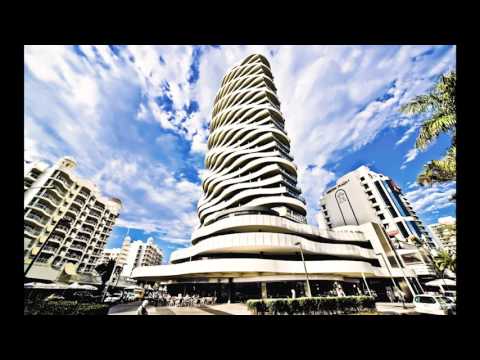
this is one of our first experiments
with trying to design a building that
contains process because the nature of
nature is about process it’s not about
simple singular events it is about the
feedback it’s about the process of
nature and in this building we did using
euclidean geometry these are sine curves
we can deal with this relatively simply
through mathematics but what we were
able to do with this project is capture
some kind of sense of emotion this is a
building that is about its place it’s
about its context it’s about building a
building on the beach
that captures the breezes that catches
the notion that this is a special place
where most other buildings are
rectilinear and based on construction or
efficiency in this project we were
looking at trying to create something
that meant something to people and I
think having lived in Broad Beach for
the last few years I have come to
realize that many people stop and take
photographs of this building they may
not know what we are on about they may
not realize that as the shadows fall
across the building it becomes more
sculptural and for us it gives us a real
emotional sense of connection to place
but nonetheless there seems to be
something that people will respond to
it’s not entirely parametric it’s not
that complex but it expresses something
and that’s I think what person I was
talking about some self-evident excess
which is extrinsic to it being a
building but its intrinsic to it being a
work of architecture and and this is the
corner where people stand and take
photographs and like I said they don’t
really necessarily understand what we’re
on about but they know we’re on about
something and this is another building
in Broad Beach another one of our Gold
Coast projects and this is about taking
crystalline forms like the headlands of
Fingal and Burleigh and exploring
organic forms and and how do we express
what it means to be a physical object in
a dynamic environment with waves and
breezes there’s also a very obvious
allusion to the whales that migrate
along the coast so that was very
conscious in our minds at the time
because we felt that those marine
mammals said something meaningful about
the place and while the ground plane and
the context is very much about urbanism
and about how people mere few places the
towers
an emotional and physical expression of
what it is to live adjacent the ocean
where these kind of activities occur and
you can see that this is a fairly
unusual building and it’s a building
that people do seem to have some
emotional connection to and we’re
continuing to explore this in other
projects we’re working on this is one
for the Gold Coast as well where we’ve
taken the confidence out of the projects
we’ve done in the past to really push
the sculptural power of buildings in
this building we’re using really quite
advanced software to help us manipulate
and plot certain surfaces within the
building the building’s inspired by
marine life and by the context of the
place and there’s a very obvious
allusion to oceans and sea creatures in
this but there’s no way we could have
delivered this building 20 years ago
when I was a student there was we could
not have drawn it on a drawing board
when I went to university we did a
subject called computing where we spent
weeks writing code to draw a square
which is about as exciting as licking
wallpaper you know but now we have the
power in our computer systems to be able
to not only explore these beautiful
formal environments but also include
very complex and very sophisticated
environmental responses in our work this
is an incredibly sustainable building
that rejects heat admits light and does
extremely clever things so this diagram
in the background there you can see what
we call a parametric system so a
parametric software is a software where
the parameters are defined by ours we
simply put a series of numbers into
these equations and the computer works
out what it is if we put in the right
number if we’re subtle about it then we
can suddenly change the form however if
we put in the wrong number it goes
berserk and you get insane things we’ve
3d printed models that are just a
massive plastic spaghetti one of the
most exciting and thrilling things for
us is the advent of 3d printing but the
real power of this I think and what
thrills us is the capacity to explore
and develop systems and ideas that mimic
nature these are some of the prototypes
we’ve been working on in our
explorations or our practice and this is
a building that is being 3d printed
using crushed building rubble and cement
and natural fibres
it’s Euclidian geometry straight lines
simple curves but it’s not far away that
we can start doing this with 3d printing
and I sincerely think that it is not
long before that kind of technology will
support us in building buildings that
are entirely bespoke that are
constructed in situ in place so they
indelibly connected to place and our an
authentic expression of place so why is
it that this storm-battered leafless
tree at sunset is considered beautiful
and this corresponding silhouette of any
multipurpose university
it is because simple shapes fail to
resonate with the way that it nature is
organized and therefore as a consequence
fails to resonate with the way that we
as nature’s product are organized and I
think that we stand right now at the
thrilling and enthralling precipice of
having the computing power to replicate
nature in our architecture in our built
environment and I think that will
profoundly affect the nature of our
lives thank you
[Applause]
Please follow and like us: