
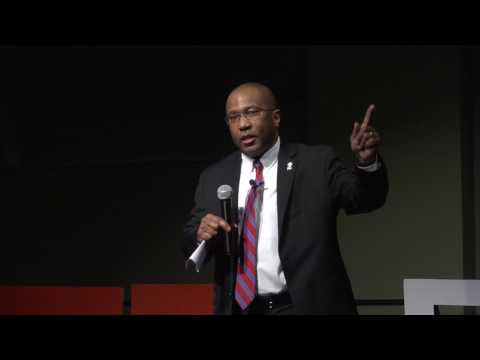
you for coming to this very important
event today we’re so delighted to host
you here on this campus dan is an
outstanding friend and when Dan was
talking about putting this event on I
said yes and we wanted to be a part of
history for you to be able to stand up
here and say that we are the first
historically black college university in
the country to host this event this is a
big deal and so we are so thrilled that
you’re all here
today I want to spend some time with you
just kind of talking about the value of
HBCUs in our country there’s a big
debate as it relates to our universities
and it shouldn’t be a debate but it is a
debate in terms of why we still have
historically black colleges and
universities and what I’m going to do
for the next 10 15 minutes is to be very
clear on why that these universities
will be here for the next 200 years 400
years because they’re they add value and
we need them in our country to continue
to help our country move forward in a
positive way so to set the stage for
those of you who may not know this and I
know some of our students are in the
audience and they know this because this
is part of when they come here they have
to go through orientation and part of
orientation is should get a sense of the
history of the institution and how it
started but those who are new in the
community I want to get take a brief a
minute to kind of share with you the
history of Delaware State University how
we were created we were created part of
a piece of legislation that was passed
in the in Washington DC as you all know
we had slaves in this country and at the
end of slavery the president at the time
was President Lincoln and they were
trying to figure out what do we do with
the former slaves as it relates to
provide them with opportunities to
advance themselves and the answer was
education so how do you do that you do
that provide providing opportunities for
those to be able to get an education so
they can advance
and have a better life and that’s the
key in our country and at the time when
these schools first came on the scene
African Americans were not allowed to go
to what they call historically white
institutions and you think about that
today and it doesn’t make sense we’re
all in this together and if you think
about and put it in context of where we
are today we all work together we live
in the greatest country in the world if
I live in a greatest country in the
world we have big responsibilities so by
creating historically black colleges and
universities that was a way to create
opportunities for former slaves to
advance President Lincoln created what
he called them a rail act it was 1862
morrero Act which during the Civil War
there were trying to figure out what
we’re going to do to bring this country
back together and so therefore the
justice marell a senator from Vermont
introduced legislation to create
land-grant colleges all over the United
States of America so in every state
there’s a land-grant college and the
purpose of that was to provide with
education and tools so that you can
provide for yourself and you can live
off the land and you can do things in
the right way in terms of building up
the land in the state of Delaware the
land-grant was a University of Delaware
in the state of Maryland land-grant is
University of Maryland in the state of
Pennsylvania the land-grant Espenson
Penn State Florida University of Florida
every state there’s a land-grant so at
the end when the war ended they said
Black’s need to have an opportunity to
get enrolled in these land-grant
colleges as for those states that would
say yes those students could enroll well
we didn’t have a single state to say yes
to african-americans so the federal
government created a second land-grant
Act called the 1890s land-grant Act and
that created 18 universities now we have
19 in the 1890
universities are all located in southern
states if you go to North Carolina North
Carolina A&T would be the 1890
land-grant there if you go to South
Carolina South Carolina State will be
the land-grant institution there you go
to Mississippi
Alcorn would be the land-grant
institution there so every southern
state primarily would have an
institution and Delaware a little bit
confused about where we are either we’re
in the south are we in the north so we
write that border go on the borderline
so we had to decide our legislature said
clearly that you can enroll at the
University of Delaware if they would say
yes and they said no so the General
Assembly created the State College for
colored students in 1891 and that’s the
birth of Delaware State University so
the state college for color students
started out on this campus this was a
plantation it was called the LA command
plantation and on this campus the Saint
that the mansion is still here so you
have time today it’s a historic landmark
if you had time today I would encourage
you to go see it and you can go into
this mansion and you can see at the
bottom where they used to keep slaves
literally in this house and that was a
first building here so 12 students
enrolled at the state college for color
students with three professors and
everything took place in this house so
that vision was set and it was we had 20
the state the federal government
appropriated twenty five thousand
dollars for the state to purchase the
lock of implantation and to get this
school started they didn’t apropriate
the full amount they said this is an
experiment we don’t know if it’s going
to work so let’s give them $8,000 so the
way I look at it they owe us some money
if you think about that and that’s why
you hear schools like I was always
struggling try
to get up and trying to get back on the
right track in terms of facilities but
that was the birth of it and the first
president of this institution was a
white man he was a chemistry professor
at the University of Delaware president
well he stayed here for about three
years and the next president became
William Jason and Williams aces served
this institution for 28 years
and his very first building that he
built on his campus it cost fifteen
hundred dollars and he had to raise that
amount and with this was a farm in the
very first building was a chapel and his
students he felt it was important to
have the foundation laid and by having a
chapel he made it the requirement for
students to go to Chapel every single
morning to get the day started
and in that chapel they didn’t have
Wi-Fi either and they didn’t have
internet connections they didn’t have
heat they didn’t have running water so
that kind of gives you a sense of the
struggle that students went through to
lay this foundation down so fast forward
125 years later and we’re celebrating
our one hundred and twenty-fifth
anniversary and we’ve been celebrating
fast-forward now we’re an institution
with literally with students from all
over the world
attending 29 different countries 37 47
different states represented here at
this institution with Delaware being a
primary the largest part because we’re
still a state institution we have 4,600
students we went from three faculty
members to over 230 faculty members we
went from one faculty member with a PhD
which is the highest degree you can have
in the Academy to more than 200 faculty
members with the terminal degree so
therefore we are a first-rate quality
institution that’s producing graduates
that are doing great things around the
world so the data is there to support
that the data is there to support
institutions like Delaware State
University University and our existence
and
why we are here and what we’re doing to
contribute to society so I used that as
an example to set the stage in terms of
the points that I want to make today and
the main point that I wanted to leave
with you is that there’s value in having
an institution like Delaware State in
this country at one time we had more
than 300 historically black colleges and
universities today we only have 105 we
have 47 47 public land institutions that
would be classified as historically
black meaning they get funding from the
state and 58 private institutions and it
gets funding by raising money sometimes
people get confused between public and
private a private institution will be
like Morehouse College in Atlanta or
Spelman College in Atlanta a school that
is prominent for African American women
and prominent in the in this space I was
talking to the president at Spelman
recently and we were talking about the
history of Spelman and she said she
takes great deal of pride in introducing
Spelman to African American women
because she make it very clear that this
institution was built for you this
institution was created for you it was
created for you to provide you with what
you need to be successful in this world
so when you have that pride you have
that connection it makes you feel good
to be in a space like this where you can
grow and you can develop and you become
your own person and when you leave you
can face the world so we’ve had
successful african-american graduates
from all of our HBCUs in America some
just to name a few that you may know and
you may not know when of the greatest
African Americans that attended a
historically black institution is a
former Supreme Court Justice Thurgood
Marshall Thurgood Marshall had the
privilege that gone not too far from
here you
first you’ve called Lincoln University
in Lincoln University pride themselves
on being preceded the first historically
black college in America and there’s a
debate that goes on between linking and
chaining university because chain is
also a historically african-americans
public institution that’s located in
Pennsylvania and they go back and forth
between who which one was the first ones
based on who produced the Graduate who
opened their doors first
but the Thurgood Marshall attended
Lincoln University and went on and got
his law degree from Howard University
which is a proud a proud historically
black institution that’s located in our
nation’s capital an institution has
produced graduates from all over the
world outstanding graduates you’re gonna
hear from one of them today our Dean
will come up she earned her PhD from
Howard University students I want you to
know that this institution institutions
like Delaware State University they are
here to provide you with the
opportunities that will open doors for
you and you will be able to achieve
whatever you want to achieve in life but
those of you who like to go to movies
there was a movie to just that’s popular
right now it’s calling hit hitting
figures how many have seen it I can’t
see your own TVs but I seen you raise
your hand but that movie celebrates
african-american women in their brains
and their strength and their courage and
how they persist to move forward despite
despite all the obstacles that people
put in your way if you haven’t seen that
movie I would encourage you to go and
see it
because the ladies who are in that movie
that they’re telling their stories they
all graduated from historically black
colleges and universities the woman who
was who plays I think it was TJ was it
RJ the first woman she graduated from
West Virginia State University which is
a historically black land-grant in West
Virginia the second woman who taught
herself how to go through that Fortran
training
and she taught herself she was
self-taught she went to river force a
historically black college that’s
located private that’s located in Ohio
and a young lady who wanted to become an
engineer
she went to Hampton University which is
a private historically black college
that’s located in Hampton Virginia so I
just give you those quick bullets so did
you get a sense of the pride that we
feel when we talk about historically
black colleges universities so I will
leave with you seven points and then I’m
going to step off the stage seven points
that I believe that’s the foundation of
why these institutions exist today
number one is access we provide access
meaning these to these schools these
institutions were created primarily
because there were no other
opportunities for african-americans so
we have never let me emphasize we have
never said anything as relates to no you
can’t come here because of the way you
look because of the way you smell
because of the way we see you we have
never said it we have said we have open
door access for opportunities if you are
willing to work and you’re willing to
commit yourself to excellence and you
get up every single day focus on
excellence and focus on improving
yourself and improving the lives of
others around you you will be successful
in this space so access is very
important as it relates to the value of
our institution second african-american
prominence in this space when you walk
around a place like this versus going to
a historically white institution which
are fine our students struggle to get
their identity and get their history
relevant you have to create programs
here in this space you are surrounded by
this every single day it’s about you’re
surrounded by the prominence of
african-americans success this building
named after one of the greatest leaders
ever dr. Martin Luther King jr. was
created my primarily from the uprising
that took place in 1968 when dr. King
was assassinated and when that uprising
occurred our students at the time took
over this campus and took over the
administration and administration
building and demanded national guard’s
actually came in to Wilmington national
guards came here because of that unrest
that took place after his assassination
but the students wanted to do something
and so therefore they demanded the
administration named a facility after
the late great dr. Martin Luther King
and that’s how we this named this
facility was named this actual building
was not here in 1968 but the original
building is that it’s not far from here
and we moved the name here to this
building
if you walk and look around there’s a
residence hall called Tubman Hall named
after the great Harriet Tubman actually
Harriet Tubman ran the Underground
Railroad right through this campus on
way to marching people to way to freedom
through Pennsylvania Harriet Tubman not
too far from here so students get a
sense of that legacy one of our
residence halls name out the mega Evers
mega Evers was a famous n-double-a-cp
civil rights leader who was assassinated
in Mississippi while he was getting out
of his car in his back who’s gunned down
because he was advocating for the rights
for others our students get to
understand that every single day and
that’s important three the values
empowerment we empower our students so
they feel like they can do anything when
they leave here and that’s important
that’s important for you to have that
confidence when you leave and you go
into this world so we took a great
dealing with that for we have an HBCU
track record there are 3,000 colleges
and universities in America HBCUs make
up less than 1% of those but listen to
this according to the Thurgood Marshall
college fund african-americans graduates
of HBCUs 40% of black members of
Congress graduated from HBCU
40% of all black engineers graduate all
black engineers in the United States
graduated from HBCUs 50% of all black
lawyers graduated from HBCUs 50% of all
black professors in colleges and
universities graduated from HBCUs and
80% of black judges graduated from HBCUs
and 12% of all of them fortune 500 big
time 20% of the CEOs african-american
graduated from HBCUs number-5 diversity
we celebrate it every single day here in
our campus when you walk on this campus
you are in America we have students
literally from all over the world
attending here we have five core values
and our number one core values diversity
we believe in the power of diversity we
believe in the power of thought we
believe in the power bringing people
together from all over and learning from
each other
that is important for us it’s important
for our students it’s important for our
faculty it’s important for our community
so diversity is very important number
six there’s a cultural level of comfort
here for our students where you feel
good about your culture you feel good
about yourself and when you have that
that lifts your spirit up and that lifts
you up and finally the value and the
most important one for me out of all of
them is the HBCU legacy the legacy that
you that we have here in terms of the
people who have gone through here and
that circle back and we take pride and
bring our alums back we take pride as
celebrating them HBCUs have been an
important part in our country for a long
time and it will continue to be an
important part so I want you to have a
great day today and thank you for being
here on the campus of Delaware State University