
[Applause]
[Music]
foolish my let’s try to define what it
is but you and I don’t speak a lie to
realize it lost in my words all in my
head
[Music]
have learn to read my eyes before I burn
couldn’t explain if I try
too busy loving all the things you hide
no love is sudden but you were more than
a surprise never felt so fine say in
your mind
you
hey thank you a musician
has just as many tools to tell a story
as does any other artist a painter or
filmmaker an author there is an audible
way to tell these stories and it’s
usually done without people noticing
even as it’s being done right in front
of their eyes or their ears for that
matter
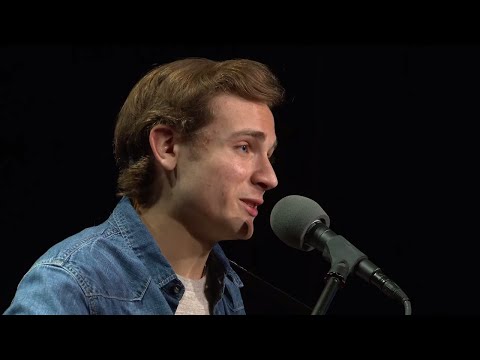
my name is Eli Bethune me and I am a
songwriter it’s what I consider myself
most within the platform of music I sing
my songs and I play my guitar in front
of crowds to entertain but ultimately
what I hope to achieve with my music is
to tell stories that is the quintessence
of what being a songwriter is all about
this past summer or this past year I had
the ability to write my first full score
to a concert play written by my mother
Helen Murray who is a professional
playwright and the artistic director of
the hub Theatre in Fairfax Virginia we
joined forces to create the Magi a
concert play about a band couple that’s
been on tour for eight years and now the
band and the couple are on the verge of
breaking up the show reads like a live
performance at a bar so it was my job to
write a full sets worth of music that
the band would play just like I would
perform if I were playing a show at a
local tavern so as a lover of film
scores and movie composers I saw this as
my first opportunity to write music that
would accompany a storyline and
underscore pivotal moments just like
movie music does for the scores for the
film’s that they are paired with as I’ve
grown up I’ve become incredibly
intrigued by the ways film production
has become reliant on composers to tell
larger and larger aspects of a film’s
emotional narrative from the listeners
perspective it’s easy to point to the
overt examples because when you hear
something happy you feel happy and the
same goes for any mood of music and the
corresponding reaction to these tunes
the more I’ve looked into the way
composers move their audiences through a
full course of emotions I’ve realized
there is
in almost mathematic precision to these
choices numbers and music theory are
being used to sway your perspectives
it’s being done to you all the time and
I too found myself using certain musical
concepts to bring the audience on an
aural journey throughout the match I now
these concepts are not new or profound
and plenty of composition majors in
universities and conservatories across
the world have studied this type of
composing but despite the fact that
music is used in this way so often many
people are being taken on emotional
journeys that they don’t necessarily
know that they are on it’s my goal now
to allow people who may not know
anything about the intricacies of music
theory and how music works to develop a
base understanding of how musicians are
using their craft to manipulate the
emotions of and tell stories to us
listeners so we’ll start with Cadence’s
Cadence’s are what complete musical
phrases think of them like the end of a
sentence the end of twinkle twinkle
little star for example and with what is
called an authentic cadence meaning the
saw the song resolves back to the one
chord or the key that the song was
written in when you hear now I wonder
what you everything about the end of the
song feels complete it is almost like
the tune is saying to you and they lived
happily ever after
composers use Cadence’s like this in
movies and television plays in live
performances to give listeners a sense
of completion and satisfaction one that
their ears won’t question and they they
don’t have to work very hard to
understand adversely there are types of
Cadence’s like those which are called
deceptive Cadence’s half Cadence’s and
play go Cadence’s which don’t always
sound as complete with these Cadence’s
the songs resolve in a place that the
ear does not anticipate it leaves us at
a completely different emotional level
composers can use deceptive Cadence’s in
movie scenes in order to make you feel
confused or uncomfortable and I too
found myself using these methods when
writing my score for the mad
so within these Cadence’s or the
punctual endings to these sentences of
music there is some intricate detail
going on in order to fully understand
how cadence is work we have to look at
the letters that make up this sentence
so the musical alphabet goes from A to G
and within that there are what are
called sharps and flats you may have
heard of those before
they’re also key signatures which
basically outline the notes in the
chords that are in a given song major
keys tend to sound happier and minor
keys are usually sadder and there is
this never-ending array of musical
sounds textures chords and notes that
composers employ to embellish their
narratives and to serve an emotional
purpose so back now to the Magi the
first song of the show is a song
entitled foolish minds which I just
played an excerpt of at the beginning of
this talk the song has this peppy upbeat
tempo like the type of tune a musician
would use to begin a performance despite
this charismatic bouncy melody I had to
find a way to let the song reflect the
shows for scene wherein the two
characters Nix and Jude we find are in
the middle of an argument that started
before the show began I I used this this
whole toying with the emotional end of
the sentence or the music in order to
tell the vote in order to for shout out
the emotional argument that was to come
like the cadence it seems Oregon
ordinary but there was more going on
so within foolish minds the song is
written in the key of E major so in the
final lines of the melody I wrote it to
end not on an E chord or the 1 chord
where the song starts but rather an a
chord which is the forth of that scale e
F G and then a your ear naturally wants
to pull back to the key that the song
was in I’m pulling out the rug a little
bit by ending in a different direction
and therefore your ears are slightly
uneasy with the songs lack of finality
I tied with this emotional ending in
order to truly set up what was to come
within that there’s plenty other things
that went in in order to make sure this
argument felt like it started the show
but also foreshadowed the fight that was
to come on a different note with the
last song of the show I wrote the leap
which is the name of the song and it
ended in similar to twinkle twinkle
little star and authentic cadence
meaning the song resolves back to the
one chord in the key that it was written
and therefore we feel like the song has
a sense of finality and completion and
it feels absolute and I made sure to do
this because I wanted the song and the
show to feel final and have this
consistent undercurrent of hope because
despite the conflict between Nicks and
Jude like the songs they two were able
to resolve peacefully now I am very
proud and loved this nine songs that I
wrote for the Magi but perhaps my best
storytelling as a songwriter was in the
first and final songs of the show
Cadence’s were not the only tools I used
to highlight the narrative additionally
I used key signatures which provided an
invisible sense of security and
familiarity to the show’s final moments
foolish minds and the leap are both
written in the key of E major and used
the same to some extent the same chords
so the first notes we hear at the
beginning of the show are also mirrored
and repeated in the last at the end of
the plot parenthetically I kind of
restructured the chords within the leap
adding some extra notes to give them a
sense of openness and power that the
chords and foolish minds didn’t have so
rather than a plane a major chord I gave
it some depth added a few notes and
changed into this weird thing called a
minor 7 flat 13 sounds nice so by
starting and ending the show in the same
key I was able to show that despite the
conflict between these two characters
there was a constant in their love that
never really disappeared I’ve always
thought of emajor as being a very
assertive powerful key so I manipulated
the tools this key gave me in order
to create two vastly different songs at
two very different moments in the show
that had a similar undercurrent of hope
now there is a myriad of music theory
terms I could talk about I’m obsessed
with the way that the mechanics and the
sound of music and the mechanics of
sound changed music so to speak within
the Magi alone I was able to employ
these techniques and what I believed
were intentional and purposeful ways so
is my belief that ordinary people even
those with no understanding about the
complexities of music develop some
understanding about the power of
musician welds to shift and sway the
perspectives of listeners like I said
first and foremost I am a songwriter and
I easily get wrapped up in the verbiage
of my lyrics writing words to my music
is one of my favorite things to do but
the more I explore with instrumentation
the more I realize how emotions can be
conveyed in a figurative way it wasn’t
necessarily my lyrics in foolish minds
that allowed the song to have this
abrupt ending I was able to mess around
with this variety of musical concepts in
order to construct at a completely
emotional different emotion it whether
it be intentional or purposeful the
music reflected the show’s narrative and
composers are constantly finding new and
creative ways to distort and shape plane
almost mathematic concepts into what are
beautiful works of art that tell stories
on their own using boring logistics to
feed creativity now the more cog is
cognizant we are these intentional
decisions the more we will be able to
enjoy and understand the myriad of
reasons we feel something greater than
ourselves when we are immersed in great
art now as I end the speaking portion of
my talk I want to ask of you one thing
try to listen more when you’re watching
a movie be on the lookout for how
composers like John Williams and Michael
Giacchino my favorite movie composers
are manipulating melodies and musical
textures to tell stories in a company
the narratives of their films the
attentive at live shows and watch how
performers are strategically placing
certain moments in their performances to
tell a dynamic story I recently had a
choral instructor tell me that the
biggest
advantage acquire can have is the
ability to listen and to listen well I
think that the more time we spend
understanding how and why music works
the way it does the more valuable and
essential that we become therefore I
think everyone can benefit from taking
the time to listen make music and tell
stories together so as I conclude this
talk I will finish off with an excerpt
from the leap thank you
[Music]
fear is the one who runs backwards when
there’s two paths up ahead you or the
fork in the road then made me lose
feeling in my legs
this map only has one route but all
these signs don’t seem to agree there’s
sometimes in a path take it hasn’t
already been decided so let’s meet in
the middle of nervous and eager and
agree this is terrifying sometimes
falling in love just day now to us so
the hell is it let’s be petrified
together you leave me help
[Music]
I’m shaking in my boots this is getting
oh the world we know the more we stand
to lose I never asked to dig this deep
never thought love meant you and me and
together ain’t our guarantee so let’s
let’s light it steadily
thank you
[Applause]
Please follow and like us: