
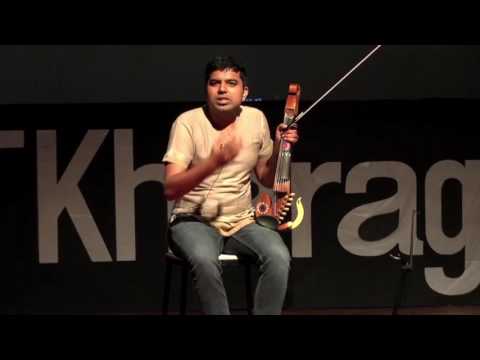
I am Karthik Eyre and I’m here to speak
about the violin and in those souls in
the soul is a brand of music that we
play the first song that I played now is
the song boundless which is the first
song from our recently released album as
you listen to the song could you tell me
what genre this song belongs to or any
genre that you could think of while
listening to this song any guesses so
what what’s what what people generally
categorize such music is under a very
broad blanket term of fusion fusion has
existed in India and of course around
the world from India it’s been popular
from the 90s but it exists around the
world as jazz fusion or rock fusion so
there’s any any kind of music which
blends two different genres is called
fusion and in India this is existed
since the 90s we’ve had really brilliant
artists play fusion music but I think
it’s time to go one step further which
is why Hindu soul came into being for us
myself and my band karthika our life I
feel that when we looking at music that
Indian classical music when we blend it
with different genres I think there’s
something that’s deeper than just a few
musicians of different cultures coming
together in jamming so which is why Indo
soul comes into place and I’m going to
talk about in those holes in a little
bit of in more detail and also give you
some examples while performing but
before that I’d like to show you about
my member of choice my instrument is a 7
string violin an electric violin the
electric violin is sort of a common
choice in fact
asked by one of the college students who
also happens to be a violinist as to why
I don’t use an acoustic violin this was
a natural choice for me because when we
are playing with bands when there’s a
loud drama or and there’s the lead
guitarist for example screaming
unfortunately the the rich tone that an
acoustic violin can give it’s just not
loud enough so the acoustic the electric
violin came into being I started using
it about nine years before it’s been
around for about 20-30 years the last
I’ve heard is L Shanker with his
recordings with Shakti and Frank Zappa
in the 1970s with the electric violin
already but the electric violin has
become very popular awfully and it’s not
just about the volume that the electric
violin is famous for for me I think what
the electric violin gives is that it’s
very pliant to its tone its tone can be
processed there’s a lot of flexibility
in terms of how you can change the tone
of the electric violin so along with my
processor and the violin
I’ve gotten a few tones together where
you can maybe add one more violent tone
to your one violin that you have add
many more layers or completely destroy
the tone and make it into something that
doesn’t sound like a violin at all so
let’s look at some of the tones that the
alright so let me use a clean tone the
[Music]
special about this violin just to show
you that it’s got seven strings as
opposed to the four strings that are
conservative a traditional violin house
so it can almost reach all the way down
add one more violence a let’s let us
have two violins playing with this
violin happening and on one octave below
on the basement let us have one more
violin playing with us
[Music]
how about adding a lot of violence below
like having a feedback loop with many
violence below this stone so you get a
sort of a layered tone like a like
hundred cellos playing together
thank you so so far these layers have
been playing the same thing that I’ve
been playing but an octave below but how
about letting them play something a
little bit different
so that’s about adding more layers now
let’s do one thing let’s just remove the
violin tone and process it to sound
something that’s totally different the
next stone is a tone that I like a lot
it’s sort of a dreamy eccentric kind of
a tone where you know sort of a phrase
sort of sound that comes so that’s a
and last but not the least any violinist
with a guitar processor
once wants to add some distortion and
make it sound like a guitar so here’s a
guitar effect on the violin a little bit
of a war affected swell so those are
some of the tones thank you so with
these stones
I think we’ve sort of scratched at the
surface of the the flexibility that the
electric violin has when it comes to how
a tone can be changed because you know
there’s only the electrical students
will understand if there is only one
piezo electric pickup here and that’s
basically taking the whole signal in and
then it’s going as electrical signal the
audio audio signal gets converted
digitally and so you know the body can
be anything it’s not like there needs to
be a resonating surface just the wood
matters which is why it looks very
different as well coming back to indoor
soul I’d like to play you a couple of
songs one song in a couple of different
ways I picked out a song called para
Dona which is a Carnatic classical song
I was formally trained in Carnatic music
down south from Chennai I’m going to
play you the same song in two settings
the first setting let’s imagine a room
in rural Tamil Nadu where there are
three people there is a ton pure player
and probably there’s a meringue guest or
just for familiarity sake let’s say
there’s a tabla player and then the
violinist so this song would sound like
this in this kind of Peru and what I
want to do next is to sort of take you
to a nice studio in in Paris where there
is a piano
set up and there is a pianist who sort
of practising Beethoven Bach lot of
Western classical music and how will it
sound if I ask him to play in para Donna
with me so I’m going to sort of contrast
these two experiences and please bear in
mind that what I am playing except for a
small Prelude is absolutely the same
song
so whatever difference you’re hearing is
just the arrangement I do not have a
Marine Angus with me but that’s
so that’s a Paragon amici today with the
tangora I really love this song it’s a
happy cheerful song and it it sounds
great when I played a Carnatic concert
but then curiosity got better of me and
I went to meet my good friend Don dear
diva
pianist and he’s currently settled in
Pondicherry he listened to this track
and he said oh this will sound great
with a Sebastian Bach oriented like some
something that sounds like Bach but in a
you know in a pure piano so I’m going to
play the piano that he recorded so we
are going to do a duet a violin and a
[Music]
you
[Music]
you
[Music]
you
you
I just like to conclude by saying I hope
you have an insight into what in the
soil means for me there are two things
that is very very important about indoor
soul
it’s not about bridging the differences
between two genres of music but it’s
more of going deep down getting to know
about both the genres for it for in this
instance Indian classical and Western
classical and finding the common things
there are after all seven swaras and
thirteen notes in the western
temperament so everything is common
there are commonalities between each
honor and to do this the second most
important thing to do is that there
should be a meeting of minds between two
musicians who are collaborating together
on this and I think if these two things
happen I think it is great for fusion
music or collaborative music to go
forward thanks for listening and have a
great day [Applause]