
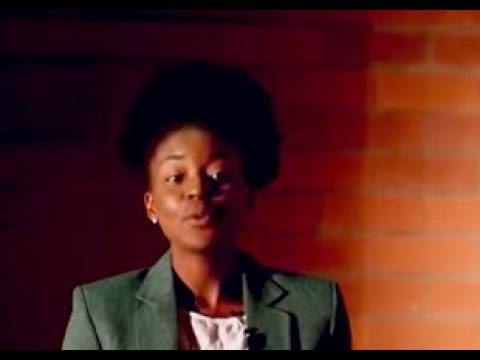
[Applause]
the evening ladies and gentlemen it’s
such an honor for me to be here and it’s
such a privilege I mean I have to keep
on pinching myself literally to make
sure that I’m really here doing my very
first TEDx talk but before I start I’ll
just like to give a little bit of
background again to who I really am so
you know who I am and where I come from
so my name is Joanne I won a cup and I
come from Cameroon it’s a country in
central Africa and I’ve been in South
Africa for the past 10 years so I know a
thing or two about being an immigrant in
a foreign country I came here with my
family
and I’m very fortunate to come from an
academic family as the reason why I came
here was due to my parents being invited
to come and work here due to the
exceptional skills and so it’s really
interesting because my sisters as well
know what it’s like to be immigrants in
different countries as my older sister
just returned from a conference in Japan
and my younger sister was in the United
States of America for a global Young
Leaders Conference so my parents and my
sisters seem to have elaborate CVS so I
myself I feel very like I’m feeling big
shoes coming in tonight but I believe
what I have to share is something that
we all need to know the key to social
cohesion lies in perception the kids
social cohesion lies in perception and
I’m going to start off my talk with a
bit of a story because I’ve been told
I’m a storyteller and I hope you enjoyed
my stories of different experiences I’ve
had in South Africa and so I’m gonna
take you way back 2007 so imagine we’re
in 2007 we just came to South Africa
this was in August and it was my very
first day in high school it was great
8:00 and I came in the middle of the
year so everyone already had their
friends you know everything was going
good so I was feeling very nervous
I was shaky are they going to like me am
I gonna make friends I can’t even speak
the language so while all those thoughts
were going through my mind
in came this white girl with ginger hair
smiling at me and she assured me to my
classroom and when I walked in everyone
was staring at me like you’re staring at
me now and I was looking back at them
and all I could see was five black faces
and twenty white faces staring at me and
the first thing that came to mind was
I’ve never been in the same room with
this many white people in my life so it
was exciting for me and I was just
really thrilled I wanted to get the full
South African experience so I told
myself I need to know the different race
groups I didn’t know the different
cultures and that was my mindset at the
time so during break time we went to the
school field and everyone was he knows
sitting in the different race groups and
I thought to myself I thought our pie
type was over like ten years ago
so how come people are still sitting in
the preferred racial group the white
people sat together
the Africans stuck together Indians had
together and I was like okay what’s
going on here nevertheless I was still
determined to have the fools that
African experience and so during first
break I sat with the white folk and
during second break I sat with the black
folk and as we were sitting having a
discussion in came this black girl you
know she was real excited she heard that
there was a new foreign kid in school
and she came to me and the first thing
she asked me was are you a refugee I was
like okay am ia refugee and being asked
this question by my own kind left me
feeling very confused I was like how can
she ask me such a question but then I
concluded that it wasn’t because she was
ignorant it’s just cuz she had the
perception that all black foreigners who
were refugees and so this was the first
of many perceptions to follow me as an
immigrant living in South Africa I
believe that our perceptions and
misconceptions that we have about each
other is what actually hinders social
cohesion now a perception is basically
our opinion or how we think
this is influenced by your cultural
background your perception can be
influenced by your religion can be
influenced by your race it can be
influenced by your family values so many
different things form a perception
meanwhile a misconception is an
incorrect way of thinking about
something so you have an opinion but
it’s not really a true opinion so that’s
a misconception so barring these two
things in mind I’m sure we’ll agree that
someone from Nigeria will think
differently to someone in South Africa
a rich person will think differently to
a poor person black person will think
differently to an Indian person and a
Christian will think differently to a
Muslim so these are all perceptions and
I’m sure before I came up here tonight
or maybe as I’m standing here you’re
already forming one or two perceptions
about me hopefully good perceptions but
but did you know that I’m not really
black don’t be fooled by the effort I’m
not really black I’ve been told so many
times that I’m not really black because
I can’t speak is a Zulu but since when
was raised defined by language things
when was raised defined by language and
so since I’ve been told this so many
times I I also concluded that you know
this was just a perception and when I
started to explain that my first
language is English I’m met by
disapproving looks from the white folk
but how come your first language is
English and your African surely your
first language should be something a
little bit more tribal sounding and so
by the time I started explaining to them
that I come from Cameroon and in
Cameroon we have 260 tribal languages
but we have two national languages which
is English and French
therefore my first language is English
then they go oh okay now we understand I
also remember when I was in high school
during a history lessons when we’re
talking about other African countries
maybe we’re talking about the Nigerian
Biafra war we’re talking about the
Rwandan genocide the teacher will stop
pause and everyone will look at me
and the teacher will signal I’m sure
Joanne has something more to say about
the Rwandan genocide because she’s from
Africa and I think to myself we are in
Africa so I don’t know if that was a
misconception of misplaced identity I’m
not sure so these are the different
kinds of perceptions that you know I
face as an immigrant in South Africa
in addition to this once in a while when
there was some news of outbreak of
violence against foreign nationals I
often felt a bit uneasy and safe not
wondering if I mean wondering if I’m
accepted in the environment I find
myself in and I believe that what we can
actually do to stop these occurrences is
to replace the spirit of division with
the spirit of Ubuntu and the Ubuntu
basically means I am because you are
this is an ancient African concept that
puts humanity at the forefront of our
being so you describe differences based
on nationality differences based on
religion culture and every other
difference you can think about so it
won’t so breaks the societal barriers
and seeks to unite us instead of trying
to separate us because of perceptions so
I believe that social cohesion can only
truly exist when we start seeing each
other as a reason for being now it seems
that Mother Nature has actually much
better interactions than we are and if I
remember my biology correctly an
ecosystem is a community of organisms
that interact with each other in an
environment and in an ecosystem you have
thousands of different organisms
some of them migrate there from
someplace else while other organisms
that they permanently and this
competition have food this competition
for what are these comfortable clothes
but in an ecosystem each organism needs
the other one to survive and so let’s
look at an example let’s imagine a herd
of cows usually wherever you find cows
you will find these birds called petal
egrets
and what these birds do is they eat the
insects from the cows and it’s
beneficial to the cows because they
don’t have to deal with this insects
anymore and it’s beneficial so that the
birds because they have food and so this
kind of relationship is called a
symbiotic relationship and as symbiotic
relationship or symbiosis is basically
an interaction between two organisms and
it’s that is beneficial to them both so
this is how a bun – is actually supposed
to work practically and not just an
understanding when an immigrant comes
into a different country instead of
forming opinions about them that is not
might not be true rather try to form
interactions with them that has
beneficial to society as a whole
and so I would like to share with you
four things that have helped me as an
immigrant in South Africa to form better
relationships on a day-to-day basis
number one ask questions ask questions
if you’re unsure about anything ask
questions rather than jumping to
conclusions about something that might
not be true rather as the person is this
really how it is number two don’t be
offended if someone has a misconception
about you because all they know is all
they’ve been exposed to so rather use
the opportunity to try and educate them
to correct the faulty thinking I’m a
dream don’t pass judgment against people
who have a different perception from you
or people of a different religion a
different race different culture because
again all they know has already been
exposed to and finally you need to know
who you are and knowing who we know is
defined by so many different things but
for me I know who I am
based on my faith I’m a child of God and
secondly my foundation is my family
therefore because I know these two
things nothing anyone tells me can ever
make me feel offended because I Know Who
I am
so in conclusion ladies and gentlemen
social cohesion as possible when we
actually start
practicing ubuntu and not just thinking
about it in our understanding it is
possible when we start forming the right
relationship relationships with each
other that is beneficial and it is
possible when we stop labeling with each
other with perceptions that are not
necessarily true thank you
you
Please follow and like us: