
I’m normally known for talking about
disruptive technologies we are in the
valley where we talking about new
business models and what they’re
happening but I’m gonna take a different
tack today I want to talk about
something that you can do with all these
different technologies as they’re
changing and I’m going to set the stage
and talk about one of the ones that are
the most exponential changing our lives
not just on the business side but also
on the personal side and so we’re gonna
start with that now we’re seeing massive
disruption in the marketplace one of the
stats that we see is that 52% of the
fortune 500 have been merged acquired
gone bankrupt fallen off the list since
2000 these companies are going away
they’re being disrupted organizations
were going away they’re being disrupted
and the reason this is changing is
because we have exponential technologies
that play apply to business models that
are transforming every industry if you
think about the top three the top five
companies in every single category they
are taking 40 to 70% of the market share
they taking forty to seventy seven
percent of the profits it is not
creating a digital divide it is creating
winner-takes-all markets in every area
and this type of change is so disruptive
now I want to illustrate what that
change looks like because there’s
different levels of innovation different
levels of transformation that’s
happening and we’re gonna do a few
things to show you this one of those
areas that’s transforming every business
every part of personal life is
artificial intelligence this is one of
the factors that is going to transform
not just those businesses not just your
personal life but humanity so when we
think about this level of disruption I’m
gonna use some examples to show you what
we’re talking about this isn’t a regular
disruption this is a huge disruption so
I’m gonna put something on the screen
and I want you to yell out loud and tell
me what you see are you guys ready all
right three two one
what do you see a Sony Walkman was
anybody a lot less good anybody know
when the swing came out
yellow
85 61 sits 8281 okay we’re getting
closer this thing came out in 79 or 81
depending where you live in Japan Oh 79
everywhere else in the world was 81
this device transformed how we looked at
music being portable it was one of
Sony’s early breakthroughs it was a
disruptive technology because it allowed
portable music and what’s interesting
about the Walkman is when I grew up I
basically cut lawns to pay for school
and this was our way to get through
things now I had to wait six to seven
years later to find the next innovation
that came out of Sony but when you look
at things later it looks different so I
want you to take a guess what do you
think was the next innovation I’m gonna
put it up on screen ready three two and
I want you to yell out loud one what do
you see the double cassette walkman you
had two cassettes you could play if
everybody knows what a cassette was and
as a hundred a minute then it’s of music
and that was the incremental innovation
it wasn’t disruptive actually it wasn’t
the CD disc man it wasn’t anything like
this this was what incremental
innovation looks like now what I want to
do is give an example what an
exponential technology does and what
that type of transformational innovation
looks like and the reason I’m bringing
this up is because when you think about
the iPod you think about design you
think about ease of use but if you go
back to the year 2000 and you think
about how were you paid for music it was
very different right in 2000 anybody
know what the average cost of a CD was
yell it out loud
twelve fifteen sixteen some said twenty
okay who got one good song raise your
hands if you remember those days who got
to anybody get two three okay so most
people get two good songs at $10 a song
right now in 2000 I didn’t pay for music
I had Napster I had LimeWire I have
Russian download sites I paid nothing
for
music but after 2000 what happened
you paid 99 cents for music some of you
guys still probably don’t pay for
physics but you paid 99 cents for music
and I went from nothing to 99 cents you
went from $10 to 99 cents that is a
business model disruption that is
transformational now this is the type of
technology we’re talking about now let’s
take one more here who here had an
iPhone in 2006 raise your hands high who
are early adopters alright it came out
in 2007 sorry about that but this one
device is interesting because this one
device took out 27 business models think
about it what do you get your music
where do you get a camera you don’t buy
digital cameras man where’s your
camcorder it’s here
flashlight manufacturers disrupted by
the iPhone who booth up and buys a
flashlight so this one device took out
27 business models 50,000 products maybe
10 million jobs on one device this is
the level of disruption we’re talking
about this is when an exponential
technology can do to your business model
and with that is where we are and this
is why I really want to talk about AI
because when we think about AI this is
where we are artificial intelligence now
there are lots of technologies that are
out there they’re gonna make this
disruption but the reason I want to
bring AI out here and all these other
ones is because they operate on data
your data everyone else’s data they
bring that together to get to decisions
to get to correlations and it becomes
very important in and out of things it’s
about capturing things that are
happening in the background
it’s about bringing that context to life
where are you what’s happening what
sensing if we think about 3d printing
it’s about putting together things right
on the fly to be able to made additive
manufacturing if you think about a are
and VR it’s basically transforming the
word your visual paradigm in front of
you and when we think about things like
robotics its automating it’s creating
human apper forces bringing that to life
bringing our robots to be more like
humans we think about blockchain it’s
serving and bringing that data to
everyone in connecting folks and when
you think about AI it is augmenting
humanity
and maybe replacing humanity over time
and why is this so important because we
are in an era where AI as possible there
are seven factors where artificial
intelligence require the first one is
lots of data and we’ve got tons of it
we’re storing that and it’s happening in
the cloud and also math talent right
we’ve got lots of algorithms that were
developed in the 70s and 80s before that
compute power was available and its
compute power that we suddenly have lots
of access to again once again because of
the cloud and it’s the ability to
compress time and bring it together and
then of course the expertise that
everybody has that AI being the new UX
being will talk to things that bringing
together the ability to take
recommendation engines and putting them
together we are now in an era where
artificial intelligence is possible it
may look like predictive analytics today
might be machine learning but we’re
headed in a world war the computers
could be smarter than us maybe they’ll
be able to think Mabel to be a creative
so let me tell you about the interesting
story about the letter A I spent a
summer in a major research institution
in 1987 and I got there at a summer
program is really excited I was a high
school student doing internships sounds
kind of fun and I met this guy who’d
just figure out how to get a computer to
find the letter A and so he’s talking
about all the stuff that he did it was a
two-year research process and he’s
talking about how he’s able to get this
and he’s like all excited he finally
finished his thesis and he said look I
succeeded we can now see the letter A I
was it kind of cool so I asked him what
are you gonna do next
and he said I’m working on lowercase a
and you realize what it was that’s it
that’s all you could do in 1986 right
and it made it very very hard but today
we can do much more than that
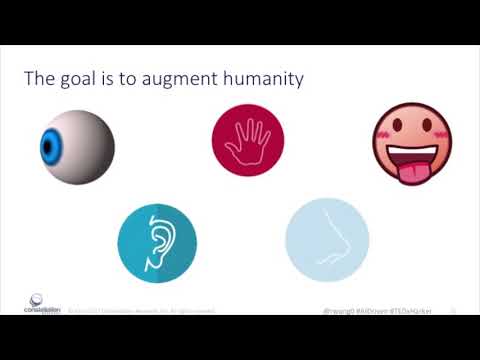
right today ai is this new user
experience we talked to our machines
we’re listening to them they’re
listening to you right ai is the ability
to connect in terms of touch sight sound
conversations even
since we’re seeing that all across the
board who’s talking to their computers
right now raise your hands all right
who’s got an Alexa who’s talking to
Syria or Google Voice or Google now
right you’re talking to your machines
they’re responding to you they’re making
guesses right computer vision is real we
can see things we can see patterns right
they can tell that there’s an anomaly
that can tell that someone doesn’t
belong in the neighborhood someone might
be able to do something that might be
suspicious or malicious right and we’re
almost getting to smell and taste at the
same time computers can actually start
figuring out smell and figuring out
what’s happening and this is all
happening all this requires lots of data
and that data we’re willing to share
we’re willing to sell we’re letting
gifted people I’ll give you an example
as these companies make these
disruptions everything is about trying
to figure out who you are or what’s
happening so pick a toaster manufacturer
these folks are in a very interesting
situation right because if you sell a
toaster to someone basically you have no
idea who buys your toaster you sell it
to 20 different companies 20 different
stores right and so the only time
someone calls up the toaster
manufacturer is when there’s a problem
right it’s broken it doesn’t work can
you help me fix that and so it’s a very
bad business because you sell it to
someone you don’t know who they are and
the only time they call you is but it
doesn’t work and so what they’re trying
to do is basically change that and this
is where Internet of Things comes into
play what they want you to do ultimately
is register now whoever fills out the
registration card for an appliance raise
your hands oh my god we got one person
that is amazing
the average is point zero eight percent
that ever felt the registration card so
they don’t know who the people are on
the back end and so if I actually
created a product that said if you
register and if you connect to the
internet
we will give you a new feature that you
didn’t have before that registration
goes 70 to 80 percent so if I told you
register and I will get you a new
feature I’ll tell you how many hours you
have left on your toaster you’re more
than likely to actually
in fact I’ll tell you you have 20 hours
left you’ve got a hundred toasts you’ve
got a thousand toasts left on your
toaster people will register it’s 70 80
percent because they want your data now
why do they want to do that they want to
figure out when that toaster is gonna
bring what’s wrong with the toaster and
once you’re connected they can do that
and in fact by doing that and using your
data they are able to create a couple
business models and one of them is the
ability to say hey I can tell you how
long you have left on your toaster the
second thing that can actually happen
over time is they can say would you like
to buy another toaster I know you got a
hundred toast left if you like a new
toaster in two to three weeks we can
make sure that happens for you and so
suddenly they have ability to figure out
how to get you toast as a service and on
top of that once they have that in place
they can figure out Wow
when your toaster is gonna break or if
they can fix it they can actually send
someone there before it breaks and then
after that they have the ability to go
out and figure out hey maybe I can sell
you something else make me I can connect
you and all these new business models
that we’re talking about are powered by
data they want to know when you use the
toaster why use the toaster what part is
broken they want to know how often
people use toasters they want to know
when these things what suppliers and
parts break and and that’s what they’re
trying to do and so every time we see
these new business models you’re gonna
see they’re being powered by data now
the other piece that’s important here is
they’re building for mass
personalization at scale in a digital
world people want to connect to you on a
one-on-one basis and that connection
point is now happening and there’s three
things that are required to do that the
first one is context where are you who
are you where are you standing what’s
the weather like right what time of day
is it how do you feel are you happy are
you sad what’s going on and that’s the
first part they use context because the
more context you have the more relevant
you are and the more relevant you have
the more likely you can earn the
permission to engage otherwise you hit
delete or you ignore someone you’re like
oh that’s not interesting and that’s why
they’re gathering all that data the
second part is providing choices right
core members choose your own adventure
books these things are great you start
on page one you go page 37 come to the
56 come back to 20 whoops sorry the end
and there’s 27 possible endings the
interesting thing about these books is
every choice in a digital world is a
signal it tells you what you’re going to
do not what you said you were gonna do
not what you thought about you’re doing
it knows exactly what you’re going to do
and then the third thing is a thing
called anticipatory analytics and these
anticipatory analytics are thinking
about what will happen so there’s a
famous hockey player named Wayne Gretzky
and someone asked his father what made
him a wonderful hockey player and the
answer was he skates to where the puck
will be it’s a very profound statement
how does he know where the puck will be
and that’s the anticipatory Analects he
takes the guess he thinks about where
it’s gonna go and when you take context
and choice and anticipatory analytics
you have the ability to figure out how
to deliver a mass personalization at
scale and that uses a lot of data so how
these AI driven smart services are being
built will look like this it’s a simple
example I walk into a large building I’m
in the lobby
it does a 27-point facial scan it does a
gait analysis it sees where I’m going
and it says it looks like Ray he’s on
the 15th floor
starts sending elevators down it doesn’t
even know who I am but it’s taking a
guess and says send elevators down I
swipe my badge in I get into the
elevator and it says would you like to
go to the 15th floor there’s a 90%
chance I’m gonna go to the 15th floor
well it’s kind of cool now I’ve been
trying to meet with my boss she’s on the
25th floor she’s got a 15-minute window
for a meeting and it says option number
2 would you like to meet with your boss
she’s on the 25th floor
oh so it’s very cool so I got a 90%
probability I’m gonna go to the 15th
floor I got an 87% probably I might take
the meeting with my boss but then option
3 comes in as a test to see what I’m
gonna do it says right there are donuts
on the fifth floor so which choice
should I take the donuts the meeting or
good in my office donuts all right we’re
going with donuts and so you get the
idea
and this is gonna happen to us every day
we’re gonna get different choices based
on probability based on context choices
and anticipatory analytics and we’re
doing that already when we make choices
on our phones we make choices digitally
and that’s how these systems are inbuilt
and they use lots of data in fact what
we’re really trying to do here is we’re
building for outcomes right we start by
figuring out hey what’s happening around
us and then we start fitting it can you
tell me can you give me an alert to
notification then what we ask is help me
make a recommendation and then
ultimately can you automate that in the
era of artificial intelligence we are at
this automation part we are starting to
predict things from happening we’re
starting to prevent things from
happening and that’s why you’re seeing a
big rush towards building systems that
are built for artificial intelligence
changing the way you work augmenting
your decisions and we love it we love
those recommendations we love to know if
you watched house of cards you might
like Game of Thrones right we loved
having those recommendations at the
consumer level and now it’s happening at
the business level and there’s a big
rush right
there’s hundreds of billions of dollars
being invested in these systems and then
we ask these types of questions
well the robots take over who thinks the
robots are gonna take over raise your
hands oh no we got this dope you know
it’s getting good so who think this is
but this is where we see this we see a
possibility where this might happen
find the human in the factory anyone see
the human right there right there
there’s two okay all right no but I
don’t think the robots are taking over
the world but but we are so compelled at
the power of this technology where
artificial intelligence is happening
that we’re starting to wonder when
robots do things better than humans or
when machines do better things than
human and there are a couple places
where we’re really good at we’re good
when it’s really complex but so are the
machines we’re good when it’s really
creative thank god that’s the area where
we were much better at and we’re really
good when you have to physically be
there but all this other stuff lots of
volume right lots of repetitiveness
that’s where machines and computing come
into
why when we think about the time to
complete one if they do things really
quickly when we think about what happens
in terms of how many connections we have
that’s where humans fail that’s where
machines do a better job and in fact if
I put this chart up maybe another 20
years we might lose some of those areas
because the machines are a little bit
better but that’s okay
what we’re really trying to do is
augment humanity right some jobs will go
away we know that’s going to happen but
we see this in a market that’s coming
and so the question then comes we built
this cool exponential technology we are
transforming business models lives are
being changed what are the ethics behind
this what are the ethics what has to
happen so who’s just heard the story two
cars of two of haast vehicles crash who
lives you want to hear this story it’s a
classic ethics question right and so the
often the question is is it the you know
young 18 year old is it the single
mother is it the pregnant woman is it
the successful businessman is it the
politician and that’s the question was
asked so you’re building these systems
who gets to play God well the obvious
answer is you know there’s gonna be an
accident so send the cars out but don’t
send the humans so that’s one way to do
it um but we’ve also heard this other
thing um where does ethics come from and
so I’m gonna take a perspective it might
be a little bit offensive but I want you
to think it through so a Thomas vehicle
hits a pet in Canada what would happen
well in the culture and the ethics in
Canada they would look at the pet that
would scan the pet tag they’d send a
message to the owner and say I’m so
sorry we’ve hit your pet we are taking
the vehicle to the nearest nearest
hospital right and that is the nearest
veterinary clinic and we’re gonna take
care of them we are so sorry please come
see your pet I just want you to know
that happen right does that sound like
Canada yeah that sounds like Canada all
right at ours vehicle it’s a pet in
Russia
yeah no no hold on what happens quick
you reach the film we were never here
change our GPS and run
and that’s perfectly acceptable it’s
perfectly a cell phone a truss vehicle
hits a pet in China hmm let’s see how
BIG’s the pet what’s the fine for
hitting the pet and how much does it
cost for the pet to live all right run
the pet over two times and we’re gonna
eat it
nobody’s getting all right I can do that
but you get what I’m saying what is the
correct answer what is the correct
answer
I don’t know and what we’re trying right
now is we’re asking these types of
questions right ethics are reflection of
our values ethics are reflection of what
our societal norms are and they’re
different everywhere we can’t even agree
in the UN on what’s right right because
we’re all different and we bring
different levels and we have this belief
that there’s going to be one assuming
excellent set of ethics to govern AI or
govern the future of biomedical
engineering or any of these technologies
and and that’s what I’m worried about
right as a technologist in the valley as
someone that loves disruptive
technologies and business models are
happening I want you to take an ethical
view I want you to rethink about where
this is all going alam mosque may have a
point he may have a point will the
robots take over whoa ai be sinister
will it completely take over the world
we had some rules in robotics Isaac
Asimov talked about rules these three
rules were you don’t do harm to humans
ultimately right but but we have to
rethink this and part of this comes to
you it comes to you as the next
generation to think about blending both
the technology and the broader view if
you’re science technology engineering
math balance it out with ethnography
philosophy anthropology we need digital
artisans in this area because we’re
building awesome things we’re building
disruptive technologies but we’re also
not thinking about the societal
consequences and we’re not thinking
about it from a holistic framework there
are politics there’s economic there’s
legislative there’s environmental
consequences to everything we do and
while we get excited about the
technologies we have while we get
excited by
these disruptions and exponential
technologies we have to think about
where we go next
and this is what I really came here to
talk about was how we get from here to
the Star Trek economy people don’t work
for money people think about ideas
people look at it in a different light
right almost every invention that we’ve
been building is really towards these
Star Trek economies think transporters
and mobile devices and translators and
all these different things that were
coming up with do we tax robots right I
wanted to put a slide up that might have
seemed offensive and I didn’t do it but
there will be a picture one day in the
paper where the robots are taking down
human statues because they oppressed us
think about it
robots like yeah they took advantage of
us we have to get rid of these humans
right but but that’s what we have to
think about at a societal level right
it’s privacy dead who thinks privacy is
dead raise your hands
all right who thinks privacy isn’t dead
raise your hands all right we’re split
50-50 let’s look at it this way we are
happy to trade our privacy for
convenience we give information because
we are on a free website who’s got a
Finster Graham account and our Instagram
account since their insta right people
create fake profiles right but it’s
because we’re trying to save some part
of our profile right was trying to save
some part of our privacy but we are
trading information to make things
easier but we keep getting chipped at a
little bit we’re trading privacy for
security right because we want to feel
safe right and we feel that that’s
enough and all across the board we’re
trading privacy away but let’s take a
holistic view a baby born in the year
2050 what rights what privileges what
roles what responsibilities will they
have I want you to think about that can
they be disconnected and not seen as a
terrorist can they pay in cash will
there be cash will be a crypto currency
right those are the questions were going
to have to ask and importantly even more
importantly
privacy isn’t dead anymore privacy we
have to defend privacy at the heart of
it because the data that we have the
information that we have this is an
international human right and my
question to you is will you be able to
defend this international human right
will you be able to think about the
privacy implications and when you build
these awesome technologies when you
change these business models well you
have a conscience to protect what is
humanity thank you very much
[Applause]
Please follow and like us: