
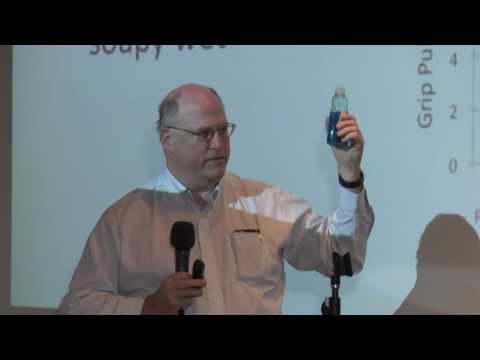
so the idea i’m going to talk about is
the idea that friction can be designed
so friction is either things slide
easily or they’re really grippy so we’re
not talking sticky not not vertical butt
slide so how many of you go the airport
and your briefcase slides off your
shoulder and you gripe button well mine
doesn’t and so this has a surface and
you can come try later where it has
extreme grip to fabric but not so much a
little tear it’s just simple example I
got more toys in here we can we can talk
about talk about later the picture you
see here is it was taking up at
Asheville it’s um in a pond up there and
full of lotus leaves and covered with
little water droplets and the day I was
up there took this picture it was a bit
windy the leaves were shaking back and
forth and the drops are perfectly still
they were just rolling back and forth
and so so little friction between that
leaf in that water droplet they could
just rock back and forth so being the
nerd I am it’s one of the curiosities
we’ve studied but that and many other
experiences basically 26 years of
Michelin working on tires let us to
consider more about can you design
friction first just you know this is a
nerd part of it a little bit what it
what is friction so if you have a load
pulling down I guess this is a yeah if
you get a load pushing down and you’re
pulling something sideways on some kind
of surface so the the pull force
relative to load force is what’s called
the friction and something people are
taught in university is that the force
to pull sideways directly proportional
to load so if you load more it’s harder
to pull and that’s just just you push
harder than it those are and second
thing kind of curious is independent of
how big that object is so how much
surface there is pushing down so whether
it’s bigger or smaller that same
relationship holds and then let’s imply
then there is friction as a property
materials so you think of things as
sticky you think of things of slippery
so my team is working very heavily on
that none of this is true and so first
maybe a little bit why is that why was
that true well if you look at things in
nature they tend to be like these
particles of sand this is glacial wash
sand where the edges are rounded there’s
little bitty protrusions but they’re
kind of shallow they barely poke out so
most materials as they wear and crumble
they have shapes like this and as you
push harder the little Peaks push into
the surface a little more and that’s
about roughly constant Airy increases
you push harder and so the friction is
about the same well you know there’s one
big exception of natural surfaces that
don’t look like that anybody got an idea
there what’s the what’s the biggest ash
things don’t look like that living
things yeah like a living things they’re
round like that some of us surrounded
like that but you know if you think of
things like the feet of a mountain goat
extremely sticky too wet Rock you may be
seen articles on geckos the lizards that
can walk up walls hang on glass and so
on there’s things like pitcher plants
that are have a super slippery layer
that they’re so slippery that bugs can’t
stick to them so they try and land and
they slide inside so now what’s
interesting is all of those are made out
of very similar material so keratin is a
common biological protein structure
that’s used in everything from your hair
your fingernails and so on and nature
manipulate that everywhere from very
slippery to very grippy so we began
thinking well can you design this can we
figure out the fundamental rules and can
we make things super slippery or super
grippy
now as an aside one of things I first
noticed was being really ambitious and
really nerdy folks at Michelin had a
colleague that rented a gecko at one
time and brought it in and we’re
watching crawl around in glass and so on
and some of us were holding it in what
shocked me is that it’s not very grippy
to your skin so it’s not at all sticky
and it’s not really sick and I’m not
sure a gecko could really hang very well
just hang you on your skin without
without digging in so you know kind of
leads to the question of why can the
gecko stick to wet rock or smooth glass
and why not very well to your skin
what’s what’s going on there ok so what
you’re looking at here is pillars that
are about four times as high as broad in
their widely spaced and they’re covering
this fabric surface it’s in fact it’s in
my briefcase here and so if you design
surfaces are very non round what happens
and look what can you what what was
going to be a result there so we’ve been
studying grip to skin so I mentioned
skin is very very interesting and that
you know first thing is you don’t wanna
hurt people it’s you know it’s it’s kind
of so-so how many of you hurt yourself
when you open your bottle of olive oil
if you look at that cap you’ll notice he
has really tall ridges and you have a
choice particulars oil on it is how
badly do you hurt yourself before you go
get your spouse or parent liars or
whatever whatever you have handy so so
you know often you see the case when you
have pretty good grip to dry surfaces
you don’t really notice it but usually
when something is soapy oily maybe it’s
in surgery and it’s bloody or so on it
gets really slippery and so on you know
kind of a measurement this is a little
pull test we do or we have people grip
between their fingers and how hard can
you pull it and then you watch little
needle go around and so with this
particular
polypropylene plastic that’s found on
typically like labels like you know
here’s an example you have a dish soap
you know feels pretty good you can grip
it you can squeeze it and so on you get
this covered with a product and it’s
hard to squeeze let alone get to get the
top off so in that label on here is made
out of polypropylene so in this case
when it was dry we could pull about 78
pounds force yanking on the tab that
material and when you get the Don liquid
on there with water you can barely give
it to move at all and I have a demo of
that if if people are curious later on
the other hand what we’ve been able to
do is to take that same piece of
polypropylene and make it when it’s dry
so you can pull harder than the current
label now and when it’s covered with
soapy and so on you can also pull
equally as hard now what’s what’s
curious about it when you pull on it
when it’s so P or oily you know your
fingers are oily they’re gooey they’re
slippery then you grab this thing and
yank it and in your mind it’s like
incredible it feels like you’re pulling
a lot more than dry but in fact we
measure the force it turns out to be the
same same amount so we’re working on
these surfaces with very high grip to
skin and you might say well you know why
is this important okay now i know this
crowd everybody says football football
we’re gonna put these on a football so
he can catch it and throw it well yeah
that’s kind of interesting but what
about if you’re a first responder and
and you want to grab somebody you don’t
want to hurt them you know maybe that
might be a little more interesting some
Clemson students told me other day that
there’s there’s three to four thousand
babies drop during delivery every year
yeah so surgeons have to wear rubber
gloves these days those gloves are
really slippery now once then get the
towel around the baby you know then you
can grab it but between the delivery and
the towel there’s there’s apparently
space where where
there are certain number of babies
dropped over a year so mayhap becomes a
little more interesting to be able to
grab continuing along that people have
implants like stents stents do what they
call my great as they move out of place
now if a stents inside your body many
times like like we’re going right now on
esophageal stents and there you’re
swallowing motion is so strong that you
can’t surgically suture it down or it’ll
tear the stitches out some patients have
a three hundred percent failure rate
with those stems in Wrath that’s the
colleague in Mecca what does that mean
they said means we fish it out of their
stomach three times before they heal or
before they die and so huge costs so if
you can grip in the throat and hold that
stint in place without being painful
without piercing the tissue without
causing damage that sounds like a pretty
interesting thing to do so that’s the
kind of things we we work on what the
characteristics of these surfaces is
they’re invisible to the eye so the
plastic looks the same maybe a little
more matte instead of shiny it’s
painless so no matter how hard you
squeeze it doesn’t hurt so you know you
can say well you can use sandpaper use
safety walk you know I mentioned the lid
on the olive oil you know there are
things where to try and increase grip
force it really hurts and in fact people
stopped because of the pain before they
can really get to the maximum amount
amount of force there so in these
services again sorry the phone is here
you can’t see it they look like pillars
on pillars and and so on so small
contact area but designed according to
features your skin an interesting thing
about your skin is that the nerves are
about a tenth of a millimeter 100
microns in so if you penetrate less than
that there’s no pain so the
only defect we’ve seen with this is when
we play with them a lot our iPhone
sensors don’t work that so so that may
be kind of conclude here is we we design
friction make things super slippery
we’re super grippy I talked a lot about
grippy tonight not so much on slippery
example on slippery is we make ordinary
plastics lower friction and Teflon so an
interesting application of that is
vascular catheters so these are the long
tubes through your body to apply stands
they’re all Teflon lined and that Teflon
is a major expense as well as it means
they’re not recyclable and so on so we
work on on that as an example of low
friction so I mentioned that PTFE teflon
internal organs and we talked a little
bit about anchoring stents in your body
think about during laparoscopic surgery
so laparoscopic surgery you have very
tiny grip grips going through a very
tiny opening and you want to hold and
pull things at a place so that you can
stitch and so on so these days lots of
times the grips holding things out of
place cause significant damage during
the surgery that is they squeeze so hard
that they are tearing and ripping and
bruising and so on and some things you
just can’t grab laparoscopically like
liver bleeds real easily and it’s
extremely slippery and it heals very
slowly particularly for patients that
are that are sick anyway so just another
we were we were working on surfaces
today we need to grip things like liver
intestines that don’t cause damage or
pain now when I mention you’re just
curiosity is we have surfaces that grip
melting ice so that is if you take an
ice cube out of the freezer when it’s
really dry you can sort of hold it and
you pour water on and sort of get super
slippery so we have surfaces that when
you pour the water on the ice it gets a
lot grippier so grippy that you could
take that
piece of plastic hold it up vertical the
ice cube will hang there until it melts
so no idea what that’s good for if
anybody has to it’s good for let me know
but it makes a really cool little video
and finally we are working on surgical
gloves so that those babies won’t be
dropped in any questions or thoughts
there ah yeah yeah we are partnering
with an oem to develop so the question
was are we developing the product for
the stents and so we designed the
surface and then we make the tooling to
make the product that will go on the
stents and then we’re not going to make
the stents and we’re debating how far we
go in that manufacturing process but
really our goal is design make tools so
other people can make these things in
large corner yeah well you mentioned the
FDA it’s really curious because we have
no chemistry we have no coatings in many
applications we’re suppressing coatings
in chemistry like I think every time you
get a vaccination you get a little bit
of silicone oil in you or your child and
that’s because that’s the lubricant on
the seal on the syringe plunger it’s the
anti stick coating on the vaccine vial
and so on and so their technology you
eliminate that so how FDA’s look at
these is really wide open because we’re
just changing the shape we use existing
materials we don’t add anything don’t
take anything away and so yeah we’re
working that there ah well I could tell
lots of bad jokes but as you all know
well by now you know I’m just a real
nerd and when we started we were
thinking nano micro whatever and my
daughter said dad you’re such a nerd and
so i’ll put up or shut up and and so my
daughter sara had a friend Whitney
Williams who was doing a senior project
at upstate USC in Spartanburg in design
and she came up with our name and logo
one colors and so on and it’s a play on
the three founders holtzman Warner King
so John Warner many of you may know he’s
one of the cofounders of the company and
then bill King up in uris Illinois and
this spelling is unique in google it
doesn’t bring up any nasty websites and
it’s kind of fun and people are very
kind ask about it thank you yeah I know
that come visit us and we’re in the next
manufacturing building so you know
what’s really proprietary about us is
our design capabilities and our modeling
and our standing of friction our biggest
surfaces we make by rapid prototyping
some of the techniques now can come down
to less than less than the size your
hair 100 microns we have CNC Mills micro
machines that can run bits down to 50
microns about half the size of your hair
and they’re saying so you’re doing
machining under microscope and they’re
they’re kind of fun too fun to watch and
then we also do some electrical
discharge machining you know that for
certain geometries and so on to remove
metal and then smaller we have a range
of patterns that we do laser processing
and we partner with a laser company and
then for our smallest patterns we do
silicon micro fab so we use silicon
wafers like a workshop and so instead of
making computer chips or so on we make
patterns and then we have technologies
to copy those and get them into hard
yes yes so the question was in I fear
the product called sharklet so sharklet
also designs microservices and they do
it exclusively for antibacterial
properties and I know very well in the
some years ago we work to them on making
some of their tooling and so so there’s
lots and lots of natural surfaces so
I’ve talked about friction and grip and
so on in nature their surfaces are
antimicrobial there’s reduced drag I see
one of our most fun surface as if you’re
in South Carolina is we have a service
that stops condensation of water on your
cold water Doug so you know in the
summer in the summer you get your icy
beverage you put on your desk and your
paper is getting wet in about three
minutes well we have a surface that
delays that to a couple of hours and
we’re trying to figure out how to bring
that the market but well actually
actually it adds less than a percent
extra plastic and it should be very low
cost that’s not what will charge for it
but so that answer question that yeah
there’s lots o so sharklet is in the
space doing antimicrobial there’s a
company out of MIT called liquid glide
and a competitor called slips technology
out of Harvard they’re the ones with a
really cool ketchup mayonnaise bottle
commercials where it all runs out every
time they do a publicity blast we get
all kinds of phone calls and and that’s
all
you [Music]