
and my journey started here in a small
town in southern Ontario my parents made
the long journey from India to Canada in
the 1960s in search of a better life
if there’s one picture that could
summarize my life growing up in Canada
it would be this I wanted to be the next
Wayne Gretzky my parents were really
good about letting my brother and I fit
in as much as possible into the Canadian
culture that said there was also a
period where my parents felt like maybe
we were losing touch with our cultural
heritage and so shortly after this
picture was taken my hockey dreams were
crushed in an effort to get us closer to
our roots my parents decided to pick up
and move us to Iowa now you might be
wondering what does iowa have to do with
indian culture well little do people
know Iowa Fairfield Iowa is home to
Maharishi school and University founded
by the Maharishi himself who became
quite well known for bringing
Transcendental Meditation to the West in
the 60s now some of our friends and
family thought maybe we had joined a
cult overall it was a very positive
enriching experience for me I went on to
study computer science at Maharishi
University and a few years after I
joined the work force that’s when I
realized I had definitely entered a cult
the cult of Dilbert I spent the first 15
years of my career working for two very
successful startup companies these
companies went public worth hundreds of
millions of dollars and for someone like
myself coming out of a tech background
it was a good experience but that said
there were definitely times when it felt
like I was living in a cartoon
now I didn’t realize it at the time but
a lot of his Dilbert dysfunction that I
was experiencing had to do with the fact
that I was working in a hierarchical
structure in hierarchies do
strange things to people and
organizations especially when there’s
monetary incentives involved when you
work in a hierarchy you’re incentivized
to basically manage up your livelihood
hinges on your ability to manage up and
so the higher up you go in an
organization the more difficult it
becomes to really differentiate talent
and performance and to understand what’s
going on at the lower levels in the
organization there’s this funny joke
that hierarchies are like trees full of
monkeys and the monkeys at the top
looking down all they see are smiling
faces the monkeys at the bottom looking
up you know they see something else
well the point came in my career when it
was time to move up the tree and become
a managerial monkey and I was terrified
I didn’t want to be a Dilbert like
manager like some of the managers I had
experienced and so I decided to go back
to business school ten years ago and in
one of my first management classes I was
introduced to this concept of informal
networks that yes we work in hierarchies
but that’s not actually how work gets
done it gets done through connection
relationship we’re social animals we
like to have friends at work and if
leaders took the time to map that
dynamic to really understand the social
dynamic inside their organization they
could make better decisions about their
people and teams and really tap the true
power the hidden power in their
organization and so for me this was like
a cloud parting moment I heard angels
singing like descending I’m like this is
the answer or at least an answer to the
Dilbert problem and so being a software
guy I went out looking for some tools
that could allow me to do this mapping
quickly and easily and to make a long
story short when I didn’t find what I
was looking for I decided to team up
with a classmate of mine and I started a
company called key hubs which is
dedicated to uncovering hidden networks
and organizations and helping leaders
see their organization through the lens
of connection versus just through the
lens of hierarchy and so for the last
seven years I’ve been out knocking on
doors talking to business leaders both
large fortune 500 companies and small
nonprofits and everything in between and
what we found over
the last seven years of doing this work
is there are some recurring patterns we
see the same patterns playing out over
and over again regardless of where we go
regardless of the type of organization
we work with or what industry it’s in
and what I want to do today is share
with you what some of those patterns are
and how they’re not just playing out in
our organizations but in our
professional networks and our
communities so this is a key hubs map
this was generated by asking a question
to a group of employees in an
organization the nodes represent the
employees and the arrows represent the
answer to the question we asked which
was who is a positive influence in this
organization who do you reference as a
role model and so what you see here is
there are some key hubs there are some
individuals that have garnered more
followership than others who have more
influence this person in particular
stands out this is a key positive
influence in the organization who is
this person we like to play these games
with our clients we’ll go into the
boardroom and we’ll say so who do you
think this big blue hub is and in this
case the leaders rattled off a bunch of
names oh it must be John or Mary or Bob
and after 8 or 9 wrong guesses they sort
of embarrassingly threw up their hands
and said who is this person how could we
not know who this person is well when we
take this network and we overlay it on
the formal hierarchical structure this
is what we get this key hub is buried in
the hierarchy four levels down out of
sight out of mind
and we see this to varying degrees
pretty much everywhere we go that talent
influence highly connected collaborative
people are often hidden in lower levels
of the organization so that’s one
pattern that we see everywhere another
pattern that we see has to do with teams
and collaboration or the lack thereof
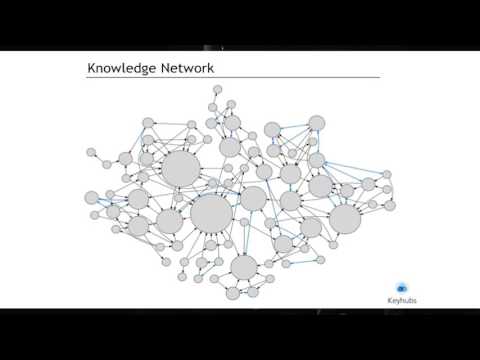
this is a knowledge network in a global
organization we ask the question who do
you go to and you really need to get
work done and you can see there’s some
hubs
connections but the real insight comes
when we overlay the different
departments by color on top of this
network colors represent different
departments and you can see some of the
departments aren’t really connected to
one another their silos but when we dig
even a little deeper we find some more
interesting insights the largest
department in green is siloed in three
areas there’s a group up at the top
that’s not connected to the group a
little bit to the left not connected to
a group at the bottom and we looked at
this or like what’s going on here this
shouldn’t be happening and when we slice
this data from a geographical
perspective we see that the silo effect
is largely due to culture and language
the red team is in Japan the yellow and
purple towards the bottom or Pacific Rim
and the more integrated team between
blue and green is North America and
United Kingdom so this is a pattern that
we see everywhere we go birds of a
feather flocking together and if you
look at the research on how networks
form it’s very consistent if we took a
bunch of strangers and threw them in a
room what would happen very naturally
very organically is that birds of a
feather would flock together hey you
look like me kind of think like me let’s
hang out I’ll connect you to people who
look like us and think like us and
you’ll get these cliques and these
cliques will turn into polarize cultures
and that’s what we see happening in
organizations now you might look at that
and say okay so what what’s the big deal
well what’s very fascinating is if you
look at the latest research on career
success what social scientists have
found is that the biggest predictors of
career success actually fly in the face
of our natural tendency to gravitate
towards likeness the first thing about
career success has to do with how we
connect with others it has to do with
diversity of connection now historically
when we think about connection and
career success we think yeah that kind
of makes sense it’s how big your rolodex
is how many LinkedIn connections do you
have it’s it’s how big of a hub am I in
my network but the research suggests
it’s not how many connections you have
it’s how many different networks do you
bridge
are you a bridge to diverse networks
that is one of the biggest predictors of
career success now you look at that you
say why is that well when you are a
bridge to different networks you put
yourself in a position to be a
translator of different perspectives and
points of view and when you put yourself
in the position of being a translator
that’s where creative ideas can be
combined this is how innovation happens
growth and development so the first
piece is diversity of connection the
other piece is whether you operate in an
open network versus a closed one so the
biggest predictor of career success has
to do with diversity of connection and
whether you’re in an open network versus
a close one so what does that mean open
network close network
well imagine yourself a sea creature the
difference between being in an open and
a closed network is like the difference
between swimming and the wide open sea
with no boundaries or swimming in a
fishbowl
now when I came across this research I
reflected and I thought is this really
true has my career progressed and grown
as a result of the networks I’ve been
swimming in does it have to do with
closed and open networks and so I went
to LinkedIn and I mapped my connections
and my journey started here in the
Maharishi Fairfield Network I swam with
people who are really into yoga
meditation and herbal tea this was the
extent of my life for many years and it
was here that I landed my first job a
professor at the University had started
a company I heard about it I was lucky
to get the job and over the next 11
years I inherited another network of
people I jumped from one fishbowl to
another that’s what brought me to
Minneapolis 20 years ago now this
network was very different than the
Maharishi Network these were more
computer science people radiologists
medical imaging type folks and this was
really the extent of my whole life
I spent most of my time working or
sleeping and so the extent of my career
in my life
was lived through the lens of these two
fish bowls now 11 years went by and I
was ready for a change it so happens
that one of my customers have started a
company in this network and I said hey
you know you have some opportunities I’m
looking to make a change he’s like yeah
as a matter of fact we do and boom I
jumped from one fish bowl into another
same industry but very different culture
shortly after I joined this company I
decided to go back to business school
and boom I jumped into another network
the MBA Network completely disconnected
from my prior networks and it was this
change of scenery that gave me the idea
for a business but it was still a closed
network because I spent most of my time
with the same group of 70 or so
classmates over a year and a half period
so pretty much for the for the course of
my whole career up until this point I
was operating in limited closed networks
I really didn’t step into an open
network for the first time until I quit
my job seven years ago and that’s when
my life really started to change and my
career grew and progressed in ways I
couldn’t have possibly imagined now at
first I had to draw from my existing
network I was a starving desperate
entrepreneur and I needed to find
customers and so what I did is I looked
through my rolodex and I thought who
could be a potential customer and I put
big targets on their head I needed to
pay the bills and I reached out to them
and I said let’s have coffee I’ve got
this cool new product you know I’d love
to show it to you and it was very
economically driven one-way driven and
what would often happen is these folks
would be very kind they knew me they had
worked from with me in some prior life
and they said sure because we’ll sit
down and have coffee but oftentimes you
know that maybe it was the product maybe
it was my desperation they’re like you
know thanks but no thanks but maybe you
should meet this other person and they’d
pawned me off to someone else and I had
nothing better to do so I would meet
with these people and they would pawn me
off and connect me to someone who
connected me to someone and six or seven
links down
the chain chicheng I would land a
project or some new opportunity and what
I realized is that it didn’t matter who
I connected with because they were
connected to someone who is connected to
someone who’s connected to someone who
might be interested in my work it was a
totally nonlinear random process and
after a while once my business started
to grow I realized I was deriving more
joy from connecting with other human
beings than landing the deal people are
amazing my health and well-being reached
new heights and it was because I was in
this process of connecting with others
and oftentimes their conversations would
go deeper beyond the surface level
chitchat of who you are and where he
from and my life was enriched my life
was enriched and my career was
blossoming in ways I couldn’t have
possibly expected so when you look at my
network post seven years ago it grew
considerably in a few short years my
network was much larger than all my
prior networks combined and what was
great about this network is it had no
boundaries there were people from all
walks of life in this network not just
yoga people or medical scientists people
but artists and musicians scientists and
corporate executives and homemakers this
was the most diverse network I had ever
stepped into and it was changing my life
in so many wonderful ways
now just as I started to get kind of
proud of my wonderfully open diverse
Network I realized that my network
actually wasn’t very diverse at all
through a long and winding road of
connection I got invited to teach a full
semester course at Minneapolis Community
and Technical College or MCTC now I
thought I knew diversity right child of
him
RINs canada iowa maharishi but when i
stepped into the classroom at MCTC
that’s when i really learned what
diversity is my students represented
diversity in every demographic dimension
you can think of age gender ethnicity
religion but perhaps most importantly
socioeconomic status some of my students
were homeless or had experienced
homelessness some of them had spent most
of their adult life in prison one of my
students was shot three times for
stealing crack and somehow lived to tell
about it they were teaching me about the
power and resilience of the human spirit
I was learning things that I had never
learned before and my life reached new
heights of enrichment now I ask the
question how could I have lived some
40-plus years and never cross paths with
such phenomenal human beings and if you
look at our cities by ethnicity you see
the same pattern playing out in our
communities that are playing out in our
organizations and social networks birds
of a feather flock together we’re all
living in our own bubbles of sameness
yet the science is pointing us in a
different direction think about the
opportunity for learning and innovation
we have before us and it’s not just the
Twin Cities from coast-to-coast whether
it be New York Chicago Los Angeles we’re
all living in our own silos yet there’s
a big beautiful world out there not just
outside our state right here in our
backyard and I invite you I encourage
you to step a little outside of your
comfort zone and connect with people who
look and think different from you it
will not only
enhance your career I believe it will
nourish your soul and if we all take if
we all take steps to move into open
diverse networks I believe it will not
only transform our lives but it will change the world thank you