
[Applause]
now a couple of years ago a question
started to intrigue me and the question
was how many medical devices and
diagnostics do we need in a country to
provide universal health coverage I
started to look at India as my case
study and focus specifically on diabetes
now the International Diabetes
Federation actually says that India has
60 1.2 million people with diabetes
right now if you actually follow the
standard practice standard operating
procedures on each one of them and do
all the tests and all the treatment that
they’re supposed to do here’s what we
are actually faced with for a year three
billion blood sugar tests three billion
blood pressure tests two billion urine
tests two billion hemoglobin tests 250
million visits to the doctor 2.5 million
hospitalizations 5.4 billion syringes
and countless number of dialysis session
for people who actually end up getting
end-stage kidney disease because of
diabetes this is a large number and when
you actually total up the cost that’s
associated with it it comes to around
0.8% of our country’s GDP let me put
that in perspective India for its entire
healthcare budget only spends 1.8
percent of its GDP so not only are you
gonna need a 67 percent increase to take
care of diabetes let’s actually add the
cost of cardiovascular disease let’s add
the cost of reproductive and child
health cancer airborne pollution related
diseases and essentially this vibrant
and young India’s picture starts graying
a little bit and the problem is
essentially that India does need to
spend more money on health care but also
we need more health for our money so
what works is the fact that most of the
medical devices and most of the medical
diagnostics are essentially made for the
top 1%
of the world’s population right and then
we in India just adopt them and wait for
them to get cheaper for all of us to be
able to afford it and India can’t afford
that so what we ended up saying is why
don’t we actually start developing for
the bottom billion and that was the
basic dream with which I came back to
India in 2011 I traveled the length and
breadth of this country I asked people
what do you want from health what is
health for you what do you want to
improve in health care delivery and it
was around those interactions that the
concept of democratizing Diagnostics
really started to hit me
the idea of affordable reliable quality
digital diagnostics available anywhere
anytime now when we actually started
this the problem was quite complex
because you had to take stuff that was
actually lying in three big rooms
biochemistry analyzers you needed
patient monitors you needed all this
stuff that lies in big labs and these
big labs take a lot of money from us
saying we have three Tesla and four
Tesla and we had to reduce it into
something that can actually be used in
the rural environment and had to be used
in a very very rugged manner and that’s
when me and my team started to work on
this device called the swash slate which
literally translates to a health tablet
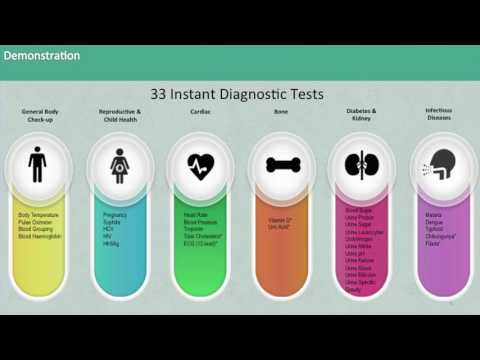
samasta slate is a powerful device that
actually allows you to do 33 diagnostic
tests on a mobile phone so instead of
just doing one and then putting it on a
mobile phone we said let’s actually put
all 33 on it because disease is
multi-dimensional so should be the
solution let me show you let me show you
a live demo so my dear friend here uncle
he has a girlfriend
let’s take a look at his heart if it’s
any different right so here is his live
ECG that you can actually see this is a
tablet that I’ve picked up this is a
tablet on which you can play Angry Birds
but it’s also a tablet on which you can
actually do a live ECG or funk it and
then at the end of it go ahead and
produce a report just like this that can
actually tell a clinician on whether onk
it needs to be in a hospital or not let
me show you something other cool stuff
that happens as this ECG is being
captured we actually reduce all of his
patient data into a six
a kilobyte file that can actually be
then uploaded onto the internet by 2 G
by 3 gee by 4 G but also without any G
it can actually be uploaded onto the
internet via an SMS that can then send
data to our SMS server and then moved on
and that works beautifully for example
in Lake where we are out there where
mothers need to be transmitted or
transferred to a hospital we want the
data to transmit with them and you don’t
have internet so how do you do that you
can do that with these kinds of system
let me show you something else here is
an example of antenatal care visit app
antenatal care as a pregnancy related
preventive app so it’s already recorded
GPS that this particular hazard happened
in Mumbai let me show you another cool
feature so we go ahead we’ll show some
questions you can answer these questions
and as these questions are answered the
system will actually throw back advice
that you can tell the patient so the
frontline health worker is actually
getting advice so if you can focus on
that it actually gets standardized
advice that you can give a patient
anywhere about what they are supposed to
do and that’s very critical it also
generates referrals so for example if
the mother is bleeding from the vagina
or has a leaking of watery fluid as soon
as you press save hair it generates an
emergency referral and that emergency
referral as soon as you press ok goes to
the first referral unit and the doctor
has all the data awaiting them all he
has to do is scan the mother’s iris or
scan the mother’s fingerprint and all
this information is available to him for
the first time you actually have mothers
showing up in rural areas for delivery
with an entire antenatal care visits
records with them and that’s beautiful
now for you what if you wanted to know
that that persistent fever is it typhoid
is it malaria is it dengue well uncle’s
here exactly just as we were speaking
done a test on this machine which is a
machine meant for urban India and that’s
a machine where he’s actually going in
and doing a malaria test and as he just
press analyze within one second the
system will actually tell you whether
this person has malaria or not one
second doesn’t take two weeks doesn’t
take one
doesn’t take a day it takes one second
and that’s the beauty of this particular
system
it’s an end-to-end digitization solution
we begin with decision support we go on
to doing referrals we go on to doing
advice and move on now the government of
India actually partnered with us they
put us in six to six of Jammu and
Kashmir we’ve been live in Raj or a
bunch and Doda these are places where
you generally hear off unfortunately
because of terrorism but slowly and
steadily a health revolution is
happening there you can actually see
that mothers are actually showing up in
these clinics and getting their tests
done sixty-one percent was what we were
reaching before the swashplate
eighty nine point one percent today and
the number of mothers who are getting
all their tests done has actually grown
by twenty five percent twenty five times
rather and that’s where we actually feel
really really proud about what we’ve
actually gone ahead and done what’s also
interesting is it used to take fourteen
days to get an antenatal care visit you
had to run from one facility to another
to another just to get a preventive
visit for a pregnant lady now from
fourteen days it just takes forty
minutes flat and that’s better than what
happens in Mumbai that’s better than
what happens in Paris that’s better than
what happens in London forty minutes
flat a mother knows exactly what to do
to protect herself and to protect her
kid we have also now found that this is
a problem for urban India when you go to
your doctor don’t you waste two to five
days just getting diagnostics going back
to the doctor getting some medication
and adjusting it now with the health
cube which is this little device that
you just saw there doctors can actually
do the test right there and then and
give you solutions as we speak and give
you medications in fact in the Delhi
government’s peer agree clinic which is
their smart cities solution for health
care a patient can walk in go to the
doctor get Diagnostics go back to the
doctor then go to the pharmacist get the
medication all of the system done in a
paperless system in four point three
eight minutes flat that’s the beauty of
this particular solution and that’s the
whole point of being working for the
bottom billion you know
for me health and technology are
intertwined
they cannot be separated any more and it
is up to us in India to lead this
revolution by putting rural first and
essentially enabling the digital version
of healthcare thank you
Oh [Applause]