
the organizers who invited me in this
event and gave me the chance to present
my version of the truth amongst very
many other significant presenters who
have already presented their versions of
the truth so I’m going to present to you
my version of the truth so what could
that be that’s progress objective kind
of truth and what I understand that is
is probably some subjective
interpretation of my reality and of
course this cannot be one reality it’s
many realities in the same sense that
Nelson Goodman
talked about worlds creating worlds
perceiving representing worlds in his
book ways of world making so I’m going
to present to you a glimpse some aspects
of my reality and this in the particular
case of the person that talks here is
includes a lot of virtual reality so and
because virtual reality is quite a hot
topic right now I think it’s appropriate
to discuss that and to discuss issues
that relate to the making of virtual
reality experiences and I’ll say a few
words about where I come from I studied
architecture as a first degree in
National Technical University of Athens
then went on to do or to study computer
aided design and I did my PhD on exactly
that subject I’m going to talk to you
about the design of virtual environments
and particularly space in virtual
environments I did that back in the 90s
and when we had the first wave of
virtual environment technology I’m going
to talk to you about that in a few
minutes and I’ve been a scientist and
design
from this aspect currently and since
2002 I’ve been working and teaching in
the national capital national
capodistrian university of athens in the
Faculty of Communication in media
studies and I direct I had the special
media research group there which is a
part of the new technologies laboratory
that we have in the department and I’ve
been also practicing artists since the
ages of the musician back then and since
the 90s have been creating interactive
installation artworks and funnily enough
this is very relevant because virtual
reality and that was one of the reasons
that I started off researching and
investigating virtual reality is that I
realized that virtual reality was a
unique platform where I could
incorporate my two main loves and
passions which was music and making
space I think this would probably be
more well understood as I proceed so
let’s start quickly what is virtual
reality not virtual reality is
interactive three-dimensional graphics
it’s an environment consisting of
interactive 3d graphics and it has to be
freely navigable you have to be able to
play and interact with objects in there
not all computer games have virtual
reality in fact very few but games are
related to the evolution of virtual
reality and of course and one more thing
I have to stress cyberspace is virtual
reality I am totally against the idea of
cyberspace being related to the web the
web is not cyberspace cyberspace is a
multi-user virtual environment of a huge
global scale at least as William Gibson
coined the term and what is not virtual
reality panoramic 360-degree video is
not virtual reality
whatever they tell you it’s not 3d
animation you see in movies is not
virtual reality virtual reality has to
be interactive and freely navigable
there is many different types of
experiences afforded by the composition
of 3d graphics and physical
environmental stimuli and this is a
continuum of such systems that afford
different kinds of experiences and now
going back to the end of the 80s we had
the first wave of virtual reality
technology and that’s where I began
working on the subject back in 1993 and
there were many problems though involved
there virtual reality was neither mature
as a technology was not robust enough
and of course it was no way affordable
so it could never become a consumer
product
now we experienced the second wave of
virtual reality technology there’s a few
key points of you turning points that
have given us this possibility firstly
the evolution of course of real time in
3d into interactive 3d graphics
technologies both in terms of the
graphics engines and in terms of the
software libraries that support the use
of these systems the authoring tools
many game engines have evolved to be
very complex authoring tools for and
quite often freely available IO devices
are more robust and cheaper and and the
key point we say is the emergence of
oculus rift a cheap high-quality HMD
head-mounted display simulation gear the
that you that you see in all the adverts
that relate to virtual reality and the
HTC vive of course is also another one
which is very important so when this
came along this was a turning point VR
started its comeback you can
and another very important key point is
the acquisition of the oculus rift
company by Facebook which probably hints
to the possibility of some sort of
convergence which me and many other
people foresee a sort of convergence of
the social networking systems and
immersive experiences I won’t go too
much into that because it is all
speculative because there’s still so
many problems involved with this
possibility but I think we can see this
coming now a virtual reality but this is
an illusion is it area it is a reality
of course we can get into big discussion
from a philosophical perspective as to
what is a reality and what is not I mean
and many will tell you that what we are
experiencing now face-to-face
communication is not a reality is
mediated it’s still very much mediated
so you know this is also mediated so
what’s the difference another
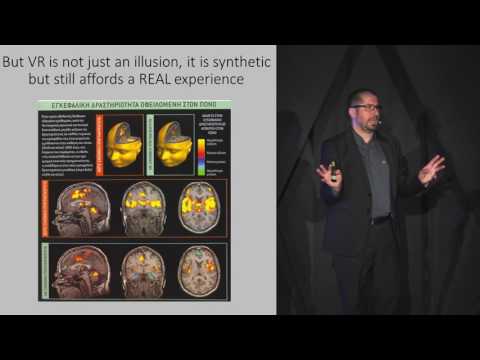
significant thing is that there’s
evidence that proves that the use of
immersive virtual reality systems have a
significant impact on the plasticity of
the brain on what happens to the user of
the of on the user’s brain so what I
mean by that is that people for instance
that have been exposed to virtual
environment experiences immersive
experiences have felt less pain they
don’t think they feel less pain it’s
been measured that they experience less
pain that’s in the case of patients with
extreme burns who are being immersed in
such environments and also very another
very interesting experiment that has
been conducted by Professor Russia but a
kayo Faculty of science in Japan he’s
worked with paraplegic patients and he
studied them the activity in their brain
that shows the projection as Heidegger
has discussed this you know the
projection that we we experience before
we move towards someplace
so this will do move and a paraplegic
patient cannot feel that so these people
actually after being immersed in virtual
environments to experience that so their
brain changes because of that so to me
that’s pretty much real or it has a very
real impact so I’ll quickly run through
some of the main out through that the
what the process of design virtual
environments a very complex thing it
involves the interactive design aspect
and this is a series of you know aspects
that we need to consider when we are
making virtual environments it also
involves the creation of content and
please keep this thought in mind a
little bit because I think this is very
important and the convergence of all
these forms of content in an interactive
spatial environmental context means the
composition of a virtual environment
experience and of course it involves the
evolution of technological
infrastructure that’s probably the first
thing and that’s the thing that’s very
advanced now and also when we talk about
social we are it involves the creation
and maintenance of sustainable social
virtual environments and of course
there’s all these different versions of
technologies like mix the reality long
better reality that’s there’s no time
for me to discuss now and and these are
a series of methods that we have to
create content now there’s two problems
and there’s two which to me are more
like driving forces to work with this
medium back in the 90s when I started
working with this media one of the main
reasons was that I couldn’t understand
why people using virtual reality were
just designing real-life buildings I
mean here you had a medium which has the
potential to realize whatever you
imagined to make it actually feel real
for people who were immersed in it so
that was one of the main driving forces
that I wanted to investigate how to
create spaces which were in no way
realistic where whatever else apart from
realistic and when of course when you
use
virtual-reality as a training – you need
realism you need as much realism as you
can get but when you don’t need that
then what do you do that’s a big and
difficult design issue and quite quickly
and after you know the 20 23 years that
I’ve worked on it now that the
technology is mature and it’s almost
ready to become a consumer product I
realized that one of the main and the
most important problems with creating
virtual environments is that we have a
lack of knowledge on how to create
content we have lack of content of
content that will have an emotional
impact as narrative for instance for
virtual environments and we have a very
we have a lack of understanding of the
potentiality of the medium because
virtual reality is a medium is not a
technology is a media technology and to
be more precise as a media interface so
I wanted to sort of conclude the
theoretical part of what I’m going to
say and then move on to the more lively
audio-visual stuff to conclude that to
say that there’s a serious need to
investigate an experiment creatively
experiment with creating content and
experiences where this content will be
positioned for utilizing the potential
of VR as a medium so that’s exactly what
I’ve been doing in the last 23 years I
will show you quickly some of my
experimental works back in the 90s where
I was trying to understand how people
behaved how people behaved in this
environment how people navigate it
orientated acted in this virtual
environments I have contacted a series
of studies on that I’ve also
experimented creatively with some
artistic works with interactive sound
also this is a design project that we
did back in 1999 in the university of
athens when I was working the Department
of Informatics with the virtual reality
group there this is a design
of a virtual museum which incorporated
10 museums 9 museums of the University
of Athens and the Cycladic Museum 2 and
so these are glimpses into the design of
this and you see that there’s no
realistic building here so that’s that’s
exactly I was lucky enough to be able to
implement my concerns and my ideas that
I came up with in my PhD in this big
project and other artistic
experimentations with virtual
environments and more recently we are
working with my colleagues in the
special media research group and I’ll
show you two of the projects that we’ve
done this is a video of an entire
installation that we did last September
and at Binaca Newseum this shows you the
virtual reality is not a system you
interact with with a head-mounted
display necessarily you can invent more
embodied ways to interact with the
virtual environment and that’s exactly
what we try to do here so this is a
virtual environment to frame based work
so you can’t move oh you know inside it
at all
but you can interact with this object
the people who are positioned there in
front of it can transform change its
form by by means of their actual
movement this was an exhibition called
out Tapia’s curated by fellows volvulus
at Binaca museum it was about
performance in the city so in that case
we put the actual audience in the
position of the performance so the
audience performed and by transforming
the audience could transform the
composition that we had created and at
the same time interactively create the
audio scape the soundscape so the sound
here is interactively transformed by
means of users movement
I’ll quickly go to the next latest
experimentation that we have contacted
which is in the context of domes the
full dome and we were lucky enough to
participate in a research project which
was called EMD l and there is many very
interesting different issues that come
to when you when you discuss the
creation with their antics interactive
content for large-scale displays like
the dome and so you see some glimpses
into what we tested and I’ll show you
the final work that we created and was
presented at sat the immersion festival
in Montreal on May 2015 this was done
the interface was done in collaboration
with the AI dad research group and
Professor Mike Phillips and the work was
again done by myself feel anything now
hierapolis and penny Papadopoulou as the
previous piece you just saw here you see
virtual environment which is multi-user
and the advantage of the dome is that
you do not isolate yourself from other
people as you do when you wear a
headband in this place here you can have
a social experience and that’s exactly
what we try to work with we try to get
users to interact with each other
through interacting with the virtual
environment the people the audience
could manipulate with an object that we
gave them they could manipulate parts of
this composition and while manipulating
that they were altering the form and at
the same time the audio the the
soundscape that was a meted from the
object so this was also an interactive
audio piece and it was a performative
installation piece that lasted
approximately 20
five minutes this is a very short
version of it here and as users interact
with the elements the objects these
objects get detached and that fly off to
the ceiling event some point the ceiling
becomes very heavy no goes down on their
heads and collapses so leave you for a
evolution on the soundscape and as the
ceiling becomes heavier the sounded and
needs comes closer to you and you listen
more to it
– but a louder sort of
[Music]
version of the soundscape Leatherby’s
emitted from the ceiling and is a
different sound set of sounds coming up
from the ceiling at a different set of
sounds that comes to you from the sides
of this hemispherical surface it’s about
a hundred and thirty nine speakers in
this infrastructure and we can utilize
so it’s like 39 channel audio here
[Music]
[Laughter]
[Music]
and you see the person here holding the
device that he interacts with the
objects so with this device you could
just grab the object and turn it around
any way you want and transform the sound
at the same time in various ways
[Music]
thank you [Applause]