
and I’m an astronaut with the European
Space Agency it’s now yeah oh just over
five months since I returned from my
first mission in space on board the
International Space Station and this is
one of the pictures that I took from the
space station it was taken from cupola
which is our window module it’s actually
seven windows put together which forms
this giant window that we can sit by and
look down at the earth and it’s where
most of the astronauts love to spend
their free time taking pictures and just
looking at our beautiful planet and most
vast knots when they return to Earth
they spend a lot of time talking about
what a beautiful sight it is to see the
earth from space and it really is but
something that struck me was the site of
the night sky or the cosmos which I
found just as beautiful because looking
out into the cosmos from the space
station you can see millions and
millions of stars and that I found was a
very inspiring sight because it gives
you a sense of just how big our galaxy
is and how big the universe is and that
really sets things into perspective I
mean you cannot help but feel that the
earth and all of us on earth are just a
small part of something much much larger
and that thought I find very optimistic
because when something is as large
almost infinitely large as our universe
it must mean that there are many
opportunities and many exciting
discoveries waiting for us in the future
so even though Neil Armstrong said that
it was a giant leap for mankind that he
took in nineteen-sixty-nine when he
first set foot on the moon what we did
back then
was actually just taking a very very
small first step and we’ve only just
begun the exploration of space and I’m
certain that in the future when we set
sail from the earth into space just like
the Portuguese explorers 500 years ago
set sail from Portugal to sail around
the world that there will be many
exciting discoveries waiting for us that
future that i’m talking about begins
onboard the International Space Station
which is our laboratory in space
circling the Earth 16 times every single
day the space station today has grown
enormously big since the first module
was launched in 1998 it’s difficult to
convey just how big the space station is
today I can tell you it’s the size of a
football field it’s about 80 meters long
about 100 meters wide but it’s not until
you actually see it in space that that
you understand how big it is and I
remember as we were approaching the
space station about to dock in our small
three persons Soyuz spacecraft that we
had flown up there with and I looked out
the window as we were approaching and I
saw the solar panels out of the window
for the first time and that’s when I
really realized just how big an
impressive the space station is and it
is a very not only impressive but a
unique laboratory that we have in space
where we can do scientific research in
almost all fields from physics the
chemistry biology and physiology and we
can also develop and test new
technologies and this knowledge that we
gain from the research and the
technologies that we develop these are
things that we can use to travel further
into space in the future for example to
return humans to the moon where we might
in the future build villages or maybe a
research station that we can send
scientists to for six months or a year
at a time just like we do here on earth
in dark arctica by the South Pole it’ll
also allow us to send humans to Mars a
mission that will take between two and
three years but what’s so interesting
about this research is also the fact
that it’s dual use its research that not
only benefits us in space but also
benefits mankind here on earth to take
just one example human physiology is an
area of research that we spend a lot of
time working with in space onboard the
space station because a lot of things
happen to ask knots in space we tend to
lose muscle we tend to lose bone density
our immune systems are compromised and
it’s important that we understand not
just how and why that happens but also
how we counteract that because if we
want to send humans further out into
space to the moon for a year or two mars
a mission that will take two or three
years it’s important that the astronauts
arrive healthy and safe and return to
Earth healthy and safe what’s
interesting is that we can also use that
knowledge here on earth because
weightlessness is very similar to being
bedridden if you’re a patient
hospitalized and confined to your bed
for days or weeks at a time you’ll
experience a loss of muscle and a loss
of bone density that’s similar to what
astronauts experience in weightlessness
weightlessness is also similar to the
natural aging process that a lot of
elderly people here on earth experience
for example osteoporosis which is a loss
of bone density is similar to what
astronauts experience in space so by
studying astronauts we can help patients
another curious thing that happens in
space is that you tend to grow and some
astronauts grow all the way up to six or
seven centimeters in height and that’s
because in some ways our spines resemble
a spring and here on the ground gravity
compresses our spines but once you’re in
space and weightless our spines are no
longer compressed and they tend to
elongate just like a spring does and I
can lead to a wide variety of problems
it can lead to back pain it can increase
your risk of discos perhaps later in
life but it also can lead to some
practical problems because of the
spacesuits that we wear are obviously
tailored to us and the seats that we sit
in on board so is when we have to land
again are molded to us and if you’re
suddenly six or seven centimeters taller
well you can no longer fit in your own
space suit or sit in your own seat and
so one of the things I had to test
during my mission is this suit we call
it a skin suit most of all it resembles
a wetsuit that you might use for diving
except that it has special fibers woven
into it which seeks to mimic gravity and
compress the spine and thereby prevent
this this growth that a lot of
astronauts experience what you also see
on the picture is that I’m exercising on
our bicycle onboard the space station
it’s one of three ways that we can
exercise we also have a treadmill for
running and we have a strength training
device exercise is the only way that we
know of today how to counteract this
loss of muscle and bone density that we
experience and so for astronauts who are
in space for more than a few weeks at a
time it’s a requirement that they spend
two hours every single day exercising
and that’s not a very efficient use of
your time if you’re up there to do
research so this is still something that
we’re looking at trying to find other
ways to stay healthy in space without
having to use two hours every single day
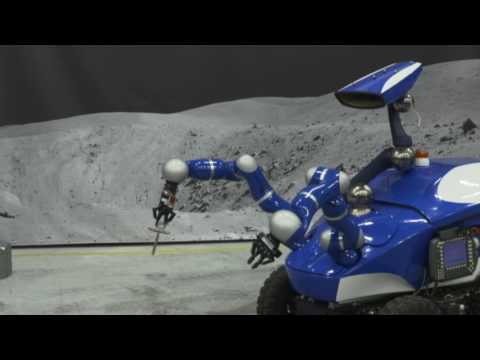
robotic technology is so also something
that we work with a lot in space and
what we’re very interested in developing
is the technology that allow astronauts
and robots to cooperate more closely
together in the future we imagine that
in the future if we arrived at the Moon
or Mars that we might have robots on the
surface helping to build a base before
the astronauts land themselves and one
of the key technologies that we’d like
to develop is what we call force
feedback which essentially means that
the astronaut has a way of feeling the
force or controlling the force that the
robot is is using and solving a certain
task today when you play a video game or
sorry today when you control a robot
it’s a very similar to playing a video
game you have a hand controller or
joystick and you control the robot but
what it means is that certain very
simple tasks like picking up a glass of
water can be very difficult for a robot
because a robot has no intuitive
understanding of the forces necessary to
that it needs to apply in its fingers
when picking up the glass and chances
are the robot will simply crush the
class but by giving the astronauts a way
to control or sense this force well we
can solve tasks that require greater
precision and greater dexterity in the
future and so I had a chance to not only
drive a robot here on the earth from the
space station but also to solve simple
tasks like inserting a peg into a hole
and to do that I had a very simple
joystick like this but through that
joystick I could feel for example the
friction force that I needed to overcome
when inserting a pig into a hole and I
know what you’re thinking now you’re
thinking this doesn’t look very
impressive and you’re probably right
it’s just a joystick after all but what
we’re working towards what we’re working
towards is a full exoskeleton robot arm
that you see here this is a robotic arm
that you can wear yourself
I mean you put your arm into it you move
your arm and the robot follows your
movements at the same time the robotic
arm sends back the forces to this
exoskeleton arm that you’re wearing and
through that arm you can feel the forces
and control the forces and this is a
very exciting technology not just when
we talk about space exploration but also
here on earth because you can imagine
doctors in hospitals in Europe
performing surgery on patients in other
countries using technology like this I
also think it’s very exciting to know
that we here in Europe have companies
currently developing and building
technology like this that will send up
to the space station within the next
year or two smart wearable technology is
also another area that we’re interested
in and before any conspiracy theorists
here in the audience get too excited I
have to point out that this picture
wasn’t taking in space it was taken
under water in the during one of NASA’s
NEEMO missions which takes place in an
underwater laboratory and where I had a
chance to live for a week together with
several other astronauts and I could
work with and test some of the
technology before bringing it in to
space on board the space station the
space station today is so big and so
complex that it’s impossible for the
astronauts to have a deep knowledge of
all the different systems that we have
to work with so we tend to work with the
help of procedures and checklists most
of all it’s like going to a Kia buying a
piece of furniture and then assembling
it at home with the help of your little
instruction booklet you go line by line
you read the instructions and you follow
them that’s a very inefficient way of
working especially in space when you’re
weightless because you keep having to
float between what you’re working with
and your laptop computer to read the
next lines and the procedures so what
we’d like to develop is some kind of
wearable smart technology for example
glasses we’re on the glasses themselves
you can project the procedures that lets
you read or even see pictures or video
that guides you through your tasks while
you have your hands busy with whatever
it is you’re working with
and I’m sure this is technology will see
a lot more of both on board the space
one of the absolute biggest challenges
of space flight is getting into space
sending anything into space it’s very
very expensive and so on board the space
station we try to reuse and recycle as
much as we can which means that all our
wastewater we rinse it and we turn it
into drinking water and that by the way
includes our urine so we tend to say
that the coffee we had yesterday well
but to turn wastewater into clean
drinking water requires a lot of energy
and typically a lot of chemicals as well
something that we’re currently testing
is a membrane which consists of
biological proteins similar to the
proteins at you and I have in our bodies
and these proteins they only permit the
transfer of water molecules through the
membrane so it’s a way to clean waste
water without energy and without
chemicals because it’s through the
membranes own physical and chemical
processes or properties or if you will
biological properties that the waste
water can be cleaned and again this is a
very exciting technology not just when
it comes to space light but also here on
earth because we obviously also have a
need to clean wastewater here on earth
the space station is also a fantastic
place from which to observe the earth
and I had a chance to work on an
experiment where I had to try to film
lightning phenomenon with the help of a
simple just a normal off-the-shelf
camera and these are a special lightning
phenomena that we call blue Jets and red
sprites these are giant lightning that
shoots that shoot upwards into space
rather than down towards the ground we
only discovered these lightning
phenomena by accident about 15 20 years
ago and I guess that makes sense because
normally when there’s a thunder storm
where someone on the surface of the
earth and it’s difficult to see what
happens above the clouds but it turns
out a lot of interesting things happen
we just don’t know very much about it we
don’t know how often these blue and red
lightning occur or under what conditions
are formed or even what effect that they
have in our atmosphere but we assume
that they must have a considerable
effect because they sometimes shoot all
the way up to an altitude of 80 or 90
kilometers one evening after dinner I
was sitting in cupola again our our big
window looking down at the earth as we
were flying over India at night and this
giant thunderstorm developed and luckily
I had my camera with me so I quickly
pointed it towards this thunderstorm and
started filming as much as I could
actually I didn’t even really know where
to point it because this thunderstorm
was was so large that lightning what’s
going on all around me and on this
picture you can see in the in the lower
left-hand corner one of the solar arrays
or solar panels of the space station and
then this next to it is gigantic
thunderstorm lit up by traditional
after we passed the the thunderstorm I
heard back to my laptop computer to
download the files because I had a
feeling that I’ve been lucky to film
something special and I got really
excited when I when I look through the
files on the camera because I saw among
other things this and this is a some of
that red lightning that we call red
sprites shooting up into space at the
same time that there’s this more
traditional white lightning and as I
went through the the recordings I also
came across this and this is one of
these Blue Lightning these blue Jets
again shooting upwards into space but
not only that I’d actually been so lucky
to film this blue jet a pulsating blue
jet shooting up three times in a row
within a second or two and here it’s
important that you pay attention because
I have a short video of ten seconds but
if you blink you’re going to miss it and
you don’t want to miss it so on the
right hand side this cloud here you’ll
see in just two or three seconds this
blue jet right now should be there there
did you all manage to see that if not
it’s on YouTube and I recommend you to
go see it because it’s it’s it’s
impressive after the mission I had a
chance to talk to the scientists behind
this project and they told me that this
is the first time that this pulsating
blue jet has ever been observed so I
think it’s very exciting that we’re
still learning new things about our own
planet and we’re still making
discoveries it wasn’t just when it came
to lightning that I was lucky I was also
really lucky to take a picture of my
home country of Denmark Denmark is so
far north that it’s seldom that the
space station flies directly overhead
which means it’s seldom that we can see
Denmark from space and of course I have
to be honest it’s all so seldom that
it’s sunny and cloudless and clear in
Denmark it’s not like
weather here in Lisbon unfortunately
there’s something very special and not
just about seeing your home country but
about seeing the Earth from space
because there’s a few things that you
very quickly notice first of all when
you’re flying over the day side of the
earth you don’t see signs of a lot of
humans you don’t see cities you don’t
see bridges or roads and you don’t see
borders between countries either for all
intents and purposes the earth could be
uninhabited it’s only when you fly over
on the night side of the earth and when
you see all the lights of the city’s
light up the night sky that you realize
that there are people living here and
just how many people there are but when
you’re flying over the days side you
don’t see any of that the earth might as
well be uninhabited something else we
also very quickly notice is the
contrasting colors especially the
contrast between the blue colors of the
water and then this pitch black color of
space which surrounds us and if you look
in the upper left-hand corner you see on
the boundary between the Earth and space
is very very thin blue line and that’s
our atmosphere that’s all that separates
or protects us from the cold vastness of
space if that blue line disappears it
means we have no atmosphere and without
an atmosphere well there’s no life on
Earth and so you you get a sense of
perhaps how fragile the earth is because
that atmosphere doesn’t look very thick
I mean it looks like something that that
we need to take care of and it is
because without it as I said there is no
life on Earth but that’s exactly why we
travel into space and that’s exactly why
we live and work on board the space
station which by the way we’ve done for
more than 15 years now because by
working and researching in space we get
not only a better understanding of who
we are
a better understanding of our planet
earth but it also allows us to prepare
for the future a future where I’m
certain we’ll see villages on the moon
and colonies on Mars thank you [Applause]