
I’m a very active person I love
traveling I love doing a lot of sports
like hiking swimming and and so on so
that’s why I seven years ago I did a
trip to the west coast of Ireland very
beautiful very wild nature and so on so
we were hiking there so I went back to
work and then six months later I hear a
sound and basically one second in one
second my life changed completely from
being very active as you can see on the
left to being completely immobile after
a work accident so I had a very heavy
lamp construction that basically fell
from the ceiling on my head
and so basically they left me without
balance for a very long time very
isolated and losing the most important
thing in my life my independence
so this accident took me on a long rehab
journey to get back to the person that I
am today and this rehab journey often
left me frustrated and demotivated in
the way we have was being approached
it’s very boring in the way current
rehabilitation is being done it’s very
repetitive not engaging also the access
to rehab it’s it’s in the beginning you
have Allah but then suddenly there is
this you have much less access to rehab
and then there is this gap where it’s
very few and you actually still need a
lot I’m an engineer myself biomedical
engineer and so I wanted to find a
solution to change that do going looking
into different conditions having my own
experience and then looking into
different conditions such going from
traumatic brain injury to stroke to
spinal cord injury patients who in a lot
of cases have either upper limb lower
limb or both disabilities and when I was
looking into those patients when we take
for example stroke patients the mobility
that they have that they gain after die
rehabilitation is only 15 percent it’s
only 15 person
that those people gained back when they
leave the hospital and a lot of that 15%
they will actually lose again because
there’s it’s a few more mobility
basically to have an active life and so
there is no follow-up rehab as well so
there must be a way to change this 15%
and a mechanism to actually give them
back more of that mobility and there is
one mechanism that can bring a solution
and that is neuroplasticity and
basically neuroplasticity is something
that we use on a daily basis we use it
to learn new things to learn a new
movement for example and to make
something inner to ourselves and let’s
let’s so neuroplasticity what it is it’s
basically it’s this amazing capacity of
your brain to change and to adapt to
interactions with the environment so for
example the stroke patient that I was
talking about earlier so when you when a
person has a stroke part of your brain
becomes damaged and this damaged part
will affect a certain function whether
it’s cognitive whether its physical so
in a lot of cases part of the of the
body of a stroke patient has been
affected with some paralyzation and so
we can actually this new plasticity that
exists we can rewire retrain the brains
that actually we can have an undamaged
part of your brain take over that
function again and reinstate that
movement a connection between your brain
and your motion I often compare it to
there is it’s Wi-Fi connection between
your brain and your arm and because of
the stroke is being broken and we want
to reinstall that Wi-Fi connection and
so for these stroke patients for example
what we want to offer them is really the
ability to gain back more of that motion
and more of that mobility and so that is
where VR virtual reality really will
make a difference because we can allow
people such as stroke case and spinal
cord injury patients with upper limb
disabilities lower limb disabilities we
give them the opportunity to engage with
objects in the virtual world because of
the high level of immersion as well
in the physical world they will not even
be able to pick up a pen because they
one day like the strength and also they
have lack of fine motor skills and that
is currently an issue in physiotherapy
because of that lack of being able to
interact with objects they get really
frustrated they tune out and they don’t
achieve the number of repetitions that
they should be achieving while going
through the rehabilitation so with VR we
can change that because we can give them
a challenge an exercise they don’t think
about the number of repetitions but they
just do it they achieve the challenge
and then another big problem currently
with with rehabilitation is that on
average the waiting time for these
serious conditions is about three months
before people move in move from the
hospital they acute world into a rehab
facility and having gone through rehab
myself initially you’re very motivated
because you knew what it was before and
you want to get back there you want to
be come back the active person that you
were before and the independent person
but then when you have you don’t have
access to anything during three months
basically become very demotivated again
up to people get very depressed even
worse people commit suicide and that is
something that we need to tackle and we
need to reduce that and that is where VR
can really make a difference to really
bring the rehab a lot quicker to
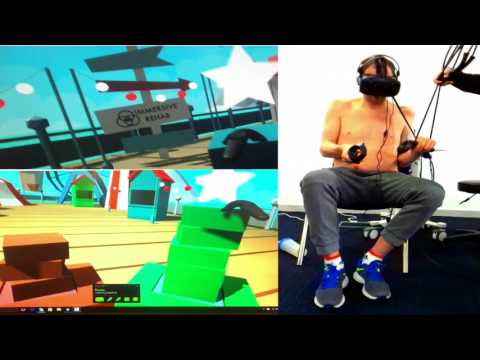
patients so this is David Smith he’s a
Paralympic athlete he was a gold
medalist in 2012 for Great Britain and
he’s also spinal cord injury patients so
what he’s doing is using our VR we have
platform where he’s immersed in a 3d
environment and basically it’s based on
the grasping method so he’s moving
objects around and in this case he had
three times spinal cord tumor three
surgeries and three times paralyzed from
the waist down and upper limb was
affected as a stroke and as an athlete
himself he was working constantly with
visual stimulation and constantly
working on recreating these neural
pathways that had been damaged because a
visual injury
and working on that neuroplasticity to
gain back his mobility and after about
eight weeks he was already walking again
and he still has his shoes in his upper
limb but it has been tremendous and
amazing to work with him to help develop
the product as well so we are what what
I’ve seen from the work and the work
with with patients that have been
affected by several conditions is that
it can have tremendous impact on
people’s health and people’s recovery
and in terms of the current compared to
the current rehabilitation in terms of
longer engagement and increased motion
the results have been have been
impressive and I’ll take you through two
cases that I’ve worked with so one of
them was a male in his 20s he had a
traumatic brain injury and a spinal cord
injury as well and his current
engagement with physiotherapy is one
minute and he’s tuning out so he doesn’t
want to do it anymore
he’s very disengaged in the VR we have
experience as you saw before he was in
it for ten minutes he wanted to do it
over and over again he was having fun he
was really engaged the other patient
that I worked with is a man in his 60s
he just had a stroke a few weeks before
and his one side was completely affected
and in the current rehabilitation so the
physio would ask him to move his arms
without any engagement with objects
there is this conviction installed in
patient and I’ve seen it in several
patients is that when you have something
that is affected you might have
experiences yourself as well you want to
protect it and you don’t want to over
like do the movement even though you can
move your arm you will always try to
protect it and he was convinced no I
can’t move my arm that far and then when
he was put in there so there’s some fear
as well that is installed in the
patients and so when he was put in the
VR we have experienced this fear kind of
went away we gave him a challenge and he
that conviction as well that he couldn’t
move his arm went away and he was moving
his arm in a very safe way but much
further than he was actually doing when
he was just doing his rehab and so that
was also really
kind of that limiting believes that you
cannot move because of its a very hard
condition that you’re going through as
well and the protection mechanism so
giving back an increased motion range
and helping them to get better was a
really great result
so VR VR is just I mean it’s just an
amazing technology giving groundbreaking
results already in health care and it
will make a tremendous impact going
further further whether it soon we have
whether it’s mental health so it’s
really important to embrace these new
technologies to let people take charge
of their own health and well-being and
empower them because there’s nothing
worse in not having any options so thank
you
[Applause]
Please follow and like us: