
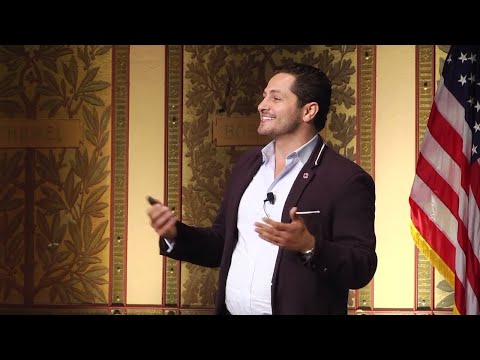
everybody how’s everybody doing
Pedro great speech you couldn’t have set
set me up better as I as I talk to you
guys today about the future of business
[Applause]
great who can tell me what just happened
okay that’s what movement building is
all about and what’s happening today
with the future of business is all about
movements and what we do at the Hult
prize which I founded about a decade ago
is inspire people like Pedro to do what
they do and do it best because all it
takes is one I’m going to talk to you
today about why impact is changing
everything we know or used to know about
business a little bit about me while
some of you may or may not have heard
about the Hult prize in our foundation
I’ve probably been invited to Georgetown
because of founding falafels Inc you
know ten years of impact work and
venture funding and 50 million dollars
invested and little brown three cents to
make falafel balls is what puts you on
the map and get you to Georgetown but
it’s uh it’s ironic bite size impact
I’ve had I’ve had a very wonderful
career in this space we have had the
pleasure my organization of hope prize
and I’ll talk to you a little bit about
that but more so been able to advise and
great companies I’m on the board of the
United Nations Development Program and
been recognized across the Middle East
by some super-duper publications I’ve
got this book how many books and writing
and Millennials it’s called the pursuit
of impact and I’ll talk to you a little
bit more why I think this is today
life’s greatest pursuit my career
started in the impact space about ten
years ago I launched something called
the whole prize and the whole prize is
the world’s largest program which gives
students college students around the
world a risk-free platform to do the
things that Pedro did and some of the
other great impact entrepreneurs and
I’m super shocked I’ve got the winner of
the 2016 halt prize in the front row
stand up like left everybody should meet
you yeah and I swear I swear to you it’s
totally random that he’s here
but Wyclef was a student and that whole
prize we run thematic challenges every
year and we have young people who don’t
necessarily have an idea come together
as a team and try to solve a challenge
that we set every single year so in 2016
it was doubling the income of urban
populations through connectivity and why
clefts company was formed as a response
to the whole prize challenge we have
almost a hundred thousand participants
every year between volunteers who
organize on campuses and participants
and his team emerged through multiple
rounds on campus in country in region
and then went to our incubator and then
finally won and today I’m super excited
to announce that why clefts company boo
paths since winning the whole prize just
in 2016 when 12 months before that had
never even thought of becoming
entrepreneurs impact entrepreneurs is
today one of Africa’s largest
transportation companies and they’ve
just won a contract which makes them the
official ticketing agent using their
technology which connects people in
rural to people in urban for increased
economic opportunities in all of Kenya
okay
that’s the power of the Hult prize
platform we’ve partnered up with the
United Nations this is if you can’t
really see the picture but we’ve got
President Bill Clinton right there in
the middle and behind them is the winner
of this past year’s hall prize which was
all about refugees and a team out of
Rutgers University for Muslim Americans
from Rutgers won by creating a
point-to-point ride-sharing system and
that’s what we do a whole prize but
again I’m going to talk to a little bit
more about why this business the
business of impact is on the rise 2012
we were recognized what seems like an
ages ago as one of the top five ideas
changing the world I wasn’t exactly sure
I knew we were having impact then but I
didn’t realize it until about a year ago
why President Clinton had the foresight
to tell us and tell the world that the
platform we had set up again a risk-free
platform which allows young people
around the world to dream and create and
then we provide the shortcuts to
entrepreneurship around it was something
that was gaining global recognition and
soli but surely we begin cracking the
code we’re on the front page of this
newspaper front page of that right what
was it about
and then the Vatican came knocking and I
was lucky enough with a group of
founding partners to design a program
called the Lada Tosi challenge
co-founder along with one of my dear
friends trusted brothers Eric heart of
this program that empowers young people
again to solve climate change in
migration issues inspired by His
Holiness Pope Francis so now you’ve got
politicians you’ve got religious
institutions and you’ve got everyone in
the world talking about young people and
developing business that both serve
humanity and serve capitalists
simultaneously right and then there was
this about six months ago falafel Inc
right how many of you been to falafel
amazing you know again I’m always
humbled when I talked to be like oh what
are you going to George how you talking
about Holt prize and your portfolio of
amazing I was a no no I’m talking about
falafel and hummus and it’s been it’s
been a great honor but here we’ve built
a business model which validates that
the future of businesses impact to date
we’ve been open less than six months
we’ve fed over 35,000 refugees we employ
to refugees full-time and we’ve just
secured enough backing to open a minimum
of 100 stores around the world
after opening those hundred stores will
literally be feeding more than five
million refugees a year okay every store
employs about ten we have publicly
traded companies trying to acquire our
brand today what that means is the idea
of social innovation premium is true
it’s not just about how much money goes
to your bottom line you can achieve
market validation and maximizing
shareholder wealth which is what every
business is meant to do
maximize shareholder value by achieving
impact what’s driving this you don’t
take anything away from today’s TEDx
talk it should be this slide by 2060 60
trillion dollars will be transferred
from our parents and grandparents and
great-grandparents generation to
Millennials the first five trillion by
2022 what does that mean that means that
the people controlling the money will be
in charge and why it is them being in
charge matter because Millennials make
decisions differently than every single
generation before them here’s the data
that proves it this is Hult prize data
plus nielsen global research eight out
of ten Millennials choose brands that
they can associate and affiliate impact
to all else being equal they don’t have
to go out of their way they get at least
that minimum the same quality and
service or product and the cost is equal
sixty percent pay a premium and these
numbers are going up every single day
every single year so corporations of the
future understand and that’s why people
say the idea of social entrepreneurship
versus regular entrepreneurship the
lines are no longer black and white
they’re coming together as one because
if you want to be relevant in the next
decade I assure you look at the data the
sixty trillion dollars in wealth
transfer and the Millennial buying
behavior right it’s not just purchasing
guys my friends right now I’m born in 82
so I’m on the very tail end of the
millennial generation so my friends now
are taking over come I have friends who
run publicly traded fortune 1000
companies they’re my age they’re making
decisions differently
right you think when Pedro is 23 by the
way congratulations you think when when
Pedro is going to sell its company
eventually guys don’t don’t get it
twisted he’s going to put a handsome
paycheck in his pocket do you think he’s
just going to
chase bottom-line he’s gonna make every
single decision hiring spending R&D okay
his cofounders are all going to spin off
other companies that all do the same the
world is changing right now okay now
let’s go to my story I wasn’t always
this shared value economy guy I actually
began my career on Wall Street and I
enjoyed it I didn’t choose Wall Street
because I wanted to make the most amount
of money that I could in my time right
one of my time
it’s like forever ago I graduated in
2000 high school and my parents
immigrated to the u.s. from Palestine
pretty much nothing and as the child of
immigrants I wanted to repay mom and dad
all right
not literally figuratively I wanted mom
to be proud when she called her sisters
and brothers and family back home what
does your son do and she had to give
them the bad news that I wasn’t an
engineer or a doctor
right they had come to the US and you
know we were five and none of us studied
medicine right but I thought if I
maximized wealth then we’d have a great
store in her hands it’s not because I
love money it was because back then
society told us that maximizing income
was a way of success social success
that’s what I was after the money and I
was a damn good investment banker so I
graduated undergrad played college
football and went on first first stop
New York I had my Series seven in 63
before I got in right my last year of
college I took literally graduated in
three and a half years and that last
half year I got my securities licenses
by the age of 25 I was one of the top
investment bankers trading CMBS
commercial mortgage-backed security who
knows what those are right are we are we
now too old
right this is the financial instrument
which collapsed the financial market
okay March 6 2009 a day I won’t ever
forget
Dow Jones 6200 some points I’m commuting
now between Washington DC and New York
and the Middle East I’m raising money
from the Arab world because of my
background and fluent in Arabic and
placing it against us real estate I had
a portfolio of over three billion
dollars and a pipeline three times as
big right getting paid commissions on
every deal boom boom boom boom boom and
then the market all came crashing down I
laid off 50 people overnight and then
began to rethink everything and I said
there has to be more but what is it
right I thought it was money right and
in the ten years since I had graduated
from high school and had this kind of
peak of my career in finance
the world changed right all of you guys
came into being right inter connectivity
ICT information communication technology
kept us now from being able to turn a
blind eye to the social challenges
people were blaming Wall Street business
school and every other profit-making
entity for the collapse of what was the
greatest financial recession in history
her second biggest depending on who you
ask
so what was it so I went back to
business school because I wasn’t sure
along with all my other friends right
and those that any go back to business
school they were looking for something
also but maybe they had not thought it
was money
they thought it was fame this was the
advent now you’re talking 2009 in 2010
right a lot of people were beginning to
get on you talking about snapchat right
before that you add the Facebook and you
had other technology platforms which
were creating social media networks and
people were trying to beginning to for
the first time to build these great
social profiles online and fame became a
huge motivator but they were getting
that and people were still coming up
empty so certainly it’s not making money
and it’s not getting famous it’s got to
be pedigree right I’m gonna go to
Harvard and we come to Georgetown right
nothing wrong with coming to school here
but a lot of folks in my generation
thought you know what it’s not going to
work making money let me go down the
path a pedigree they were kind of right
right some of them went to business
schools some went to foundations others
went
back maybe to their home countries that
were immigrants to have this idea of
pedigree helping people achieving social
status social inclusion but you come up
empty until you pursue impact and what
we discovered whether it’s falafel Inc
the Lada Tosi challenge or the whole
prize
unlocking the pursuit of impact can get
you wealth can get you fame and can get
you all this thinking pedigree you need
because there is no better gift to
humanity than helping the world and
impacting people’s lives what is impact
changing the trajectory of people
business society culture you change the
trajectory so I have impact on your life
maybe not today but at any time in your
lifetime this presentation changes your
view on the world than I’ve had impact
on you the business of impact today for
every dollar spent okay every one out of
five is spent on impact and that number
is just growing the business of impact
is an eight trillion dollar industry
today and remember by 2060 sixty
trillion dollars is being transferred
what’s the magic well this is what we
teach a whole prize and this is the
fundamental attributes that I built
falafel Inc off of build businesses of
the future that are impact centered
profit minded and market driven impact
centered means every decision you make
yields in net impact hiring spending
research product service all of it
profit minded means you haven’t built a
business which depends on charity you
build businesses that have business
models attached to them which means
simply by existing you generate revenue
and you have impact all you have to do
is exist when your lights go on you
don’t have to think it’s not literally
selling a product taking a percentage of
profits and donating it
that’s 1.0 it needs to be designed for
impact
and finally market driven you’re solving
a market-based challenge simple right
the nice thing about building the
companies correctly based on inputs is
guess what the output that you need to
measure is not the 31 or 60 or 100 that
you often see it’s $1.00 make money at
falafel Inc all we have to do is count
how much money revenue comes through the
door our charter for our company employs
and empowers refugees for every 10 bucks
spent in store we have a literally a
contract signed with the World Food
Program that they can take us to court
over if we don’t fulfill our end of the
obligation this is a company that’s
designed for impact and there’s many
many others the reason that measuring
dollars matters is because folks the
world is capitalistic you’re gonna grow
up you’re gonna get out of school you’re
gonna mature and your jobs whatever the
case is and you’re gonna realize you
need to make money cuz that’s the
currency from now till bitcoin if you
haven’t gotten to Bitcoin it’s not too
early I just started buying shares about
three months ago and I’m in the space
like I took me that long to believe but
for now right the only currency that you
can remit you can’t go remix the social
impact you’re having four dollars today
you can only remit dollars right for
impact
you need money so if you build your
company correctly then you just count
the revenue
here’s companies doing it today Paul
Paul Manzano advisory board he serves as
a judge for the Hult prize he’s the CEO
of Unilever he doesn’t talk about
Unilever in terms of P&L he looks at
social innovation pipeline he’s looking
at the design of their product how much
impact can have his products and
services have on society and he knows
that’s going to drive up market price
another example you see here on the
screen is a spire food group 2013 halt
Prize winner I just took boo pass out
Wyclef I had you
on the screen to aspire food group folks
is a company which is the largest
manufacturer of insects as a human
consumable they’ve got a valuation today
of well over a hundred million dollars
they started with nothing they were an
entry into the whole price a medical
student and engineer a former investment
banker and a lawyer at McGill today
they’re all millionaires and they’re
getting livestock out of the ecosystem
and by doing that they’re able to not
just save the environment but they’re
able to provide an equivalent
like-for-like product in terms of
protein right they’ve created a soluble
powder colorless literally this despair
that you can add in to anything and it’s
made from crickets which take literally
twenty-one over twenty five hundred less
gallons of water to produce so the
equivalent one pound of protein 2,500
gallons one pound of cricket protein one
gallon of water by existing and making
money they’re having that impact on the
world right now falafel Inc right this
put at the end it’s what you all been
waiting for right what’s our story so
falafel Inc folks was created about six
months ago we had a refugee challenge at
the whole price and a lot of our
startups were asking us how do you build
a company that could both make money and
be profitable as well as impact the
refugee crisis as the CEO of the whole
price I thought well it’s my job to at
least create a company that validates we
asked young people like we do every year
we challenge them with one problem and
that problem was can we transform the
lives and restore the rights and dignity
of ten million refugees in five years
right it’s a hard task right so I’m
Palestinian we love eating hummus and
falafel it’s all right
it’s our street food so my wife was
literally I live in Northern Virginia I
call that home my wife was in Georgetown
and she called me she said quick pitas
for sale buy it and I said what am I
going to do with it she said
no don’t you always have this dream of a
fatigue for that in the homeless shop
you know it’s like sorry immigrants you
know we love opening restaurants and gas
stations once we’ve made it right
everybody can attest to that
so you know one thing led to another and
we got into the business and then
because I run the whole prize I had no
other choice but to turn it into a
social enterprise what we do so we
thought how do we create a product so we
said what are the three characteristics
that people are looking for in food and
thank you to Georgetown who actually put
us on the map you want the truth we said
we need to make it
I have affordable but the reality that
the word is cheap you just can’t use
that in marketing right an affordable
product right second is has impact
because remember that slide I showed you
about eight out of ten
Millennials prefer it’s true whether you
do it consciously or not so we designed
the impact inside I just use our own
framework not very complicated said how
do we make sure there’s impact right and
how do we create we went after vegan
right away right and then we said ah we
can’t get all the way there let’s at
least go vegetarian right no sure where
am i sorry guys for your protein eaters
although we’re working now on a
potential vegan Shoreham a product but
we’ll go into that next a technique next
year but it has to be good do not as
you’re building social enterprises and
thinking about the businesses of the
future don’t sell yourself short do not
create subpar products and services
because you will only attract the
millennial generation if it’s as good
they will not sacrifice right you may
have a minority but as a majority it has
to be so for us it’s all fresh local
tasty and good marketing so our hashtag
which is picked up around the world is
eat with dignity and we’ve now launched
the food for good foundation where we’re
encouraging other restaurants pubs some
publicly traded to join the food for
movement so that they could provide the
same business model that we do because
we are one store with one founder right
and we’re able we’re on a trajectory to
get to millions and millions of refugees
a year if we had another 50 brands like
ours the refugee crisis would disappear
full stop right imagine the
possibilities so I leave that with you
guys today the future of business is
real its impact centered profit minded
and market driven and I wish all of you
the best of luck as you move into this
next generation which is the most
exciting generation of our times thank
you
[Applause]
Please follow and like us: