
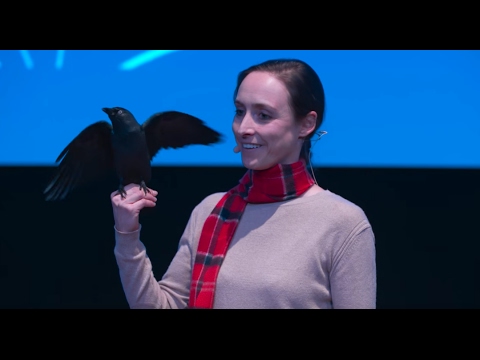
talk about intelligent birds today and
therefore I thought I better introduce
you to one right away
this is Dolly she is a jackdaw and
belongs to the corvids the crow family
that’s one of the two families bad
families with the largest brains
relative to their body Tony Pena
maybe you can’t imagine that this little
head has the cognitive kept the brain
capacity like that of a great ape and
too many people grow and another reason
why abroad I have to say because I
wanted her to be the first covered in a
TED talk there has been a crow and
parrot before and I thought it’s about
time for covered as well if she now
doesn’t come back to me then don’t worry
Dan I pick her up and a break but don’t
worry she’s she’s not she’s not
she will find a place to sit and then
I’d pick her up later just do me the
favor and and keep the doors closed
so um so too many crows don’t have the
most positive image but why that is I
never understood
I find them highly fascinating birds and
I’m intrigued by their social and by
their complex social life and in fact um
doli was brought to me when she was a
chick because she had fallen out of the
nest prematurely and I hand raped her
and that established a very special bond
between us and response the last also
she’s pad for many years with a jackdaw
male the ability to form bonds is very
typical of jackals and of Corbet’s they
form long-term friendships and lifelong
pair bonds they recognize former group
members for many years and they are
virtually inseparable from their partner
and a very pet and tender toward each
other and talk about the most
fascinating thing about crows is their
intelligence and talking about doctors
there for example extremely sensitive to
eye orientation and they recognize
attentional states and even if it’s a
person and not a bird they also use it
in the use I orientation as
communicative signals but it also in
competitive situations reason about the
perspective of others and consider the
knowledge state so they they show
aspects of a theory so called theory of
mind that’s something that develops in
human children quite late so and the
past decades have seen a major increase
in research on the animal mind and and
until the 90s these studies largely
focused on primates our closest
relatives and they revealed that
they exhibit many cognitive abilities
that have originally considered to be
uniquely human and that’s not so
surprising considering that our last
ancestor lived only 6 million years ago
and that we share the majority of our
genome but when throughout the last 15
years that it has been shown that crows
and also parrots parallel the great apes
and cognitive ability this was of major
significance and the implication of it
is that intelligence not just evolved in
our lineage but several times
independently and interestingly this is
also matched and if you look at brain
size and diverted breaths in addition to
our lineage the primates there’s three
more groups that stand out for the large
relative brains to in relation to their
body and very surprisingly this includes
two bird groups crows and parrots and I
mean their last ancestors their last
shared ancestor with us lifted around
300 million years ago so this is amazing
and it shows that studying comets in
parrots might they might be very good
candidates for studying the evolution of
complex cognition to men hey this is
boring because some people still want to
draw a clear-cut line between animals
and humans I mean we are certainly very
very special but we are still a primate
species and we have an evolutionary past
as a cognitive scientist I find it
usually fascinating to to try to trying
to understand how and why we became so
special and why our brain expanded not
so very long ago all of a sudden and
became enormously big we have been the
largest brain relative to body size of
all animals and we are very special
because we are the most by far the most
innovative
being on the planet and we can realize
we can realize cognate we can realize
what is otherwise merely potential but
foremost we can recognize potential and
we can dream up theoretical
possibilities
Thole come here we can dream up
slightly distracting for me because
she’s now calling for me
Dulli um well but so we humans have the
ability to to dream up world and we can
escape our natural limitations
to an extent that animals could never do
they don’t need many behavioral they
don’t need much behavioral flexibility
in their daily lives they live they
typically lived as a largely predictable
life within the limits of their species
typical behavior repertoire so they eat
they sleep they reproduce but he
wouldn’t think of them they wouldn’t
suddenly think that they want to go for
the moon for example and make plans to
realize that like we do but on the other
hand there are living conditions on a
rule on the planet that make might
require cognitive flexibility and the
ability to be spontaneous it mate might
be important for survival for example in
harsh complex and unpredictable
environments it might be my payoff to be
innovative and clever and we are not the
only species that are subject to this
but the big question is to to what
extent other species might have evolved
complex cognitive abilities that allow
them to cope with novel situations very
quickly I give you two particularly
astonishing examples of such flexible
behaviors in two representatives in
representatives of two of the largest
brained AVL family
I’m going to talk about New Caledonian
crows and island species that lives that
uses tools habitually for stick to us
habitually for retrieving their food and
also about coffin cockatoos and
particularly innovative and explorative
parrot species living on the tannin bar
islands and I’m starting with one of the
best studies to date showing that
animals might be able to think about
cause and effect to some extent and make
and causally interfere to solve novel
problems here we expose the birds to
food out of reach on a platter is
entered on a platform inside of a
transparent box and as a tube on top of
the box so please put yourselves end up
and the perspective of the bird it might
be seemed very simple to you at first
sight but consider that they cannot lift
or shake this box and also we humans
might we might comprehend from just
looking at this box seeing the hinges
and the magnets that this platform can
be collapsed but if you don’t know that
a platform can be collapsed it doesn’t
make any sense
to drop stones into this tube which is
obviously the solution to the problem so
we first established that none of our
New Caledonian crows solve that problem
without any experience of the mechanism
none of them did and crows don’t use
stone tools habitually in the wild but
then we subjected them to to
experimental groups that that were
allowed to learn certain aspects of this
problem so one group was trained to nuts
turn from the rim into the tube right
into its mouth and so they were they
were conditioned to carry out to
precisely the correct behaviors and they
knew that stones were important and that
had to go into the mouth of the tooth
now she’s complaining de bahía the
other group they they only learned
indirectly not just the mechanism of
this task they had to push the platform
down directly with their big through a
shortened tube but importantly they
never ever learned anything about stones
being important
they were never reinforced for touching
stones so what do you think which of the
two groups of the problem not so
surprisingly the first group that had
been trained to nuts stones into the
tube and succeeded but their only
transfer was to consisted in picking up
stones and carrying to the mouth of the
tube before dropping it but also the
other there were animals from the other
group that succeeded and they suddenly
decided to use tools stone spontaneously
as another tools to solve this problem
and this is remarkable because they’ve
never interacted with stones before it
actually shows that they were reasoning
about the mechanistic structure of the
problem and about physical forces
gravity and pressure and we’re putting
the two flexibly into relation until
they came up with the right solution
spontaneously and I show you how this
looked like in reality this is first the
training phase where the bird learns to
push down the platform with its beak so
it learns about the collapsibility
and next it’s exposed to the original
test again where the tube where there’s
a long tube on top of the box and you
can see that in the beginning it’s
fairly annoyed that suddenly can’t reach
yes loli is annoyed too so but then it
clicks and suddenly she uses a tool and
uses and with it extensive reach next
I’m going to talk to probably one of the
most amazing innovative behaviors
spontaneously shown by an animal
reporter today and that is by and guffin
cockatoo a species that does not use
tools in the wild and and this was a
chance observation by my sister at least
osburgh who observed that figure hoe a
copper tool was playing with a little
stone and he wasn’t at some stage he was
inserting it through the mesh of the
aviary and it fell just outside of his
reach and then he tried for a few
moments to retrieve it with his claws
but when this was not successful he said
he suddenly went away and came back with
a little stick and then tried to fish
for the toy of the out of his reach and
when after this happened it learned that
there was caused a follow-up study and
after this happened he was immediately
separated from his peers and tested and
their more controlled conditions
the bird was tested with a peanut his
favorite food and was just placed
outside of the Avery behind the mesh and
to our big astonishment the bird did not
go and fetch the tool that we had
provided but instead he started capping
out and wouldn’t splinter out of the
wooden beam of the aviary step by step
and then used the splinter to and now
this is they start singing when they’re
bored and so then use that splinter to
fish store the food out of reach and I
bet see for yourself please so you can
see that it’s pretty pretty tedious
pretty tedious to bite out a splinter
and it suggests that he really acted in
a goal-directed manner and you’ll also
see that it’s not exactly easy to
maneuver such a tool with a curved beak
we had to help Elizabeth but then he
it’s not exactly easy to maneuver it but
he if you look closely we used his
tongue to support the tool against his
upper beak – to have more control of the
grip we replicated his behavior but he
used several different methods and
different materials flexibly so we
really had the impression that he had
some kind of inner some kind of template
in front of his inner eyes and was
shaping and going on really producing
the tools according to some plan and of
course we we can show that and future
research we have to study in more detail
the cognitive processes that underlie
such complex innovative behavior but he
definitely shaped another tool out of a
shapeless source material and it will
fulfill another need and a that meets
the definition of real tool innovation
and it’s may be interesting for you to
know for you to know that this is a
behavior if the tool iterations are
developing very late in human auto Gini
by a children readily starts using tools
at an early age they only invent a tool
readily when they’re about and 5 to 8
years of age so this is surprising so I
hope that I could show to you that tears
and large brain burst species
have evolved capacities for complex
thought processes that allow them to
respond to novel situation flexibly and
that allow them to solve novel problems
but this might be hard to swallow for
some people that want to make a big
distinction between animals and humans
and but actually I think there is a big
fundamental difference between us and
animals and that is that we are the only
species that can fully foresee the
consequences of our own actions and as a
consequence we are only also the only
species that carries the full
responsibility for our own actions and
therefore my appeal to you is if you
want to be different then show it and
take responsibility for your actions for
the sake of this planet and all species
living on it thank you
[Applause] [Music]