
do a little bit of a technology talk and
I’m gonna talk about Wi-Fi how many of
you are familiar with Wi-Fi show of
hands okay that’s good how many of you
have used Wi-Fi today show of hands
okay all right that’s good
so Wi-Fi is a technology has some
interesting properties and I think there
are three reasons that it’s one of the
more interesting technologies and
something that’s worthy of a talk one as
we’ve just proven almost everybody uses
it everybody is familiar with this
technology – like all technologies one
of the key things that happens is that
it advances it keeps moving in terms of
speed in terms of distance in terms of
technical parameters 3 and interestingly
enough it’s one of the few technologies
that keeps finding its ways into
different products different end
products we would have never imagined
when this industry started that we’d be
seeing Wi-Fi in so many different end
devices and we’ll talk a little bit
about that I suppose there’s a fourth
reason that Wi-Fi is kind of interesting
and that’s that I’ve been working on it
for 15 or 16 years so I know one or two
things about it ok one or two we’ll see
if I’m right by the end of the talk I I
don’t know who does these things I don’t
know who has the time for this I
definitely don’t have the time for this
but somebody did a survey about Wi-Fi
and there were some interesting factoids
that came up first 60 percent of
respondents can’t go a day without using
Wi-Fi ok so we had a survey here in this
room informal survey everybody used it
today 60 percent of people can’t go a
day without again I don’t know who comes
up with these wacky things but
somebody did second
39 percent of respondents would give up
coffee in exchange for Wi-Fi
I am definitely in the 61% okay I
actually started today I think the last
speaker mentioned that he started today
in Atlanta I started the day in
Bangalore India
okay that’s a long way away if it wasn’t
for coffee I wouldn’t be here right now
so I can say definitely in the 61% and
then finally I guess this is kind of
passe now 50% of respondents would not
would exchange Facebook for Wi-Fi I
guess New Deal is snapchat things like
that I don’t know somebody will have to
tell me what the new modern social media
I’m an old guy so I have no idea but the
the main message is that Wi-Fi obviously
is a technology that we all use that we
all have familiarity with and that we
all take for granted in many ways shapes
and forms I want to just give a quick
history of the technology that is a very
interesting technology in 1971 somebody
had the wild idea that they wanted to
connect the Hawaiian Islands so to
connect Maui with Hawaii with Oahu kind
of difficult to do so they figured oh
we’re gonna try to use wireless to do
that and if Aloha net was born and then
in 1985 the FCC did something they
opened up what they call garbage
frequencies most things that we use that
are wireless require a license from the
federal government but in 1985 the FCC
said we’re gonna open up something and
require and allow unlicensed technology
people can use it for free and that was
a really a key turning point in the
development of Wi-Fi among other
technologies bluetooth is also a
technology that we all know and love
that takes advantage of the unlicensed
band in 1988 NCR got the idea that they
wanted to have wire
cash registers and so in order to get
cash registers to talk to each other
they figured out they needed some way to
standardize and they got together with
Bell Labs and in 1997 a very nice name
the I Triple E 802 11 standard was born
that’s kind of a mouthful not a very
sexy thing and so in 1999 so we said oh
we better call this something else we’re
gonna call it Wi-Fi okay instead of I
Triple E 802 11 something something kind
of a wacky name again but then it also
in 1999 this crazy fella called Steve
Jobs got up on stage just down the
street here in the Flint Center in
DeAnza and did a demonstration with a
laptop and he ran a hula-hoop over it
and showed that there were no wires that
were connected this and this is really
where Wi-Fi started to take off when
Jobs did this thing that’s what got
people excited about the technology and
it really started to take root okay
Wi-Fi as I said is a technology as the
characteristic of technical evolution
and I’ll just take you through that very
quickly in 1997 this first standard was
capable of delivering 2 megabits per
second and then in 1999 a new standard
came after that that was capable of
delivering 11 megabits per second and
then another standard on top of that
something called 802 11 G came to pass
that was capable of delivering 54
megabits per second and then finally
another standard 802 11 n capable of 450
megabits per second and finally where we
are today the fifth generation of Wi-Fi
technology something called 802 11 AC we
ran out of letters it can’t be a bead we
had to go to two letters AC and that’s
capable of over a gigabit per second so
in a relatively short period
time twenty years this technology has
boosted speed over 500 times
okay so massive massive increases in
really a relatively short period of time
you can see that the volumes the number
of shipments that take place have
exponentially increased you see that
here we’re at reaching over 2 billion
shipments per year two billion products
per year are shipped with Wi-Fi
technology that’s a huge number probably
more than any other single technology
today Wi-Fi as the leading shipper now I
had an interesting conversation with
somebody at Starbucks I was complaining
to them about the price of my coffee is
that price went up what’s the deal is
that a prices always go up unfortunately
not in this business okay
prices have gone way down our first
chipsets this is just focusing on a
chipset the first chipset price was
something in the $30 range $35 today a
Wi-Fi chip a semiconductor device sells
for something around two so a massive
drop in price that’s enabled this
increase huge increase in volume the
second interesting property about the
technology I spoke of a minute ago is
how its moved across product categories
if you remember in that first graphic I
talked about Steve Jobs and doing this
hula-hoop over the PC really Wi-Fi was
intended his first intense intention was
to connect your PC a notebook PC to the
Internet and the first products were all
around that you had all the different
kinds of pcs connecting to home routers
cable routers DSL routers whatever it
might be but a very simple set of
products simple set of product ranges
that incorporated the technology but
then things started going mobile
things started moving portable devices
tablets phones and those technologies
those products started to build in Wi-Fi
and then about 2010 we had video TVs CD
players these little Roku sticks the
little streaming media sticks all of
these things started building in Wi-Fi
and then one of the previous speakers
was talking about the Internet of Things
the Internet of Things and we’ll spend
some time on this and some subsequent
slides is a huge huge new revolution
technical revolution you’ve got all
sorts of things that are connecting to
the Internet washing machines
refrigerators thermostats somebody was
mentioning Barbie dolls all kinds of
things are now connecting to the
internet and in almost every case
they’re using Wi-Fi technology to do so
so there’s been a huge change in how the
industry thinks about this technology
what kind of products are are we
focusing on and it seems like as fast as
the speeds are evolving the markets then
the market segments are changing with it
what is the Internet of Things okay
everybody has all sorts of different
definitions but you can see that really
it’s the convergence of people machines
and software all three things coming
together in various products products
that can learn products that can think
products that can sense all of these
things coming together are creating a
huge new opportunity for the technical
community whether it be the
semiconductor piece that I come from
whether it be software whether it
becomes security like the other
gentleman was speaking about all of
these things are coming together in this
new product category called the Internet
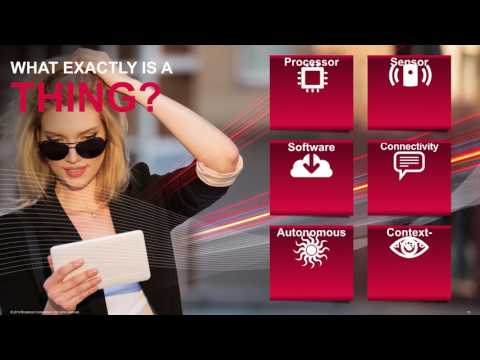
of Things and if we look at what is a
thing right this is kind of a very
general
term there are many different components
that go into this but you typically have
some processor something that’s thinking
something is be able to compute you’ve
got sensors that can sense the
environment sense people touch
you’ve got software you’ve got
connectivity so all of these things have
to connect in some way to the internet
using Wi-Fi using bluetooth using GPS
all of these different connectivity
technologies typically come to bear in
the internet of things they’re
autonomous they can behave by themselves
and finally they’re contextually aware
they’re aware of their environment in
some way so the Internet of Things is
something that’s taking off it’s
meaningful it’s a huge opportunity and
certainly as people start embarking on
their careers it’s going to open up a
whole new frontier for technical
development to give you a sense of how
big the market is the current market for
cell phones is about 5.6 billion units
okay the Internet of Things which means
automobiles thermostats all these
different things that are shown here in
this graphic that opportunity is some
people say thirty billion this
particular number is one that I pulled
out here is 30 billion
some people say 50 billion some people
say a hundred billion no matter what
number you use it’s an order of
magnitude greater than the single
biggest opportunity that’s out there
today which is cell phones so this is a
massive massive opportunity again not
only for the semiconductor industry but
also for software for security
everything we all have to be thinking
about how to address this massive
opportunity I wanted to spend a couple
minutes on on sort of what’s coming next
in Wi-Fi there’s an emerging standard
that is called 802 11 a X remember I
said we started running out of letters
and so now we have to go with two
now we’re up to a X I suppose it’s gonna
go to be something soon I guess my
engineering guys are all working on that
ax is probably solving a problem that
most of us in the room deal with you see
all these students here on laptops in a
classroom what happens
Wi-Fi shuts down doesn’t operate very
well everybody starts working on their
their chemistry assignment in one of the
classrooms over here in Bellarmine and
the Y everyone complains
oh the Wi-Fi is slow well that’s because
many many people are connected to it at
one time you’ve gone to a football game
a basketball game you try to go and find
out what’s happening with your fantasy
team very slow right you’re on a train
you’re commuting again experience is
very slow so this new standard that
we’re working on this 802 11 ax that is
specifically meant to address the
problem of congestion in a room like
this if everybody was flipping over
their laptops the Wi-Fi would grind to a
halt but this technology this new
emerging standard is going to help us
all move faster and be able to operate
in these very very congested
environments and this should start
shipping sometime at the end of 2017 or
2018 is when we’ll start seeing the
first products come online but then
what’s after that
okay what’s coming after this twenty
seven twenty eight eighteen we will
already have products that are in
development the first initiative that
we’re working on is really how to make
this easier it’s kind of difficult still
you have passwords you have to type in
there’s all these security concerns that
we talked about earlier we have to make
the technology far easier and there’s a
lot of work going on to do that secondly
is a frequency of operation we talked a
minute ago about the FCC opening up
these unlicensed bands those what bands
are in the two gigahertz or five
gigahertz spectrum newer technologies
are coming online that will use
something in the 60 gigahertz frequency
very
very high frequency what that enables is
super high capacity in 60 gigahertz in
millimeter wave radio you can be
operating at speeds of 10 20 gigabits
and that becomes important for
applications like virtual reality I was
just at the CES show in Las Vegas a
couple of weeks ago and almost everybody
was talking about virtual reality but
almost everybody was using a wire to
connect to these goggles right and
people are tripping and falling all over
the place and if you can get this to
work with a wireless technology that
will really enable VR and AR to take off
and this is what has to happen in order
to do that we have to move frequency
bands okay
of course range and again I’m sure many
of you have had the experience in your
home where there are these dead spots
when you’re trying to connect to Wi-Fi
aw it doesn’t work in my room oh it
doesn’t work in the den it doesn’t work
in the office this is a problem and so
rather than having lots of different
repeaters or mesh there’s a bunch of
different technical solutions that are
coming online that will enable one
router to connect to all corners of a
home so you don’t have to buy 10 and 20
different products and then finally more
speed of course it wouldn’t be a
technology if we weren’t pushing the
speed envelope we’re pushing that today
we’re at gigabits we’re talking about
now going to 10 and 20 gigabits per
second so this Wi-Fi again it’s very
very instructive it’s one of these
technologies that is moving on a
technical axis moving on a product axis
something that we all use something that
we’re all familiar with and again
because I’ve been working on it for so
long it’s something that I’m very excited about thank you all very much