
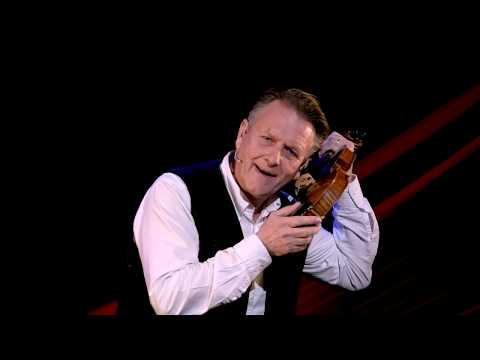
I want to share a secret with you or at
least my idea of what the secret was
behind the extraordinary musical
instruments that were made by Antonio
Stradivari and a few of his
contemporaries in the 17th and 18th
centuries in Italy and it wasn’t that he
put the blood of his dead wife into his
varnish or that he boiled his wood in
toads piss while reciting ancient texts
under a full moon now it was much
simpler than that now some of these old
stories may turn out to be true and we
love those old stories but that is not
what made these people capable of making
these wonderful instruments the secret I
think probably is that these people were
profoundly talented and they lived in an
age where all kinds of different
disciplines were merged together in a
pool of intense creativity much like
today where cross-disciplinary work is
everywhere in our own modern Renaissance
the enigma of a fine violin tone is
laced with debate and it’s all the time
it’s represented wrongly in the media
and due to the scarcity of these
instruments and the exorbitant price
tags that they have people’s idea about
real value has been compromised now I
make violins violas cellos and double
basses strictly in the traditional way
I’m actually also very interested in the
acoustic research involved in getting to
know what these instruments are all
about
so I began taking part in meetings of
scientists and musical instrument makers
first in Oberlin in the US and then in
Cambridge in the UK
initially there was a huge gap in the
language that these two groups used and
the violin makers had a hard time
understanding the terminology used in
the in the laboratory and the scientists
found the descriptions used by the
instrument makers very subjective to say
I’d like to introduce the first series
of electric stringed instruments that
have a built-in convolution engine which
is using digital signal processing to
emulate the tone of really really fine
instruments and in collaboration with a
company called signal wizard in the UK
and Manchester University we’ve managed
to make an instrument that has extremely
fine tonal characteristics and getting
ever closer to those really fine
instruments and it involves a very
precise measurement of violins violas
cellos and double basses and the
development of a software hardware suite
that is able to take the recorded sound
of these instruments and produce a copy
of it in real time now an electric
violin usually an electric violin can
sound rather dull although it has to be
said that you know a talented musician
can exploit that electric sound to great
effect but our team has managed to make
an instrument that is quasi
indistinguishable from a really fine
violin I’d say quasi indistinguishable
because a very very talented violinist
has a very very developed sense of tone
and playability so I’ve collaborated
with Professor Patrick cadets key at the
University of Manchester in creating a
platform using digital signal processing
and psycho acoustic evaluation along
with measurements of the really the
finest instruments in the world
and the technique involved is using a
very sensitive force hammer and hitting
the bridge of the instrument recording
that sound creating a an acoustic file
from that and then using that file as
the basis for a digital filter that
digital filter is then downloaded onto
the device now the hardware and the
software needed to make this happen
which has been developed by Patrick
cadets key comes in the form of V sound
which is a kind of an off board digital
stomp box pedal which can be used with
existing electric instruments and then
also d cello which is a similar circuit
which is embedded into some of my
electric custom-made electric
instruments I’ve been using my
experience as a violin maker to gain
access to and measure some of the finest
instruments that I can get my hands on
using the methodologies and the
techniques that I’ve learned through my
interaction with the scientific
community one of the drawbacks of
playing even the finest digital
emulation of the violin through an
conventional loudspeaker is that the
conventional loudspeaker lacks a kind of
a spacial embodiment that you hear when
you play a fine violin in a good
acoustic space and that’s because the
violin because of the way it’s shaped
and the way it vibrates it throws the
sound in different directions at
different frequencies into the space so
for example when you play a really
high-pitched tone on a violin the sound
projected from the instrument will be
directed in specific directions whereas
if you play the lowest note of that
instrument it will be dispersed more or
less evenly through the space and what
this means is that the sound that’s
coming from the instrument will be
bouncing off the walls and the ceilings
and the floor
totally contingent on the way that the
instrument is played so one of the
things
we’re researching also is a method to be
able to recreate this using
omnidirectional speakers one of the most
valuable aspects of these projects not
only for me as a violin maker but also
for the the whole stringed instrument
cultural community is to harvest what
can best be described as a fingerprint
or a sonic fingerprint of these fine
instruments by and and then making a
database of files each of which will be
used to characterize that instrument for
posterity just think of the Albert
global Seed Vault
up in Spitsbergen where a whole variety
of plant seeds are preserved as spare
copies of plant seeds from seed banks
from all over the world well if a
priceless Stradivari violin is destroyed
its sonic characteristics can be
preserved in much the same way but it
must be stressed that a recording of a
particular performance on a particular
violin is in essence not the same thing
as this sonic ring fingerprint because
what this technique does it puts the
tone at the fingertips of any player now
two-tone is not the same thing as its
graphical representation the spectral
plot of a cello is not the same thing as
when somebody manages to make a cello
sing a beautiful musical phrase we
mustn’t confuse acoustics with tone
acoustics is a physical language
consisting of physical data tone is more
of an aesthetic and has more to do with
art acoustics is an intellectual pursuit
the legendary violinist Jascha Heifetz
was approached by a woman once backstage
after a concert where she said mr.
Heifetz your violin sounds wonderful to
which he replied and he put the violin
up to his ear and he said funny I can’t
hear a thing
and so what is it that that fascinates
people about the string tone well the
hyford story reminds us that it’s a
conglomerate of many many things one
obviously the talent of the performer –
the mindset of the people listening and
three the nature of the acoustic space
where the performance takes place so
some of my colleagues have been doing
comparative research on comparing old
violins to new violins and the results
of these tests and experiments have our
critical evaluation a violin tone but
also gives us the knowledge needed to
make better and better new instruments
now I’m not particularly interested in
the debate were old violins versus new
violence but I’m fascinated by the
prospect of being able to make a great
instrument based on hard knowledge on
top of the age-old tradition that I’ve
been lucky enough to inherit now you
might ask why do this why why not what
what’s wrong with the normal violin it
doesn’t need a USB cable but for me
personally it’s a it’s a way to learn
something new about violin tone in a
very non-trivial way and to deepen my
understanding of this wooden box and the
way it behaves and how I can make it a
better tool to make a musician be able
to realize a better performance often on
and recently I’ve had the feeling that I
need to get away from measurements and
nology and just to feel how it what it
feels like to cut with a sharp gouge
through a piece of wood or to use my
teeth on biting the wood to ascertain
the density of it and to use my sense of
smell and my sense of hearing and to
experience that magic and arts that
makes violin making almost an esoteric
pursuit in the hope that there’s
somewhere a realm where these two
seemingly incongruous approaches can
merge and great things can be done and
great instruments can be made now a very
very good violinist can still tell the
difference between a real violin and a
digital emulation of that violin
according to a recent study that we’ve
done but not by a great statistical
margin so we’re hoping that with
continued research well there’s a work
to be done now I’m going to leave you
with a short musical phrase played on a
purely electric violin with no sounding
body followed by that same recording the
same playing on the electric violin but
through this digital emulation and the
now I’m gonna play this again but I’d
like you to just listen very carefully
and you can you can almost hear in the
processed version of the sound you can
almost hear the wood and the air of the
original instrument that was measured so
let’s go again you very much [Applause]
Please follow and like us: