
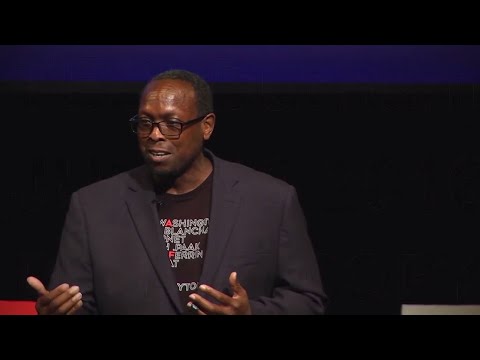
so of course we’ve all been inundated –
last couple of days with these images of
black men being killed by police and
though my talk was well planned before
this particular moment what we’re going
to talk about today are these
connections between the historical
images of black men that inspire fear
not just in police officers but
Americans alike Todd of my talk is devil
want to put me in a bowtie it of course
is a lyric from Kendrick Lamar from his
2015 song I in the lyric Kendrick writes
I’ve been through a whole lot trials and
tribulations but I know God the devil
want to put me in a bowtie the chorus
and I love myself when you’re looking at
me tell me what you see
I love myself and I was struck by that
idea of wearing a bowtie because we’re
in a particular historical moment now
where there seems to be a proliferation
of Negroes with bow ties we have the
gentleman on the top right who is a
British businessman we have a brother on
the bottom who we know as if you watch
The Wire brother who’s owned and we’ll
talk about brother moves on in a second
and we have young men from an academy in
Chicago which purports to be able to
graduate a hundred percent of their
students every year what has occurred in
the context of these moments
particularly since the election of
Barack Obama in 2008 is that there is a
movement within black America they’ve
somehow if you have the first black
president somehow that young black
people need to dress the part that if we
wear bowties if we stop sagging if we
buy into what we might think of as a
politics of respectability now of course
black folks have always worn bowties
black men have always worn bowties I
wore a bow tie when I was four haven’t
worn a bow tie as an adult the gentlemen
in the bottom brotherhood zone and for
those who who watch the wire you know
that he was a bit of an enforcer but
those of us who watched the wire for so
many years when we first saw brother
what we saw was a member of the Fuda
Islam which of course is the
paramilitary wing of the nation Islam
who always wear bowties right and
provide security not just for the nation
Islam but also very well known black
celebrities and we think about where
this goes fully this idea of a politics
of black respectability considering this
tweet from dr. Steve Perry who was a
well-known educator who tweets I witness
200 boys voluntarily cut dreads braids
unkept frosh because I am Steve Harvey
Steve Harvey the US Army connected
aesthetics to success and this is where
this bowtie narrative is problematic
that somehow they the young black people
not dress the part not only will they be
successful in school that somehow it
would also save their lives
now of course I’m a professor at Duke
University if I teach a class that’s
8:30 in the morning
three-quarters those students are white
students who shuffle into my class
wearing pajamas and flip-flops uncombed
hair and baseball caps and none of them
are of the belief that there’s a
connection between their intellectual
capabilities and how they chose to roll
out of bed that morning when they came
to my class so we’re wondering where
this is coming from and of course we
might argue that this in politics of
black respectability is a response to
the violence that historically has been
directed at black bodies in general in
this case specifically black male bodies
in 2011 the good folks at the
opportunity agenda issued a report this
is November 2011 this is important
because it is literally a few months
before the killing of Trayvon Martin and
what the opportunity agenda did is they
did a study of how images of black men
and boys circulate in American culture
what they said is that they were
distorted patterns of portrayal under
representation of black men and boys and
of course that might sound a little
strange but for a moment if you factor
LeBron James and Barack Obama and Kanye
West and jay-z out of the equation there
is exactly very few representations or
diverse representations of black men and
boys in mainstream culture you also said
that whenever
there were presentations of black men
and boys it was always with a negative
association limited positive association
and more importantly when black men and
boys were presented in mainstream
culture was always within the context of
a problem frame what do we do with these
black men and boys they’re going to say
that these images in fact create casual
links to mediate and public policy
creating general antagonism exaggerated
viewers of criminality and violence
think about the ways that we talk about
young black men smoking weed who play
college football as a criminal act
Francis even though the smoking of
marijuana is likely on a bunch of states
exaggerated views of criminality and
violence lack of identification and
sympathy and support for punitive
responses to black men and boys so we
might want to ask where some of this
might come from so the great scholar
Clyde teller wrote in 2000 black men are
densely mytho genic the objects of
layered fictions produced by others what
does it feel like to be a myth Du Bois
might have asked instead of to be a
problem
and then of course we get officer Darren
Wilson from just two years ago at this
point it looked though he was almost
bulking up to run through the shots like
it was making him mad that I’m shooting
at him and that face that he had was
looking straight through me like I
wasn’t even there I wasn’t anything in
his way confirming the very thing that
Clyde Taylor talked about in the first
place and you might ask where might some
of this fear come from so somebody who
should know the gentleman behind me Jack
Johnson the first black heavyweight
champion of the 20th century because
there was one in 19th century and the
foot Jack in some sort of context this
is an era of race in America that’s
defined by Jim Crow that’s defined by
high instances of lynchings and in this
context what was Jack Johnson’s job I
always get a kick asking students about
this I always a boxer is a pugilist
Sanja to let you and all that right but
if we get to the nuts and bolts of what
Jack Johnson’s job was Jack Johnson’s
job was to put white men on their asses
in an error in which black men were
killed for even enacting what we call
reckless eyeballing that’s the act of a
black person looking a white person in
the face if a black person didn’t cross
the street when a white person was
coming their way it might have gotten
them killed in this era Jack Johnson his
job was to put these white men on their
asses but you know Jack couldn’t be cool
Jack in some ways define early of mid
you know turning the twentieth century
blacks whack so you see Jack on the one
hand as if you listen didn’t you see
Jack with the fur coat and the Model T
and this is important because Jack
driving around in his Model T where most
white Americans were not driving Model
T’s so he’s what we call the uppity
Negro he also had this other little
habit that folks were barred the bible
black and white folks he liked to put it
nicely he liked to love across the color
line right Jack loved himself some white
women and of course in 1904 1906 1909
that may create a problem
which explains why Jack Johnson was the
first American ever indicted on the Mann
Act the Mann Act which made it illegal
to transport underage women in
parentheses white women of course state
lines for purposes of prostitution Jack
Johnson was the first person in America
indicted on the Mann Act you might argue
that the Mann Act was it created for him
he represented a kind of threat because
what Jack Johnson represented was
progress and very often progress will
generate as a response white rage so if
you have this black man that represents
a certain kind of progress and let’s be
clear he also made black people
uncomfortable
you need an antidote of course you might
need a few antidotes at the same time
that Jack Johnson becomes the
heavyweight boxing champion the
gentleman on the
Bert Williams becomes the most well
known black entertainer in the country
in fact he’s black America’s first
crossover success he was not born the
United States he was light-skinned which
is why when he appeared on stage he
appeared on stage as a blackface
minstrel and then you look nexted to mr.
Williams you have a gentleman whose
birth name was Lincoln Perry but if you
are a historian of early 20th century
American film you know him as step-in
Fetchit as in step and go fetch it so
you had images that were construed to
counter the representations of progress
at someone like Jack Johnson represented
but of course there are always responses
in this context so by the time we get to
the night 1940s and 1950s and I put
these particular figures importantly
because they were not necessarily
political figures but figures who came
out of the entertainment industry so we
have Paul Robeson right who of course is
not only an all-american football player
graduating from Rutgers at the beginning
of the 20th century he’s also a
well-known orator he’s also an actor
right he’s also a columnist right and so
he becomes the embodiment of a
generation of young black entertainers
and actors and athletes who become
politicized in the mid twentieth century
one of the people that he most
politicized is the gentleman who was
simply known as a Calypso singer in the
1950s Harry Belafonte right and of
course Halle Berry in front if we go
forward to 2016 is mentoring a
generation of black actors and actresses
and entertainers about being politically
committed what that generation creates
is a particular generation of athletes
that emerge in the 1960s the late
Muhammad Ali that’s his famous photo on
the cover Esquire magazine 1966 he was
very good friends with Malcolm X
happened to be a photographer and
archivists himself Muhammad Ali might
have been the most photographed athlete
of the 20th century right and very
consciously staged his own images right
this is a photo of Malcolm X taking a
photo of Muhammad Ali
well I below them you have a picture of
Muhammad Ali and Sam cooked the great
vocalist because Sam Cooke
Muhammad Ali Malcolm X and Jim Brown who
was in that fourth photo were in fact
close friends for an 18-month period
until the death of Sam Cooke in December
of 1964 and Malcolm X in February of
1965 they represented the coming
together of a particular generation of
athletes and entertainers that
represented a certain notion of progress
but we know whenever progress emerges it
has to be an antidote and the antidote
was a transcended Negro the person that
you might argue might be the only black
man of the 20th century to ever
transcend race that would be mr.
Orenthal James Simpson to fully
understand who LJ Simpson was as a
football player at USC in the late 1960s
you have to look at someone like Jim
Brown Jim Brown who was an all-american
football player who was an all-american
lacrosse player famous story about Jim
Brown showing up on the cross field with
his lacrosse stick and the white coach
going who gave that Negro a stick but he
also was politically engaged so they
needed an antidote the antidote was
aren’t all who one time was asked how do
you feel about being a black athlete and
he goes I’m not black I’m old J and when
I say that he’s a nigger of the
transcended race he was to do that when
you saw Oh J great football player bad
actor somebody who I might want to have
a beer with right
you wouldn’t name six or seven things
before you got to the points like oh
yeah no J sense as a black dude so much
he transcended race it he was a
spokesperson for mange
a company like Hertz if you got a chance
to see Oh J made in America they talked
about him doing the commercials with him
and they’re saying to themselves okay we
just can’t have one singular Negro
running through the airport that might
create some concerns Wright said they
would always have a white person in the
commercial that could cosign if he was
somebody significant ohayo J he was that
me grow and again to put this in some
sort of context when we talk about
antidotes to progress Mohammed Ali who
was infinitely a much more visible and
popular athlete at the time that owed J
Simpson was Hawking for Hertz Muhammad
Ali was a pitch person for Roach spring
think about that for a second and of
course all of that leads to 1994 how
quickly they slide down and this is a
particular photo for Time magazine that
is also mediated by the artist Hank
Willis Thomas the idea of the fall of
the proper nigga where by the time we
get to the 1990s and 2000 we see a
certain kind of remixes of these images
so you could see someone like LeBron
James on a cover of a mainstream
magazine with a white fashion model but
somehow that photograph looks something
straight out of 1930s newspapers and
magazines where the Nazis are depicted
as King Kong and King Kong is running
away with American white women and
somehow that is LeBron James seventy
years later we look at the two photos on
the right the two photos at the bottom
Eldred Tiger Woods the golfer who kind
of transcended race and Shawn Carter the
hustler the drug dealer from Brooklyn
which one of them is the rapper and
which one of them is the golfer if you
look at these photos interesting kind of
mix there right as the images of
Gress and non progress get a little
complicated
and while elite black men have the
ability to wear whatever uniforms they
wear are things that look a little
different for everyday black men when
Mike Brown was killed in August of 2014
there were immediately these photos of
Mike Brown that depicted him in his less
humane humanity if you will and of
course black Twitter got on and they
begin to address that to mainstream
media if you’re going to depict him
how about depicting him in a way that
highlights his humanity but doesn’t just
simply connect to the narrative that’s
being told to folks from law enforcement
so he had young black people cognizant
of what was happening what we mean said
if I got killed how would the media
choose to depict me so they shot selfies
of themselves in ways that they know the
meteor would depict them versus how they
are in everyday life right so much so
that they force in New York Times
actually write an article to respond to
the type of visual biases that corporate
news in fact engage in in the context of
these situations what you have is the
musician and you have a student you have
someone who served in law enforcement
right recognizing that at the time came
very rarely were they actually depicted
in those kind of contexts of course that
brings us to this particular historical
moment gentleman from Baton Rouge
Louisiana a family man
another gentleman from Minneapolis
another family man right this idea of
Blackman is an endangered species and
when we think about a society that’s
afraid and fearful these black men wear
these narratives coming from and we
realize that in many ways they are
historicized this last photo the art of
Hank Willis Thomas a piece simply call
strange fruit
what are the kinds of emotions that are
generated when you see a photo like this
right this is a contemporary photo this
is a piece of art that’s been done in
the last five years the great poet in a
statistician
amiri baraka talked about the changing
Seine and what we see in terms of the
presentation of black masculinity in
American culture despite young black men
pulling up their pared pants and wearing
bowties
it’s a continued circulation of them as
strange fruit thank you very much
[Applause]
Please follow and like us: