
I feel we share a common core belief a
belief that there is no problem greater
small that humanity faces or will ever
face that we cannot overcome together
through our combined will and sheer
human ingenuity and I know it’s a
commonly held belief because I see it
constantly portrayed in popular culture
a devastating asteroid might have come
hurtling from the heavens and lay low
the mighty dinosaur but if it came
through humanity well we just grab Bruce
Willis and Ben Affleck and throw him in
a pair of Space Shuttle some drilling
equipment a pair of nukes and a killer
Aerosmith soundtrack and boom get it
done like easy peasy lemon squeezy right
so when we wonder why in reality the
world is so beset with problems and we
have an immeasurable amount of
information available to all of us at
the click of a button
the conclusion we must tend to draw is
it must be a failure of will we just
don’t care enough and while human apathy
is to an extent a natural conclusion to
draw
I think it’s dangerously misplaced you
see I think we genuinely passionately
want to solve the problems but we can’t
bring our collective will to bear on the
solution because we can’t agree on what
this solution is a situation that’s
getting exponentially worse as the
experts who genuinely understand what
needs to be done seem to be suffering
from an ever-increasing inability to
persuade mainstream society but they do
in fact hold the keys and to my way of
thinking this is actually the greatest
crisis that humanity faces now you might
find that a surprising statement surely
it’s war or famine or poverty or social
inequity or the rising tide of bigotry
and hatred that seems to be sweeping
across the face of the earth
but those things have solutions things
like war are essentially an expression
of a collective will a negative will but
a collective will nonetheless so unless
we address the fundamental dysfunction
in how we solve problems the solutions
to all those kinds of issues will
continue to slide maddeningly through
our fingers and so as I look at this
spiral into the death of persuasion and
I see this rising tide of hysteria that
seems to be creeping into public debate
and international politics it seems to
me that now more than
our ability to understand how to bring
about a focused collective positive will
against the challenges it faces is more
vital than ever now I have a vested
interest in this I work in creating a
public positive dialogue around
immigration and multiculturalism I don’t
know if you’ve noticed but the movement
of humanity across the borders of
nations is kind of a topic
touchy subject right about now and when
I first was involved with the field it
was natural to conclude that the reason
that immigration was so contentious is
because it was so misunderstood
so the solution I was given was go out
and present them with the facts the
passion with which I presented these
facts was only equalled by their
staggering and distressing inability to
significantly change public opinion now
I was fortunate enough to come across a
wonderfully inside insightful TED talk
entitled on being wrong by brilliant
woman called Katherine Schultz and since
it really helped me understand the
struggles I was having what I’d like to
do is walk through the steps that
Schultz outlines it as to why we have so
much trouble changing people’s minds but
apply them specifically to my field of
public policy so in order to avoid
muttering the waters since a lot of
public debate is around subjective areas
what I’d like to do today is focus on an
area that is purely objective and relies
on fact above all else
specifically the scientists so I’d like
you to imagine that we are scientists
and we’ve looked through the ruthlessly
peer-reviewed research that’s been done
by a wide range of highly accredited
independent institutions and the result
of that we’ve come to certain
conclusions we’ve decided that vaccines
are overwhelmingly safe and that they
help protect millions of lives or maybe
it’s that GMOs are not only better for
human health but they’re better for the
ecosystem since they dramatically reduce
the amount of pesticides that farms are
then washing out into the ecosystem or
maybe that it’s the earth is going
through a period of human driven climate
change all that it’s round or that it’s
more than ten thousand years old or that
evolution is real etc etc etc
so I now meet somebody who has a
different point of view on some or all
of these topics and at this point what
Schulz outlines is that my first
conclusion is they must have
misunderstood the facts or not had them
in the first place because if they had
the facts surely they would have come to
the same conclusion that I had and yet
when I present them with the exact same
facts it persuaded me they say well
that’s your opinion but I think that
vaccines cause autism and GMOs of
frankenfoods that are destroying and
killing the bees and that evolution is
just a theory because if we evolved from
monkeys why they’re still monkeys and
that’s my opinion I’m entitled to it and
it seems to me that at this point logic
based people tend to get caught in kind
of a logic loop because having been
persuaded by facts themselves they can’t
get around the idea that the same facts
are persuading the person that they’re
talking to and so they go and get more
facts to bolster their point of view
only to find out that this is seems to
be further entrenching the other person
in the opposite point of view and in
defiance of the well-known axiom that
the definition of insanity is doing the
same thing and again and expecting a
different result
they go out and do more research and
present more facts it’s like watching a
pigeon fly into a window that it just
can’t seem to accept exactly there
because what they can’t seem to
understand in this kind of argument is
when it comes to that kind of public
persuasion the facts don’t matter and as
a fact aren’t a person this is a very
difficult concept to get around now
remember you may have had a different
opinion on some or all of those topics
but a big part of your scientific
training is if you were presented with
credible scientific evidences that odds
with your personal opinions then you
change your mind and so now we receive
this we will arrive at this point of
frustration and we see fat paste people
scientists logic people going just
really moving the dialogue away from a
reasoned discussion around ideas to
attacking the people and that
the mental abilities and this is
actually a constant thing that we’ve
seen throughout the ages the most
brilliant minds that we know are
constantly having this struggle with
people not accepting their point of view
and the most dangerous thing is that’s
the second stage we arrive at is we just
conclude that they’re idiots and in fact
because of this we start to demonize the
opinion and the people and whether or
not they’re intelligent at all and the
worst thing is this brings us to the
third stage that Schulz outlines because
you have to remember the other person is
going through exactly the same process
you are but now that they know that you
have the facts and not only are you not
an idiot but you’re actually quite well
educated in this field in fact you’re an
expert the final conclusion they draw is
you know what the real truth is but
you’re manipulating for some nefarious
end you’re a corporate shill for big
pharma and we reach this impasse where
we look at each other we throw up our
hands and we want to go and find
somebody else who we agree with because
that’s much easier and this is where we
misstep because public engagement is
everything and oddly enough one of the
quotes that really summarizes this
misstep comes from one of my favorite
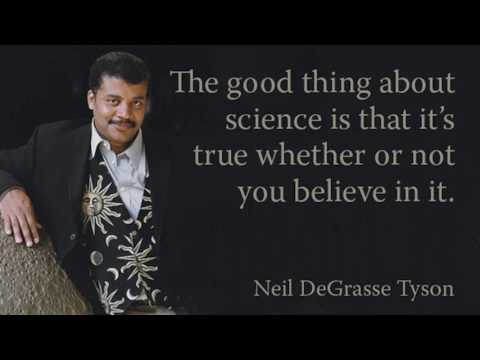
people in the world the man the myth the
legend dr. Neil deGrasse Tyson the only
guy I know with a brain the size of a
planet that can still pull off a photo
shoot like he’s modeling for the front
of a 1970s disco album right now he
quite correctly points out that the good
thing about science is it’s true whether
or not you believe in it however I feel
this really reflects the tendency for
scientists having spent so long learning
to put their own opinions aside to
rather rudely dismiss the opinions of
people that they don’t agree with but
wrong opinions matter to while science
doesn’t care about your opinion
scientists should because public opinion
drives public policy which
turn drives public funding for the
scientists which we’ve seen dramatically
slash recently and whether or not the
general community engages in
scientifically sound practices around
health and agriculture and everything
else they say that those who ignore the
lessons of history are doomed to repeat
them so Neil the one thing that history
is taught us is that if you are a
brilliant scientist and you have
irrefutable proof that the world is
teetering on the edge of catastrophe but
you can’t get anybody to listen the only
solution that you have at that point is
to take your infant son put them in a
rockin send them to another planet and
hope that they develop superpowers and
eventually meet Wonder Woman Batman and
go on to form the Justice League
fortunately it doesn’t have to quite
come to that as it happens understanding
why people change their minds and more
importantly why they don’t change the
minds is actually a well studied field
so previously for example I mentioned
Katherine Schultz and when she’s talking
about cognitive dissonance which is our
tendency to hold on to an idea even when
we’ve Breeden presented with opposite
opinions she has a rather wonderful
analogy she points out that being wrong
and being right the reason we hold on to
that feeling of being right is because
it feels awesome and being wrong makes
us feel stupid and embarrassed she also
quite insightfully points out that it’s
not being wrong that feels bad it’s
realizing that you’re wrong because up
until that point feeling wrong felt like
feeling being right and she uses a
wonderful analogy of the the wily coyote
chasing the ever elusive roadrunner off
the cliff and there’s that period where
he’s still going but he doesn’t realize
that he can’t but then you see that
expression on his face and he does this
with the toe there’s that little uh-oh
sign that comes off but he still won’t
look down because he realizes when he
looks down that’s when he’ll have to
acknowledge that he’s standing on
nothing but thin air and it’s only then
that he’ll fall and that’s when the pain
comes we also get a lot of insight from
things like the 1979 Stanford study on
Capitol
where they found that when they had
people and presented them with ideas
that were at odds with whether or not
they were foreign against capital
punishment at the end of it there were
more convinced than ever by the opposite
argument that their original position
was right we can also get insight from
things like the dunning-kruger effect or
as I like to call it the drunken dancing
effect you know how when you’re at a
party you are the best dancer at the
party well you don’t know that you’re
dancing badly because you’re drunk but
that’s also why you’re dancing badly and
they found out for perfectly sober
people this is actually a permanent
position because people who are bad at
things like interpersonal relationships
or humor or logic are bad at those
things because they don’t understand
what being good at those things look
like which is also stop some self
assessing and realizing that they’re not
good at those things which is why we all
have a friend who is convinced he’s like
the funniest person in the room when we
all keep telling him that he’s not a
similar study was done in Yale where
they showed that they had a bunch of
graduate students and they got them to
analyze their understanding and rate
their understanding of some common
everyday items like a zipper or a toilet
etc and the students essentially
shrugged and said well sure we
understand how those things work but
then they got the students to write a
detailed step-by-step explanation of
exactly how they those things work and
afterwards the students were forced to
conclude that they didn’t actually know
much about them at all they knew how to
use them but they didn’t actually
understand how they worked and this
knowledge illusion uses while the
displaced idea of how well we understand
things now all this combines to have a
devastating effect on public policy the
dunning-kruger effect and the knowledge
illusion makes us feel like we can have
meaningfully input on fields that are
completely outside of our areas of
expertise from global climate ology to
molecular biology and then cognitive
dissonance and this confirmation bias
where we’ll go and choose the evidence
that we like that supports our our point
of view we’ll make sure that we hold on
to it for dear life now
all this means that we have to
fundamentally rethink the way that we go
about persuading people these are
hard-wired emotional responses that you
can’t just logic away or browbeat out of
somebody I’ve been fortunate enough to
study to suffer from a certain amount of
occupational and geographical drift over
the course of my life starting as a
lawyer in Australia now working in
public relations here in Canada and as a
result of come to a bit of an
understanding about the difference
between an adversarial argument and a
persuasive one law is adversarial I take
my point of view you take your point of
view and then basically we try to
destroy each other’s arguments and I’m
also trying to show that I’m the
smartest person in the room but that’s
not the point the point is that it’s for
a third person who’s listening to us
that we’re trying to convince however
even if there is no third person we’ll
still take the same approach and then
wonder why it fails persuasive arguments
work on the assumption that I have to
understand and address the emotions
that’s driving them to believe this
people aren’t against vaccinations
because they’re idiots they’re against
vaccinations because they’re scared for
the children and because they’ve been so
effective in terms of presenting to
preventing disease they’ve probably
never seen someone who’s suffered from
polio and being crippled or had a child
died from measles or tuberculosis so
those aren’t real fears and tonight I’ve
been focusing on science because that’s
the stuff where the science is in there
is no debate we’re good and there’s
still this much controversy so things
like my field of immigration in other
fields we have to understand that in
order to be persuasive in our field we
have to get past the type of argument
that we’re having and move to a point
where we understand the difference
between arguing to win and arguing to
win people over thank you
you
Please follow and like us: