
I am a microbiologist and what that
means is that I studied single-cell
microscopic organisms particularly the
ones known as bacteria and you have
probably heard about bacteria before
maybe on a bad note when you get sick
after eating that undercooked hamburger
or maybe you have heard about the
delicious products that bacteria help us
make such as yogurt or cheese
I have study bacteria because I think
that they are fantastic organisms that
can help us some help us solve some of
our biggest problems as a society and
they are so intriguing particularly when
we focus in what they can eat and what
they can produce let me make this point
by asking you the following questions
who here owns a cell phone raise your
hand who here owns a laptop or an iPad
from all of us that raised our hand how
many of us have upgrade or replace these
technological devices many of us right
my point is that technology is part of
our everyday lives and as technology
advances at incredible rates we as
consumers tend to replace these devices
frequently and this is great however it
leaves us solving these two important
challenges the first one is how can we
keep up with a production of this
technology and the second one how do we
appropriately dispose the devices that
we do not use anymore it
Souths that bacteria can help us solve
these challenges let’s focus on the
first challenge how can we keep up with
production one thing that can limit the
production of any technology is if one
of the compartments in which they are
made is very expensive
or very scarce five years ago it was
impossible to think that you could keep
your computer or your cell phone on for
more than a day without charging the
battery nowadays if we watch a movie
using a modern TV you actually feel that
you’re part of that action scene because
of the quality of sound engineers have
been able to provide this technology to
us with these amazing features because
they have replaced one component in
their batteries and the speakers of
these devices and that component is a
metal known as rare earths rare earths
are metals that are super conductors and
super magnets and it is because of these
properties that we can have these great
things in our devices and although their
name is misleading you would think that
if it’s a rare earth that means that
they are rare but that is not the case
these metals are highly abundant it’s
just that when chemists and geochemists
were looking for them they couldn’t find
them and the reason why is because
they’re very hard to dissolve now the
problem is that is very hard to find
them in high concentrations in small
areas which means that is very hard to
find mines if a mine is found the miner
not only has to dig those oars they have
to put the ores in these ovens with high
temperatures
and then add acid very harsh acids this
process is very dangerous then the minor
has to take out the melted or and then
manually pass it through a series of
steps to be able to get that pure rare
earth everything that is not used is
going to get released to the drain and
this is also a bad thing because that
that melting thing that is being
discarded usually contains radioactive
compounds eventually this will be a
found in areas that are close to those
mines the process is so inefficient so
dangerous and so expensive that has led
to the few miles in the united states to
be closed and many countries have
followed right now China is the main
provider of rare earths which means that
our technology is dependent on one
country let’s think about that for a
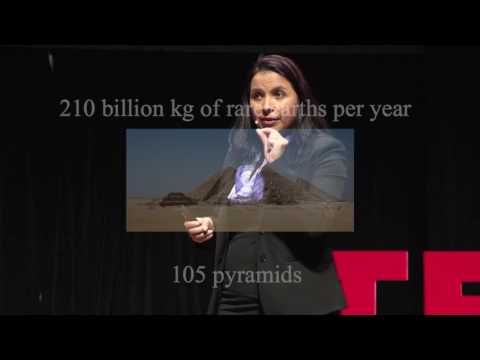
second we need approximate 210 billion
kilograms million kilograms of rare
earth per year to keep up with
production of the technology that we are
demanding this year if we put that in
perspective if we pile it all up we will
be piling 105 pyramids of giza in egypt
that’s a lot of rare earths so how can
bacteria help us solve this problem it
turns out that there is this bacteria
known as Messiah troops
Messala troops are pink bacteria that
needs rare errors to grow I decided to
dedicate my life to study this bacteria
because it’s very unique what they eat
and what they produce let me explain
this further we as humans eat foods such
as fruit or desserts and we know about
we know these food as sugars if we look
at the chemical structure of these
sugars it can look something like this
we also eat yummy bacon and cheese and
that food is known as fats and the
chemical structure of a fat looks like
this what we do is we break these
chemical structures and then we make
chemical transformations to make
everything else that we need but Messala
troves instead eat very toxic compounds
compounds that contribute to global
warming or that can generate cancer
these compounds are examples of them are
methane and formaldehyde and you can see
in these chemical structures that they
are very simple one carbon tampons so
the bacteria cannot break these
structures what they do is they build up
from there and they will be able to make
the same structures as sugars and fats
that I mentioned before but also they
can make chemicals that are of high
value for our society
such as biofuels which can substitute
diesel bio plastics and precursors of
antibiotics and now we know that in top
of these incredible chemical
transformations they use rare earths in
the process so we are left now with a
condition where we have an expert in
sensing dissolving and acquiring rare
earths so in my lab we start asking the
question can we use this masala trough
as a micro miner and we decided to test
this question by
bring up the following experiment we
order a rare-earth an ore of rare earth
we have smash it with a hammer to make
it a powder and we ask can the masala
drove grow on it can it use this or as a
source of rare earths and we find out
that it can but now all’s are expensive
mines are hard to find and the ones that
were out there are closed so we start
wondering can we use alternative sources
of rare earths and that leads me to the
second challenge that I mentioned at the
beginning of the talk how do we dispose
these old iPads or old cellphones well
it turns out that electronic waste is
becoming a serious problem for many
countries including ours it is estimated
that we discard around 4.4 million
metric tons per year and the realities
is that the majority of this electronic
waste ends up in landfills such as the
one in this picture we are slowly making
efforts to recycle this electronic waste
but the United States for example can
only recycle one percent of these rare
earths this electronic waste we still
went ahead and say can we take advantage
of these recycled sources so we went to
a recycle center we gather all
cellphones and laptops we remove the
speakers and the batteries of these
devices we are gonna smash it and we ask
can the masala trove grow on them and
surprisingly we find out that it can we
are currently engineering this metal
trove so it becomes a better as calendar
of rare earths so they can grow and
really at
late a lot of errors from these
electronic waste our goal is to optimize
the process so we can obtain pure rare
earth that is ready to be used again to
produce new technology I am very
interested in making this system
sustainable masala drops have shown at
least in principle that they are
platforms for the production of
value-added products for me the future
is clear even when my silo drops are
tiny single-cell organisms they can
achieve some of the most intriguing and
unique transformations out there if we
as microbiologist understand how they do
it we can harness masala drops for a
mosaic of applications we can clean the
environment and remove toxic compounds
from our atmosphere we can produce new
technology and we can generate many
products that have high value to us all
together allow us to conclude that
bacteria truly can solve some of our
biggest challenges as a society thank
you
[Applause]
Please follow and like us: