
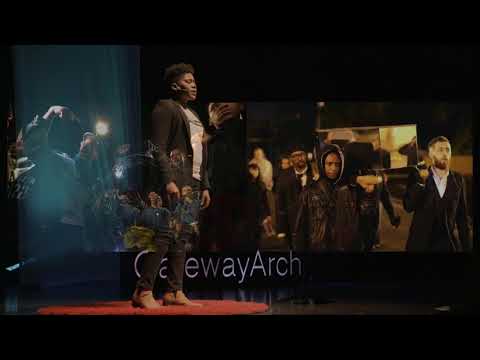
I am someone who often is given a lot of
titles for what I do there are terms
like social impact designer community
artists social impact artists social
innovator art of this but in my soul I
consider myself as simply a creator I
work with people to produce to design to
actualize different tools provocations
experiences and manifestations of
artworks that actually get to the heart
of so many issues that so many of us
continue to suffer through and face you
see I got my start in this type of
creation when I was still young I grew
up in rural Mississippi and in my home
town until 2012 where I lived was still
segregated by a railroad track from
where so many others lived on the other
side of our town but because I was
tested as a gifted student that’s when I
got the chance to experience this other
side of town and to be educated with
people so that manifestation of looking
at racial equity looking at social
division looking at poverty experiencing
domestic violence all of these issues
started very early on and after I left
college I got a chance to go back down
south and for so long in my life
especially as a visual artist I’d been
expressing so much of these frustrations
simply as an individual person for
during this experience down south in
rural Alabama after a series of
tornadoes had flattened most of Hill
County that’s when I started to learn
the power of working with
people in community where we live where
we breathe together now that project had
its own challenges that I can talk about
four hours in another talk but it taught
me so much about the power of who we are
and what we can do when we bring our
gifts our talents our perspectives
together and that experience catapulted
me to work with communities all across
this nation to address issues like youth
development youth poverty food access
disparity urban dumping social division
questioning our own identities and who
we have been told that we are versus who
we really are so I want to share a story
about one of these types of projects the
MIR casket this was a piece that came
out of so many nights and so many
experiences of being on the ground right
down the street here in Ferguson
Missouri admittedly even though I was a
student organizer I was always outspoken
as a young person I’d actually had never
gone to what’s called a protest and it
wasn’t until August 12th not even August
9th that I found myself at night on the
streets of Ferguson and I took this
video camera with me because I was by
myself I had just come from like this
Urban League young professionals meeting
I was in a business suit dressed up I
didn’t really know what to do or what to
expect
and the news had told me that out there
I would see all of these like chaotic
people but when I got there
what I saw was love and community I saw
people dancing and drumming in the
street I saw tempo giving chance to
people I saw women organizing in
building community I saw people like
mama cat who I first met at a protest
feeding the people and on that first
night I stayed out there with folks
rising our voices letting it be known
that we do not want to be slain on our
own streets and as we were doing that
all of us
this whole fleet of Humvees starts to
drive down the street and on the sides
of them marched these officers who are
dressed in military gear carrying guns
some were on top of these trucks and
they pointed these big bright lights at
us and some even pointed their guns and
on this night for the first time in my
individual life I felt threatened I felt
that even though I was not doing a
single damn thing that was harming
another person I was being threatened so
after that night I played that video
over and over and over and clips for
more nights that followed and I was
constantly haunted and in my nightmares
I would constantly see this one image
this casket that was made completely out
of mirrors that would be carried
throughout the streets and like the
mists of darkness and I couldn’t shake
this dream but also even though I’m a
designer I’m not a builder so even
though it was in my system I couldn’t
get it out by myself so I started
reaching out I sent an email to every
single artist that I knew and I said hey
can y’all come and help me make this
happen can you help me get this out my
system and artists builders actors
organizers started to come together and
we met up at this coffee shop and I
remember bringing the sketch into this
meeting with all of these amazing folks
and one Marcus one of the the builders
the lead builder of this project
he took my sketch and he was like what
if we do this like what have we not make
it a casket make it a coffin and then
Damon chimed in and then Elizabeth Vega
who like organizes all of these art
bills she was like Ferguson October is
coming up what if we actually use this
thing through the power of just asking
for help these folks helped make this
happen and so Sophie and I who’s like an
amazing
project manager we went out and we
bought all the materials we source some
we dumpster dived we found it Marcus and
Derrick Damon and others they started to
get to building when Fergus and October
hid Elizabeth Vega and some others they
created what was called in a friend ax a
series of altars that were created on
Canfield where Mike Brown was shot and
they with community help they were able
to bring this casket to life on the
streets of Ferguson on that night and
after their friend uh guess what they
organized a bunch of men to carry this
throughout the streets this casket made
of mirrors that had haunted so many of
my dreams just weeks before and what was
powerful about the design of this piece
was that as it was carried and people
saw it and marched alongside it it would
provoke you to question and empathize
with the possibility that perhaps you
could be in there that perhaps you could
see yourself in the fate of young people
like Mike Brown who had been shot and
when it was ultimately brought to the
Ferguson Police Department the face of
it was turned forward and people who
looked at it were faced with this
distortion when they looked at it
this notion of really questioning and
engaging who are we really becoming as
we allow these types of tragedies to
happen on the streets of our communities
and from those moments this casket this
piece this artwork this nightmare
started to be carried night after night
day after day into different police
departments across the city in the
region and it started to take a life of
his own in a way that made it less
important who the seven of us were
because so many people has started to
put their own spin into it they started
to take ownership
of it they started to put new narratives
into it they found different ways of
using it but there was something about
this piece it was heavy I mean it was
literally heavy but it was also heavy
for for many months after those initial
weeks it stayed in my apartment it
stayed in Derek’s minivan it was an
Elizabeth vega’s basement and all of us
felt this energy where we couldn’t quite
decide what to do with it it haunted us
still because we had a look at it we had
to engage with it and so we didn’t know
what to do and as we were contemplating
whether to smash it to store it to keep
using it to give it away people started
to take notice and both on a local level
and a national scale people started to
write about it in addition to writing
about it people started to see this as
more than just a provocation and it was
start to be seen as a work of art and so
it was in travelling exhibitions it was
even on an exhibition on view here at um
Seoul and once it got through the
regional Arts Commission by that time
people like Shiraz Borman a local poet
and activist had brought it to the
attention of collectors at the
Smithsonian Institute in Washington DC
and during this time they were just on
the brink of finishing what would become
the National Museum of african-american
history and culture and the collectors
there upon hearing these stories about
this piece and seeing it across media
because of the power of community of
every single life that touched it they
wanted it and it wasn’t just for the
sake of its of his own nature but they
saw a bigger connection you see they had
just collected the casket of Emmett Till
who was killed in 1955 by white races
vigilantes who slaughtered him bashed
his face
drugged him for miles after he had
allegedly whistled at a white woman this
piece this casket that was created in
honor of Mike Brown and the suffering
that we all felt on the streets of
Ferguson became a part of the art
historical canon about the abuses that
had been plagued upon black bodies
across generations and centuries in our
city in our nation and our world and so
it continued to take a life of his own
because the support that we got from
that institution one gave us that
leverage in that confidence to continue
to build with community to continue to
make to continue to agitate through art
to provoke to make us question who we
really are
and why are we separating ourselves why
are we judging each other
but you see as many members of our team
have continued to make and to travel to
talk to produce films to do so much we
still get the question of what’s next
because guess what they haven’t stopped
killing us this year along almost a
thousand people have been killed by
police brutality in our region over a
dozen have been slaughtered by the
police and so we get question well what
happens or what could happen if we were
to take these caskets and keep building
them and place them on the site of where
every single person has been murdered so
that the community continues to question
and see themselves in this fate will it
evoke empathy to make the killing stop
what would happen if we made smaller
versions of these caskets or mirror at
them like shields and took them to the
families of people who have been
directly affected by police brutality
just to be able to say we see you
perhaps all of those people who were a
part of the story of this piece had the
space to share their story about coming
into this work what would happen when we
amplify our voices that way so this life
of this piece continues on we’re still
creating we’re still bridging
possibilities and I think often about
that initial nightmare that when I saw
this in my head in my dreams I didn’t
know what what quite would happen with
it but I knew I had to get it out my
system and I knew that there are people
I just believed that there were people
around me who felt the same and it was
through the power of community the power
of the people who allowed us
to allowed us to create and through that
creation heal and become warriors to
really envision new possibilities of
what could really happen if we check
ourselves if we stop dividing and so
this piece continues we continue all
seven of us every single life that has
touched us and we invite you to like be
a part of this with us because the
journey continues
so thank
[Applause]
Please follow and like us: