
thank you to the parents wonderful to be
here with you on this gorgeous day on
earth it’s a bit gray but it’s gorgeous
on Mars it’s also gorgeous but it’s very
very cold how many of you want to go to
Mars put your hands up that’s fair whew
let’s see up to 15 minutes whether you
still want to go to Mars
sir the 17th century was amazing because
with telescopes scientists opened up a
whole new Vista what we could see new
worlds to see and this new results very
quickly entered the public imagination
should these this is a beautiful
painting from a French artist who taken
wagons these observations of Mars and
produce this beautiful image that we can
see the fill of this intricate French
garden and Mars high above us and
telescopes still over a hundred years
ago this is an image taken with a
Greenwich telescope recently but this is
a hundred-year-old telescope which at
the time was the best in the world you
could see Mars here but indistinct what
I’m going to do today is to take you to
Mars you could see features that are the
size of the lines on the palms of your
hands so this is about the adventures of
curiosity I’m part of this huge science
team of four hundred scientists and 200
engineers working on essentially driving
a small car on the surface of Mars and
doing science not only looking at the
landscape of Mars in the present day but
what I want you to do is week by looking
at those rocks we can go back in time so
it’s space and time we can envisage what
Mars was like almost three and a half
billion years ago
so just context there’s Mars that’s
where we are that’s today so we are 376
million kilometres away
so everything that comes for
now in this talk just think about the
distance and what we as humans as
engineers and scientists and everything
else can make do in terms of exploring a
new realm so this is what curiosity is
doing at the moment this is what it did
on Tuesday it actually lowered its arm
down and carried out an experiment on
the rocks over here it imaged them and
investigated the chemistry at the moment
curiosity is looking at this patch of
rock over here it’s taking really
high-resolution pictures and it’s doing
chemistry experiments on those rocks and
the aim is to reconstruct what the
environment was on Mars at the time
those rocks were deposited and we
believe that those rocks were deposited
three and a half billion years ago so
it’s that space for time we can use
these rocks to reconstruct what the
environment was like curiosity landed in
Gale Crater which sits on Mars is
equator
it’s a crater that’s about 150
kilometers across big crater what’s
wonderful about this is in the center of
the crater we’ve got this mountain here
called Mount sharp oil this month that’s
5 kilometers high that’s a pretty big
mountain the beautiful thing about this
mountain is that it’s made up of
stratified rocks so these are layers
upon layers if you like there a book of
the history of Mars at this particular
time and the aim was that we could land
in this area between the crater rim and
the mountain and drive and start working
from the oldest rocks here climbing
progressively upwards so it’s like
reading a history book an imperfect
history book because there’s time
missing parts missing but it gets us a
reconstruction war one place how the
surface changed on Mars in one place and
that’s what I want to show to you
obviously you all know about the
audacious landing of
ASSA t on this series of nylon tethers
almost five years ago and this is the
first picture that curiosity sent back
to us the one picture I saw and so right
we’re safe it’s almost like one of these
1930s images of Everest or something
like that where this gravelly planers
mount sharp 5 kilometers high looming
ahead of us that being our main target
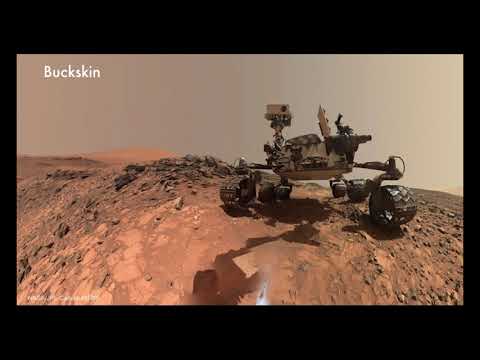
so this is curiosity it’s the size of a
mini cooper it spends an inordinate
amount of time taking pictures of itself
it’s a 21st century Rover it’s
incredibly vain so here’s a picture look
at that gaze looking at you here’s
another one here it is she’s looking at
you again examining the sand Jim it’s an
incredible laboratory here packed full
of scientific instruments not only to
measure the atmosphere the chemistry and
the environment at the / moment but also
to delve back into the time so what we
can do is we can take we can draw we can
take that rock powder and we can look at
the mineralogy of that rock powder what
minerals are present in those rocks and
we can look for what organic compounds
might be present what complex chemistry
so we can reconstruct overall what
ancient Mars looked like for the first
time in detail and this is how the team
works it’s a never-ending field trip
we’d be on Mars for almost 5 years and
it feels like five years has been a very
long time we work virtually every day
and this is the science team at JPL in
Pasadena and California in a big major
meeting where we decide what the road is
going to be doing the next day but
overall there’s about 400 people on the
team and what we do is we all dial in
and we communicate with the science team
at JPL by telephone by chat rooms email
a whole host of things to get us all
working together
on deciding what this Rover does and we
treat every day it’s a little bit like
that life chart every day
the rover tomorrow the rover could die
so we must maximize our science return
we must do something cool every day
and that’s a really good way of getting
over procrastinating that Rover isn’t
allowed to procrastinate when you’ve got
400 people hustling it I wish my son had
400 people hassling him he’s a teenager
as you can see the scientists are
incredibly serious so the rover has
driven 16 kilometers this is where we’ve
landed we’ve driven this whole distance
and we are here now and we’ve built it
because we’re going to get to these
exciting rocks at the base of Mount
sharp but I’m going to show you this
journey in a few slides that come up
upcoming so the first discovery this
these beautiful rocks here look a bit
innocuous but you can see these dark
things here are pebbles and they’re
rounded pebbles and the beautiful thing
about this discovery as these rounded
pebbles are in an ancient rock formation
and these were formed in ancient rivers
this was the first evidence ever that
liquid water flowed on Mars the first
instance you evidence that we couldn’t
be absolutely certain about this and
then we could actually image through the
channel that these cobbles came down
from this is a river channel it’s been
preserved on the Martian surface for
over 3 billion years it’s fossilized in
the landscape because the Martian
climate dried out it went arid we’ve got
to Yellowknife Bay and we drilled in
these rocks and you can see the first
drill a hole on Mars to be able to
actually analyze the chemistry and again
oh yes curiosity took another picture of
itself because she was so proud of her
drill holes here and an amazing
discovery out of this was we actually
discovered organic compounds in those
drill finds but these don’t mean life
because they can be a biological but the
fact that we have preservation of
organics means that by robot we can
detect this and that’s one step forward
in our search for life and we carried on
driving and most of our journey has been
driving to be able to get to the mounted
base of Mount sharp but you can see
these incredible images that we get
where we can then analyze these rock
formations
reconstruct the ancient environments so
you see a bunch of rocks
I see Delta’s migrating into a possible
lake that existed once over here when we
took this image we didn’t know that but
then we got to a place called Pahrump
Hills on the end of our drive and we
encountered we drove up a section like
this where we did a geological section
this is Pahrump Hills
this was the rover drive plan that we
path planned and at this stage we didn’t
know what these rocks were we have no
idea it’s only when you get to within a
few meters of the rock you can start
having an impression so this could be
any sort of environment there could be
really wet environments there could be
really dry environments what is good for
life dry is not good for life and we
discovered these rocks here look at
these beautiful laminated fine-grained
mud stones and these tell us that these
rocks were deposited in ancient lakes
it’s very difficult to find an
alternative explanation so these were
really long-lived lakes that existed on
Mars for hundreds of thousands if not
millions of years tells us that a three
and a half billion years ago Mars was a
much nicer place than it is at the
present day and we also saw evidence of
rivers think these are evidence for
currents flowing into these ancient
lakes and then we discovered recently
possible evidence for mud cracks these
are mud cracks some of you may have seen
these things this tell us that the lakes
dried out so we have short term climate
changes on Mars evidence that the lakes
dried out and it became continental so
environmental change of Mars and it’s
amazing what these rocks can tell us
about reconstructing both in time going
back billions of years but also in space
hundreds of millions of kilometers away
with the fidelity that we can do on
earth and we can build models off these
changing lakes cycles on Mars as
presented in this graphic so ok
curiosity is really proud of her results
and again she drills another hole to try
and reconstruct the chemistry of these
rocks over here this is a
Caruso and we have all of these drill
holes you can see the color of the rocks
changes the drill powder changes and
speakers the chemistry is changing so
we’re getting a flavor the lakes are
changing in their chemistry through time
and that’s interesting again that we
were able to reconstruct this fine scale
environmental change on Mars in terms of
probably local climate change but
perhaps this relates to global climate
change on Mars many billions of years
ago and here’s a very boring movie
sometimes we stick our cameras up and
see what happens and watch that there’s
a little bit of a dust devil floating
around so sometimes we see exciting
things no aliens yet but certainly some
dust devils flying around on Mars as we
speak so coming up to where we are now
the next two exploration begins this was
at Murray boots where we have these
beautiful rocks more of these Lake
mudstones over here and we’re heading in
this direction now we’re driving towards
the base of Mount sharp and our bales
here this and this is where we’re going
to be getting in the next few years is
to look at the detailed geology of these
rocks over here these rocks fill Gale
Crater and we have no idea what these
environments represent are these also
ancient Lakes did Mars have lakes that
extended up to built millions of years
or did Mars dry out did Mars once as
Lester’s atmosphere do all of these
rocks have here the present arid
environments and it’s only when we get
up close and personal with these rocks
that we can reconstruct those so watch
out in the next few years in fact we’re
going to get to these rocks over here
the Vera Rubin rich in about a month’s
time got am investigating those and then
we’re going to be climbing progressively
in the next couple of years in that next
act of exploration and discovery and
sometime in the future maybe 20-30 years
time will send humans to Mars that will
inevitably happen it’s not a quotation
question of if it will
happen and one can just hope that
Elmwood alongside the scientists and
geologists who go to Mars
there will also send some artists
because this is a picture of Earth from
Mars and perhaps we’ll get some artistic
impressions of Earth our own planet from
the surface of this now dry dead planet
Mars thank you very much
[Applause]
Please follow and like us: